

Kirjailija
Antoine Louis Claude Destutt de Tracy
Kirjat ja teokset yhdessä paikassa: 36 kirjaa, julkaisuja vuosilta 2010-2025, suosituimpien joukossa Bacon. Vertaile teosten hintoja ja tarkista saatavuus suomalaisista kirjakaupoista.
Mukana myös kirjoitusasut: Antoine-Louis Claude Destutt de Tracy, Antoine-Louis-Claude Destutt de Tracy
36 kirjaa
Kirjojen julkaisuhaarukka 2010-2025.

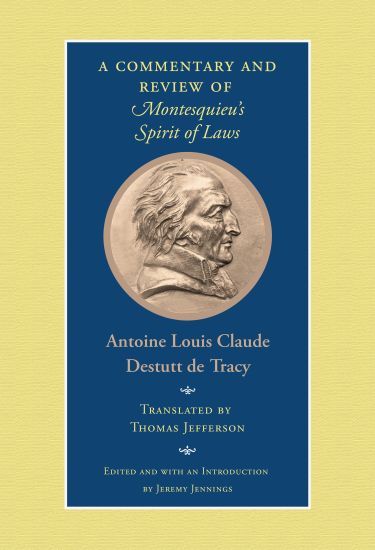
A Commentary and Review of Montesquieu's Spirit of Laws
Antoine Louis Claude Destutt De Tracy
Liberty Fund
2024
nidottu
Montesquieu's Spirit of the Laws (1748) is one of the most important political texts of the eighteenth century, exercising an enormous influence in both Europe and North America. Famously it was here that Montesquieu outlined his distinction between moderate and despotic governments and praised the virtues of England's monarchical constitution. In A Commentary and Review of Montesquieu's Spirit of Laws, Antoine Louis Claude Destutt de Tracy (1754-1836) criticizes Montesquieu's defense of monarchy and supports American-style republicanism operating in the context of a laissez-faire economic order. Destutt de Tracy was one of the founders of the Id ologues, a classical liberal group that included the economist Jean-Baptiste Say. Although born into an aristocratic family, he came to support the republican ideals of the French Revolution. Despite this, during the Reign of Terror, he was imprisoned and narrowly escaped execution. It was in the context of a failed revolution that Destutt de Tracy composed A Commentary and Review, following Montesquieu's Spirit of the Laws chapter by chapter, book by book, analyzing Montesquieu's distinctions about the various types of government--monarchy, democracy, aristocracy, despotism, oligarchy, and the like. He also examined Montesquieu's thoughts about education as they relate to the principles of government, civil and criminal laws and other forms of judgment, and laws that establish political liberty with relation to the constitution. Destutt de Tracy sent the completed work to Thomas Jefferson, who had it translated into English and published it in America in 1811, at a time when a French edition was impossible due to the censorship imposed by the Napoleonic regime. In a letter to Destutt de Tracy dated January 26, 1811, Jefferson wrote that the need for the critique of Montesquieu's work "is now supplied, and with a depth of thought, precision of idea, of language and of logic, which will force conviction into every mind. I declare to you, Sir, in the spirit of truth and sincerity, that I consider it the most precious gift the present age has received." Destutt de Tracy believed that the goal of every citizen should be a representative democracy that spreads information, promotes commerce, and extols liberty and equality. In Commentary and Review, he consistently applies logic and clear, concise analysis in his criticism of Montesquieu's work, and the result is a thought-provoking examination of the proper role of government. Volume editor Jeremy Jennings has provided a thoughtful introduction and annotations with additional information relating to Destutt de Tracy's references to historical figures, events, and literary sources.
A Commentary and Review of Montesquieu's Spirit of Laws
Antoine Louis Claude Destutt De Tracy
Liberty Fund
2024
sidottu
Montesquieu's Spirit of the Laws (1748) is one of the most important political texts of the eighteenth century, exercising an enormous influence in both Europe and North America. Famously it was here that Montesquieu outlined his distinction between moderate and despotic governments and praised the virtues of England's monarchical constitution.In A Commentary and Review of Montesquieu's Spirit of Laws, Antoine Louis Claude Destutt de Tracy (1754-1836) criticizes Montesquieu's defense of monarchy and supports American-style republicanism operating in the context of a laissez-faire economic order.Destutt de Tracy was one of the founders of the Id ologues, a classical liberal group that included the economist Jean-Baptiste Say. Although born into an aristocratic family, he came to support the republican ideals of the French Revolution. Despite this, during the Reign of Terror, he was imprisoned and narrowly escaped execution.It was in the context of a failed revolution that Destutt de Tracy composed A Commentary and Review, following Montesquieu's Spirit of the Laws chapter by chapter, book by book, analyzing Montesquieu's distinctions about the various types of government--monarchy, democracy, aristocracy, despotism, oligarchy, and the like. He also examined Montesquieu's thoughts about education as they relate to the principles of government, civil and criminal laws and other forms of judgment, and laws that establish political liberty with relation to the constitution.Destutt de Tracy sent the completed work to Thomas Jefferson, who had it translated into English and published it in America in 1811, at a time when a French edition was impossible due to the censorship imposed by the Napoleonic regime. In a letter to Destutt de Tracy dated January 26, 1811, Jefferson wrote that the need for the critique of Montesquieu's work "is now supplied, and with a depth of thought, precision of idea, of language and of logic, which will force conviction into every mind. I declare to you, Sir, in the spirit of truth and sincerity, that I consider it the most precious gift the present age has received."Destutt de Tracy believed that the goal of every citizen should be a representative democracy that spreads information, promotes commerce, and extols liberty and equality. In Commentary and Review, he consistently applies logic and clear, concise analysis in his criticism of Montesquieu's work, and the result is a thought-provoking examination of the proper role of government.Volume editor Jeremy Jennings has provided a thoughtful introduction and annotations with additional information relating to Destutt de Tracy's references to historical figures, events, and literary sources.

Projet d'éléments d'idéologie (1801)
Antoine-Louis-Claude Destutt de Tracy
Editions L'Harmattan
2021
nidottu

A Commentary and Review of Montesquieu's Spirit of Laws, Prepared For Press From the Original Manuscript in the Hands of the Publisher (1811)
Antoine Louis Claude Destutt De Tracy
Lawbook Exchange, Ltd.
2019
sidottu
Commentaire sur l'Esprit des Lois de Montesquieu (1806) is a critique of Montesquieu's pessimistic appraisal of democracy in De l'Esprit des Lois. While minister to France in the 1780s Jefferson saw this work in manuscript. It so impressed him that he arranged for its publication in France and translated it anonymously for publication in America. Looking back at this work in a letter from 1811, Jefferson commended it for correcting De l'Esprit des Lois. While other studies "nibbled only at its errors," he told his correspondent, this work rebutted them "with a depth of thought, precision of idea, of language and of logic, which will force conviction into every mind. I declare to you, Sir, in the spirit of truth and sincerity, that I consider it the most precious gift the present age has received." The Writings of Thomas Jefferson V:566-571. Reprint of the first edition. viii. 292 pp.
Élémens D'idéologie, Grammaire, Logique
Antoine Louis Claude Destutt de Tracy
Wentworth Press
2018
sidottu

Élémens D'idéologie, Grammaire, Logique
Antoine Louis Claude Destutt de Tracy
Wentworth Press
2018
pokkari

Projet d'Éléments d'Idéologie
Antoine-Louis Claude Destutt de Tracy
Hachette Livre - BNF
2018
pokkari

Élémens d'Idéologie. Partie 4-5. Traité de la Volonté Et de Ses Effets
Antoine-Louis Claude Destutt de Tracy
Hachette Livre - BNF
2018
pokkari

Commentaire Sur l'Esprit Des Lois de Montesquieu
Antoine-Louis Claude Destutt de Tracy
Hachette Livre - BNF
2017
pokkari

Principes Logiques Ou Recueil de Faits Relatifs À l'Intelligence Humaine
Antoine-Louis Claude Destutt de Tracy
Hachette Livre - BNF
2017
pokkari

Quels Sont Les Moyens de Fonder La Morale Chez Un Peuple
Antoine-Louis Claude Destutt de Tracy
Hachette Livre - BNF
2017
pokkari

Oeuvres Completes Tome II: Essais Philosophiques
Antoine Louis Claude Destutt De Tracy
Librarie Philosophique J. Vrin
2017
nidottu
A cote des quatre volumes des Elements d'ideologie qui, completes par le Commentaire sur l'Esprit des lois de Montesquieu, constituent l'opus magnum de Destutt de Tracy, celui-ci a ecrit entre 1795 et 1806 plusieurs textes aux statuts tres divers apportant un eclairage important sur la formation et le positionnement de l'Ideologie. Reunis dans le present ouvrage, ces travaux peuvent etre ranges dans quatre categories: Les memoires issus des communications lues sous le Directoire devant la classe des sciences morales et politiques de l'Institut national et constituant un premier essai de formalisation de la nouvelle philosophie. Parmi eux, le Memoire sur la faculte de penser (publie en 1798) annonce et prefigure l'Ideologie proprement dite. La confrontation avec le kantisme qui commence seulement a se diffuser en France a partir de 1796. De la metaphysique de Kant (publie en 1802) permet de mesurer tout ce qui separe l'Ideologie de cette philosophie que Destutt de Tracy qualifiera dans une lettre a Maine de Biran d'etrangere et etrange. Les textes qui s'inscrivent dans le prolongement direct des Elements d'ideologie, tels que les Principes logiques (ouvrage ecrit en 1805 mais publie en 1817) ou le memoire Nosce te ipsum adresse en 1806 a l'Academie de Berlin. L'essai consacre au livre de Charles-Francois Dupuis, L'Origine de tous les cultes. En procedant a une analyse raisonnee de cet ouvrage qui met en evidence qu'un meme et antique culte de la nature, des astres et des saisons est a la source de toutes les religions, Destutt de Tracy denonce en celles-ci un obstacle a la bonne logique et a la saine morale privee et publique.

Élémens d'Idéologie. Idéologie Proprement Dite. 2e Édition
Antoine Louis Claude Destutt de Tracy
Hachette Livre - BNF
2017
pokkari

Élémens d'Idéologie. Grammaire
Antoine Louis Claude Destutt de Tracy
Hachette Livre - BNF
2017
pokkari

Élémens d'Idéologie. Traité de la Volonté Et de Ses Effets
Antoine Louis Claude Destutt de Tracy
Hachette Livre - BNF
2017
pokkari

Élémens d'Idéologie. Logique
Antoine Louis Claude Destutt de Tracy
Hachette Livre - BNF
2017
pokkari

Projet d'Éléments d'Idéologie
Antoine Louis Claude Destutt de Tracy
Hachette Livre - BNF
2017
pokkari