Kirjojen hintavertailu. Mukana 12 390 323 kirjaa ja 12 kauppaa.

Kirjailija

Archibald Henry Sayce

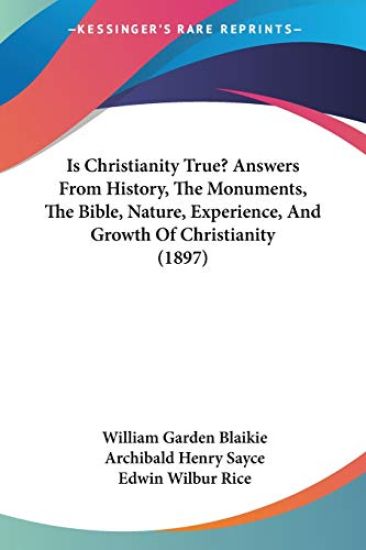
Kirjat ja teokset yhdessä paikassa: 76 kirjaa, julkaisuja vuosilta 2008-2026, suosituimpien joukossa Is Christianity True? Answers From History, The Monuments, The Bible, Nature, Experience, And Growth Of Christianity (1897). Vertaile teosten hintoja ja tarkista saatavuus suomalaisista kirjakaupoista.

Mukana myös kirjoitusasut: Archibald-Henry Sayce

76 kirjaa

Kirjojen julkaisuhaarukka 2008-2026.

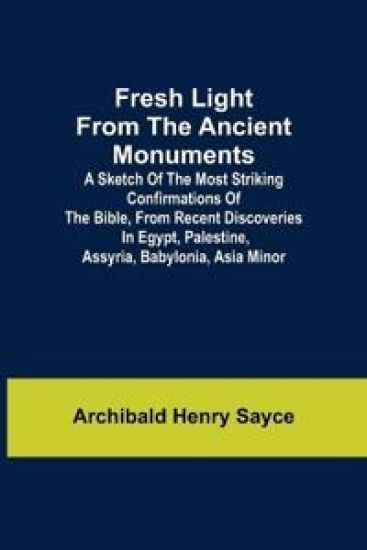
Fresh Light from the Ancient Monuments; A Sketch of the Most Striking Confirmations of the Bible, From Recent Discoveries in Egypt, Palestine, Assyria, Babylonia, Asia Minor
This book "" Fresh Light from the Ancient Monuments; A Sketch of the Most Striking Confirmations of the Bible, From Recent Discoveries in Egypt, Palestine, Assyria, Babylonia, Asia Minor "", has been considered important throughout the human history, and so that this work is never forgotten we have made efforts in its preservation by republishing this book in a modern format for present and future generations. This whole book has been reformatted, retyped and designed. These books are not made of scanned copies and hence the text is clear and readable.
Patriarchal Palestine

Patriarchal Palestine

Archibald Henry Sayce

Cambridge University Press
2019
pokkari
Archibald Henry Sayce (1845–1933) became interested in Middle Eastern languages and scripts while still a teenager. Old Persian and Akkadian cuneiform had recently been deciphered, and popular enthusiasm for these discoveries was running high when Sayce began his academic career at Oxford in 1869. In this 1895 work, he considers the history of the Holy Land in the context of the flood of new documentary and archaeological material which had come to light in the course of the nineteenth century. Sayce's approach opposed the 'higher criticism' which sought to demonstrate that the stories of the Old Testament should not be interpreted literally; in his opinion, 'in the narrative of the Pentateuch we have history and not fiction', and he believed that archaeological discoveries supported his view. Although this approach was already outdated, his reconstruction of the history of the ancient Near East remains of interest to historians of archaeology.
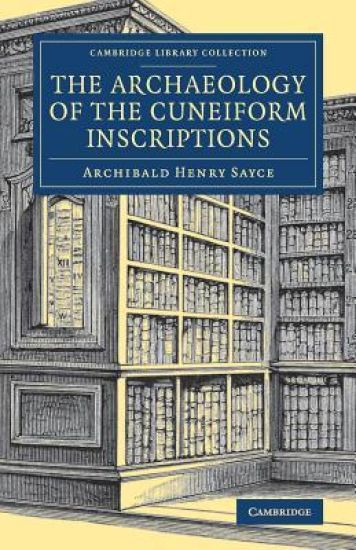
The Archaeology of the Cuneiform Inscriptions

The Archaeology of the Cuneiform Inscriptions

Archibald Henry Sayce

Cambridge University Press
2019
pokkari
Archibald Henry Sayce (1845–1933) became interested in Middle Eastern languages and scripts while still a teenager. Old Persian and Akkadian cuneiform had recently been deciphered, and popular enthusiasm for these discoveries was running high when Sayce began his academic career at Oxford in 1869. In this 1907 work, based on lectures delivered in Edinburgh in the previous year, he considers the state of archaeological knowledge of Babylonia and Assyria, which he describes as 'miserably deficient', and in particular the paradox of a huge number of cuneiform tablets in various languages drawn from many sites at which the original excavation had not provided an adequate context. Beginning with the history of the decipherment of cuneiform, Sayce goes on to describe what the tablets reveal of political and trade interactions among the different nations of the Near East and Asia Minor, and the relevance of these discoveries to Old Testament studies.
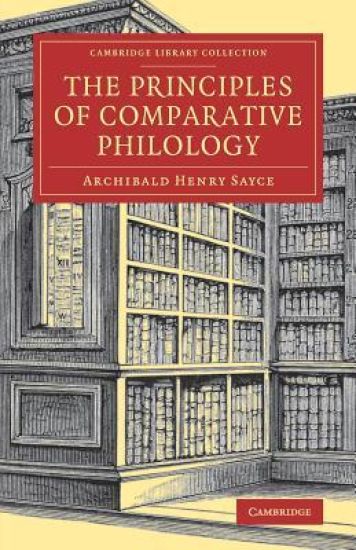
The Principles of Comparative Philology

The Principles of Comparative Philology

Archibald Henry Sayce

Cambridge University Press
2019
pokkari
Archibald Henry Sayce (1845–1933) became interested in Middle Eastern languages and scripts while still a teenager. Old Persian and Akkadian cuneiform had recently been deciphered, and popular enthusiasm for these discoveries was running high when Sayce began his academic career at Oxford in 1869. This 1874 work, based on a series of lectures, discusses the relatively new science of comparative philology, its disciplines and its relationship to physiology, history, and religion. The work describes the ways in which the laws of language, and especially of language change and development, can be hypothesised and tested. Sayce also considers, and takes issue with, the notion of 'the metaphysics of language', and examines the significance of comparative philology to the study of comparative religion and mythology. The final chapter deals with the specific issue of analogy in language development, in particular in relation to changes in pronunciation and word-stress.