Kirjojen hintavertailu. Mukana 12 541 714 kirjaa ja 12 kauppaa.

Kirjailija

Arie W. Kruglanski

Kirjat ja teokset yhdessä paikassa: 12 kirjaa, julkaisuja vuosilta 1989-2026, suosituimpien joukossa Feeling Big, Feeling Small. Vertaile teosten hintoja ja tarkista saatavuus suomalaisista kirjakaupoista.

12 kirjaa

Kirjojen julkaisuhaarukka 1989-2026.

Feeling Big, Feeling Small

Feeling Big, Feeling Small

Sophia Moskalenko; Arie W. Kruglanski

TAYLOR FRANCIS LTD
2026
sidottu
Why do we sometimes feel powerful, expansive, and driven—only to feel small, humbled, or overwhelmed moments later? This book proposes that much of human experience is shaped by a fundamental psychological rhythm between two states the authors call Bigness and Smallness. Blending psychology with insights from biology, development, culture, religion, history, and mental health, the book introduces a theory of Dynamic Magnitude—the idea that human flourishing depends on our ability to move fluidly between striving for significance and yielding to forces greater than ourselves. Through vivid examples drawn from everyday life, art, love, parenting, politics, extremism, ritual, and belief systems, the authors show how modern societies have come to privilege Bigness while neglecting the human need for Smallness. They explore how imbalance between these states fuels burnout, polarization, addiction, anxiety, depression, and radicalization, while their healthy alternation underlies creativity, intimacy, resilience, and meaning. Rather than offering self-help prescriptions or single-factor explanations, the book provides a unifying lens that connects personal psychology with larger cultural and historical patterns. Written for psychologists and social scientists, this book also speaks to a wider audience of intellectually curious readers—students of culture and history, philosophers, clinicians, and thoughtful observers of contemporary life—interested in how inner experience, social forces, and meaning-making intersect.
Feeling Big, Feeling Small

Feeling Big, Feeling Small

Sophia Moskalenko; Arie W. Kruglanski

TAYLOR FRANCIS LTD
2026
nidottu
Why do we sometimes feel powerful, expansive, and driven—only to feel small, humbled, or overwhelmed moments later? This book proposes that much of human experience is shaped by a fundamental psychological rhythm between two states the authors call Bigness and Smallness. Blending psychology with insights from biology, development, culture, religion, history, and mental health, the book introduces a theory of Dynamic Magnitude—the idea that human flourishing depends on our ability to move fluidly between striving for significance and yielding to forces greater than ourselves. Through vivid examples drawn from everyday life, art, love, parenting, politics, extremism, ritual, and belief systems, the authors show how modern societies have come to privilege Bigness while neglecting the human need for Smallness. They explore how imbalance between these states fuels burnout, polarization, addiction, anxiety, depression, and radicalization, while their healthy alternation underlies creativity, intimacy, resilience, and meaning. Rather than offering self-help prescriptions or single-factor explanations, the book provides a unifying lens that connects personal psychology with larger cultural and historical patterns. Written for psychologists and social scientists, this book also speaks to a wider audience of intellectually curious readers—students of culture and history, philosophers, clinicians, and thoughtful observers of contemporary life—interested in how inner experience, social forces, and meaning-making intersect.
The Quest for Significance

The Quest for Significance

Arie W. Kruglanski; Dan Raviv

TAYLOR FRANCIS LTD
2025
nidottu
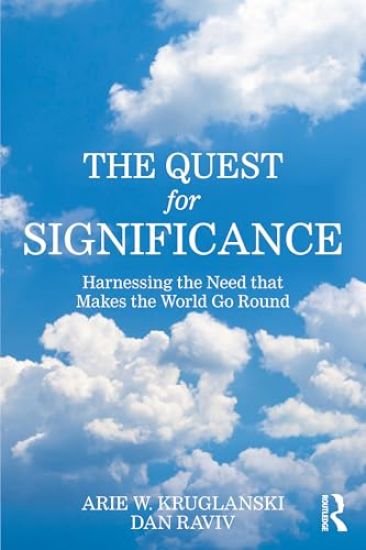
The Quest for Significance: Harnessing the Need that Makes the World Go Round is a fascinating exploration of why we all seek Significance – a fundamental human motivation – and how we can understand it to help us lead better lives.Renowned psychologist Arie Kruglanski and journalist Dan Raviv show how the Quest for Significance propels our actions, governs our feelings, and dominates our thoughts: pervasively affecting our happiness, pursuits, and relationships. Drawing on both academic research and the personal experiences of the authors, including Kruglanski’s childhood in Poland during the Holocaust, the authors help readers to understand themselves and people around them – to promote happiness, gain friendship, and find love.This one-of-a-kind book is fascinating reading for students, professionals, and anyone interested in how they can better appreciate themselves and those close to them, and live a fulfilling life.
The Quest for Significance

The Quest for Significance

Arie W. Kruglanski; Dan Raviv

TAYLOR FRANCIS LTD
2025
sidottu
The Quest for Significance: Harnessing the Need that Makes the World Go Round is a fascinating exploration of why we all seek Significance – a fundamental human motivation – and how we can understand it to help us lead better lives.Renowned psychologist Arie Kruglanski and journalist Dan Raviv show how the Quest for Significance propels our actions, governs our feelings, and dominates our thoughts: pervasively affecting our happiness, pursuits, and relationships. Drawing on both academic research and the personal experiences of the authors, including Kruglanski’s childhood in Poland during the Holocaust, the authors help readers to understand themselves and people around them – to promote happiness, gain friendship, and find love.This one-of-a-kind book is fascinating reading for students, professionals, and anyone interested in how they can better appreciate themselves and those close to them, and live a fulfilling life.
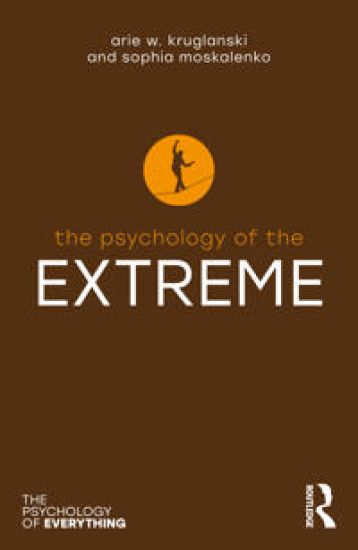
The Psychology of the Extreme

The Psychology of the Extreme

Arie W. Kruglanski; Sophia Moskalenko

TAYLOR FRANCIS LTD
2025
nidottu
What does extremism mean? How does it show up in our daily lives? What drives people to extreme behaviors, and how can we learn to live and thrive in the age of overdrive?The Psychology of the Extreme provides an accessible introduction to extremism as a force that can affect all aspects of culture and people’s choices in everyday settings. It explores the underlying psychology behind what makes people act in extreme ways, whether this is in destructive ways (such as gambling, terrorism and political violence) or in constructive ways (such as successful creators and scientists). The book features an array of case studies that show how extremism can be both pro-social and anti-social and includes interventions to reduce extremism or redirect them toward more positive and constructive tendencies. Offering a new understanding of the individual psychology of extremism, the book will appeal to all those interested in how extremism plays out in people’s and cultures' day-to-day lives.
The Psychology of the Extreme

The Psychology of the Extreme

Arie W. Kruglanski; Sophia Moskalenko

TAYLOR FRANCIS LTD
2025
sidottu
What does extremism mean? How does it show up in our daily lives? What drives people to extreme behaviors, and how can we learn to live and thrive in the age of overdrive?The Psychology of the Extreme provides an accessible introduction to extremism as a force that can affect all aspects of culture and people’s choices in everyday settings. It explores the underlying psychology behind what makes people act in extreme ways, whether this is in destructive ways (such as gambling, terrorism and political violence) or in constructive ways (such as successful creators and scientists). The book features an array of case studies that show how extremism can be both pro-social and anti-social and includes interventions to reduce extremism or redirect them toward more positive and constructive tendencies. Offering a new understanding of the individual psychology of extremism, the book will appeal to all those interested in how extremism plays out in people’s and cultures' day-to-day lives.
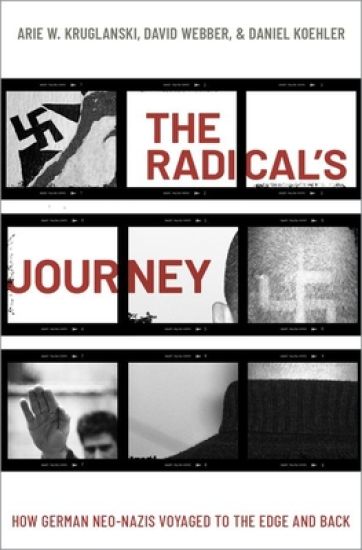
The Radical's Journey

The Radical's Journey

Arie W. Kruglanski; David Webber; Daniel Koehler

Oxford University Press Inc
2020
sidottu
This volume offers a crucial examination of right-wing extremism, supported by detailed empirical analyses of right-wing militants' experiences within and outside their organizations. The authors delve deeply into the motivations that prompt initial membership in these groups, the elements that make membership appealing, and the factors that ultimately cause members to leave. Interpreting the present empirical data within their psychological theory of radicalization, the authors determine the commonalities and differences between instances of radicalization and derive policy-relevant implications to combat right-wing extremism. In a turbulent global environment where this strain of extremist ideology has gained more mainstream popularity, this book is a critical and timely addition to scholarship on radicalization by leading experts in the field.
The Three Pillars of Radicalization

The Three Pillars of Radicalization

Arie W. Kruglanski; Jocelyn J. Bélanger; Rohan Gunaratna

Oxford University Press Inc
2019
sidottu
What fuels radicalization? Is deradicalization a possibility? The Three Pillars of Radicalization: Needs, Narratives, and Networks addresses these crucial questions by identifying the three major determinants of radicalization that progresses into violent extremism. The first determinant is the need: individuals' universal desire for personal significance. The second determinant is narrative, which guides members in their "quest for significance." The third determinant is the network, or membership in one's group that validates the collective narrative and dispenses rewards like respect and veneration to members who implement it. In this book, Arie W. Kruglanski, Jocelyn J. Bélanger, and Rohan Gunaratna present a new model of radicalization that takes into account factors that activate the individual's quest for significance. Synthesizing varied empirical evidence, this volume reinterprets prior theories of radicalization and examines major issues in deradicalization and recidivism, which will only become more relevant as communities continue to negotiate the threat of extremism.
The Psychology of Closed Mindedness

The Psychology of Closed Mindedness

Arie W. Kruglanski

Psychology Press Ltd
2014
nidottu
The fundamental phenomenon of human closed-mindedness is treated in this volume. Prior psychological treatments of closed-mindedness have typically approached it from a psychodynamic perspective and have viewed it in terms of individual pathology. By contrast, the present approach stresses the epistemic functionality of closed-mindedness and its essential role in judgement and decision-making. Far from being restricted to a select group of individuals suffering from an improper socialization, closed-mindedness is something we all experience on a daily basis. Such mundane situational conditions as time pressure, noise, fatigue, or alcoholic intoxication, for example, are all known to increase the difficulty of information processing, and may contribute to one's experienced need for nonspecific closure. Whether constituting a dimension of stable individual differences, or being engendered situationally - the need for closure, once aroused, is shown to produce the very same consequences. These fundamentally include the tendency to 'seize' on early, closure-affording 'evidence', and to 'freeze' upon it thus becoming impervious to subsequent, potentially important, information. Though such consequences form a part of the individual's personal experience, they have significant implications for interpersonal, group and inter-group phenomena as well. The present volume describes these in detail and grounds them in numerous research findings of theoretical and 'real world' relevance to a wide range of topics including stereotyping, empathy, communication, in-group favouritism and political conservatism. Throughout, a distinction is maintained between the need for a nonspecific closure (i.e., any closure as long as it is firm and definite) and needs for specific closures (i.e., for judgments whose particular contents are desired by an individual). Theory and research discussed in this book should be of interest to upper level undergraduates, graduate students and faculty in social, cognitive, and personality psychology as well as in sociology, political science and business administration.
Lay Epistemics and Human Knowledge

Lay Epistemics and Human Knowledge

Arie W. Kruglanski

Springer-Verlag New York Inc.
2013
nidottu
Whatever your reasons, kind reader, for reading these words,-what­ ever your premises about forewords, whatever the epistemic motivation with which you approach them-Iet me urge you to turn immediately to Kruglanski's first chapter and skim it. If any enthusiasm for sodal psy­ chology flows in your veins, you will certainly proceed then to read further in this important book. It represents some dozen years of Arie's thought and of his and his colleagues' research. Its intellectual scope covers 50 years of sodal psychology-from attitudes and attitude change, to balance, disso­ nance, and the various other cognitive consistency theories, to causal attribution, and to current cognitive sodal psychology. Sodal psycholo­ gists have recently begun to leave the fireside coziness of scribbling textbook catalogues of our field and to venture out into the cold, outdoor adventure of detecting (or creating?) its underlying structure. Of these attempts at providing scope plus order, Kruglanski's must surely be the most ambitious. For his is no mere overarching theory, which, like a circus tent over a diverse set of sideshows, covers everything but does little to provide thematic structure. Rather, Kruglanski tries to produce a basic reorganization of our thinking about sodal psychology. To use his LEGO blocks metaphor for the modification of knowledge structures, he attempts to dismantle the current assembly of elements of our field and reassemble them into a simpler and more coherent configuration.
The Psychology of Closed Mindedness

The Psychology of Closed Mindedness

Arie W. Kruglanski

Psychology Press Ltd
2004
sidottu
The fundamental phenomenon of human closed-mindedness is treated in this volume. Prior psychological treatments of closed-mindedness have typically approached it from a psychodynamic perspective and have viewed it in terms of individual pathology. By contrast, the present approach stresses the epistemic functionality of closed-mindedness and its essential role in judgement and decision-making. Far from being restricted to a select group of individuals suffering from an improper socialization, closed-mindedness is something we all experience on a daily basis. Such mundane situational conditions as time pressure, noise, fatigue, or alcoholic intoxication, for example, are all known to increase the difficulty of information processing, and may contribute to one's experienced need for nonspecific closure. Whether constituting a dimension of stable individual differences, or being engendered situationally - the need for closure, once aroused, is shown to produce the very same consequences. These fundamentally include the tendency to 'seize' on early, closure-affording 'evidence', and to 'freeze' upon it thus becoming impervious to subsequent, potentially important, information. Though such consequences form a part of the individual's personal experience, they have significant implications for interpersonal, group and inter-group phenomena as well. The present volume describes these in detail and grounds them in numerous research findings of theoretical and 'real world' relevance to a wide range of topics including stereotyping, empathy, communication, in-group favouritism and political conservatism. Throughout, a distinction is maintained between the need for a nonspecific closure (i.e., any closure as long as it is firm and definite) and needs for specific closures (i.e., for judgments whose particular contents are desired by an individual). Theory and research discussed in this book should be of interest to upper level undergraduates, graduate students and faculty in social, cognitive, and personality psychology as well as in sociology, political science and business administration.
Lay Epistemics and Human Knowledge

Lay Epistemics and Human Knowledge

Arie W. Kruglanski

Kluwer Academic/Plenum Publishers
1989
sidottu
Whatever your reasons, kind reader, for reading these words,-what­ ever your premises about forewords, whatever the epistemic motivation with which you approach them-Iet me urge you to turn immediately to Kruglanski's first chapter and skim it. If any enthusiasm for sodal psy­ chology flows in your veins, you will certainly proceed then to read further in this important book. It represents some dozen years of Arie's thought and of his and his colleagues' research. Its intellectual scope covers 50 years of sodal psychology-from attitudes and attitude change, to balance, disso­ nance, and the various other cognitive consistency theories, to causal attribution, and to current cognitive sodal psychology. Sodal psycholo­ gists have recently begun to leave the fireside coziness of scribbling textbook catalogues of our field and to venture out into the cold, outdoor adventure of detecting (or creating?) its underlying structure. Of these attempts at providing scope plus order, Kruglanski's must surely be the most ambitious. For his is no mere overarching theory, which, like a circus tent over a diverse set of sideshows, covers everything but does little to provide thematic structure. Rather, Kruglanski tries to produce a basic reorganization of our thinking about sodal psychology. To use his LEGO blocks metaphor for the modification of knowledge structures, he attempts to dismantle the current assembly of elements of our field and reassemble them into a simpler and more coherent configuration.