Kirjojen hintavertailu. Mukana 12 545 256 kirjaa ja 12 kauppaa.
Kirjailija
Aristophanes
Kirjat ja teokset yhdessä paikassa: 302 kirjaa, julkaisuja vuosilta 1869-2026, suosituimpien joukossa Aristophanis Comoediae Undecim, Graece Et Latine Tomi 1 (1760). Vertaile teosten hintoja ja tarkista saatavuus suomalaisista kirjakaupoista.
Nach dem Misserfolg der Wolken 423 hat Aristophanes mit den Wespen 422 schwungvoll neue Resonanz gesucht und gefunden. Zentralfiguren der Komödie sind der seiner Heliastenrolle verfallene alte Philokleon und Bdelykleon, sein Sohn und Gegenspieler. Mit diesem Duo schafft Aristophanes eine hinreißende Handlung, die Politisches – Satire auf Erscheinungen der attischen Justiz – und Familiäres – Umerziehung des Vaters durch den Sohn – kombiniert und mit ihren Lösungen überrascht. Philokleons Protektor Kleon, der führende Politiker der frühen nachperikleischen Jahre, wird gerupft. Ein in das Stück integrierter Hundeprozess gehört zu den komischsten Episoden der antiken Literatur. Die Wespen bieten besondere Ansätze zu einer Charakterkomödie avant la lettre. Den vorgegebenen dialogischen und lyrischen Formenschatz der Alten Komödie spielt Aristophanes in musterhafter Fülle aus. Kein Geringerer als Jean Racine hat sich von den Wespen zu seiner einzigen Komödie, Les Plaideurs, inspirieren lassen. Anderswo in Europa wurden die Wespen ausgiebiger erforscht. Hierzulande füllt die neue Spezialausgabe mit Einführung, griechischem Text, Prosaübersetzung und ausführlichem Begleitkommentar eine über hundertjährige philologische Lücke.
Peace is an Athenian Old Comedy written and produced by the Greek playwright Aristophanes. It won second prize at the City Dionysia where it was staged just a few days before the Peace of Nicias was validated (421 BC), which promised to end the ten-year-old Peloponnesian War. The play is notable for its joyous anticipation of peace and for its celebration of a return to an idyllic life in the countryside. However, it also sounds a note of caution, there is bitterness in the memory of lost opportunities and the ending is not happy for everyone. As in all of Aristophanes' plays, the jokes are numerous, the action is wildly absurd and the satire is savage. Cleon, the pro-war populist leader of Athens, is once again a target for the author's wit, even though he had died in battle just a few months earlier. Short summary: Trygaeus, a middle-aged Athenian, miraculously brings about a peaceful end to the Peloponnesian War, thereby earning the gratitude of farmers while bankrupting various tradesmen who had profited from the hostilities. He celebrates his triumph by marrying Harvest, a companion of Festival and Peace, all of whom he has liberated from a celestial prison. Detailed summary: Two slaves are frantically working outside an ordinary house in Athens, kneading unusually large lumps of dough and carrying them one by one into the stable. We soon learn from their banter that it is not dough but excrement gathered from various sources-they are feeding a giant dung beetle that their crazy master has brought home from the Mount Etna region and on which he intends flying to a private audience with the gods. This startling revelation is confirmed moments later by the sudden appearance of Trygaeus on the back of the dung beetle, rising above the house and hovering in an alarmingly unsteady manner. His two slaves, his neighbours and his children take fright and they plead with him to come back down to earth. He steadies the spirited beetle, he shouts comforting words to his children and he appeals to the audience not to distract his mount by farting or shitting any time in the next three days. His mission, he declares, is to reason with the gods about the war or, if they will not listen, he will prosecute the gods for treason against Greece. Then he soars across the stage heavenwards. Arriving outside the house of the gods, Trygaeus discovers that only Hermes is home. Hermes informs him that the others have packed up and departed for some remote refuge where they hope never to be troubled again by the war or the prayers of humankind. He has stayed back, he says, only to make some final arrangements and meanwhile the new occupant of the house has already moved in - War. War, he says, has imprisoned Peace in a cave nearby. Just then, as chance would have it, War comes grumbling and growling outdoors, carrying a gigantic mortar in which he intends grinding the Greeks to paste. Trygaeus discovers by eavesdropping that War no longer has a pestle to use with his gigantic mortar - the pestles he had hoped to use on the Greeks are both dead, for one was Cleon and the other was Brasidas, the leaders of the pro-war factions in Athens and Sparta respectively, both of whom have recently perished in battle. War goes back indoors to get himself a new one and Trygaeus boldly takes this opportunity to summon Greeks everywhere to come and help him set Peace free while there is still time. A Chorus of excited Greeks from various city-states arrives as prompted but they are so excited they cannot stop dancing at first. Eventually they get to work, pulling boulders from the cave's mouth under supervision by Trygaeus and Hermes. Some of the Greeks are more of a hindrance than a help and real progress is only made by the farmers. At last Peace and her companions, Festival and Harvest, are brought to light, appearing as visions of ineffable beauty.
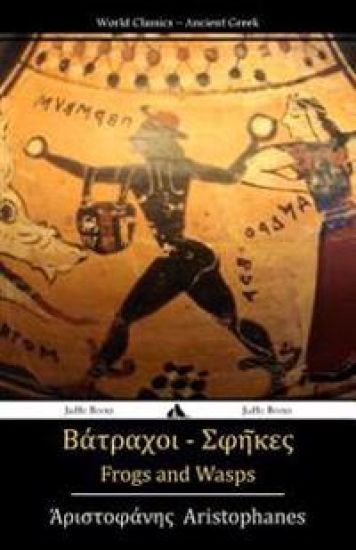
The Frogs, by Aristophanes, was produced the year after the death of Euripides, and laments the decay of Greek tragedy which Aristophanes attributed to that writer. The Frogs tells the story of the god Dionysus, who, despairing of the state of Athens' tragedians, travels to Hades (the underworld) to bring the playwright Euripides back from the dead. (Euripides had died the year before, in 406 BC.) He brings along his slave Xanthias, who is smarter and braver than Dionysus. As the play opens, Xanthias and Dionysus argue over what kind of jokes Xanthias can use to open the play. For the first half of the play, Dionysus routinely makes critical errors, forcing Xanthias to improvise in order to protect his master and prevent Dionysus from looking incompetent-but this only allows Dionysus to continue to make mistakes with no consequence. To find a reliable path to Hades, Dionysus seeks advice from his half-brother Heracles, who had been there before in order to retrieve the hell hound Cerberus. Dionysus shows up at his doorstep dressed in a lion-hide and carrying a club. Heracles, upon seeing the effeminate Dionysus dressed up like himself, can't help laughing. When Dionysus asks which road is the quickest to get to Hades, Heracles tells him that he can hang himself, drink poison, or jump off a tower. Dionysus opts for the longer journey, which Heracles himself had taken, across a lake (possibly Lake Acheron). When Dionysus arrives at the lake, Charon ferries him across. Xanthias, being a slave, is not allowed in the boat, and has to walk around it, while Dionysus is made to help row the boat. This is the point of the first choral interlude (parodos), sung by the eponymous chorus of frogs (the only scene in which frogs feature in the play). Their croaking refrain greatly annoys Dionysus, who engages in a mocking debate (agon) with the frogs. When he arrives at the shore, Dionysus meets up with Xanthias, who teases him by claiming to see the frightening monster Empusa. A second chorus composed of spirits of Dionysian Mystics soon appear. The next encounter is with Aeacus, who mistakes Dionysus for Heracles due to his attire. Still angry over Heracles' theft of Cerberus, Aeacus threatens to unleash several monsters on him in revenge. Frightened, Dionysus trades clothes with Xanthias. A maid then arrives and is happy to see Heracles. She invites him to a feast with virgin dancing girls, and Xanthias is more than happy to oblige. But Dionysus quickly wants to trade back the clothes. Dionysus, back in the Heracles lion-skin, encounters more people angry at Heracles, and so he makes Xanthias trade a third time. When Aeacus returns to confront the alleged Heracles (i.e., Xanthias), Xanthias offers him his "slave" (Dionysus) for torturing, to obtain the truth as to whether or not he is really a thief. The terrified Dionysus tells the truth that he is a god. After each is whipped, Dionysus is brought before Aeacus' masters, and the truth is verified. The maid then catches Xanthias and chats him up, interrupted by preparations for the contest scene. The maid describes the Euripides-Aeschylus conflict. Euripides, who had only just recently died, is challenging the great Aeschylus for the seat of "Best Tragic Poet" at the dinner table of Pluto, the ruler of the underworld. A contest is held with Dionysus as judge. The two playwrights take turns quoting verses from their plays and making fun of the other.
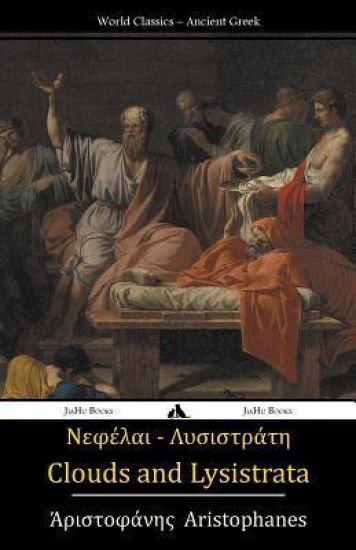
The Clouds is a comedy play written by the celebrated playwright Aristophanes lampooning intellectual fashions in classical Athens. It was originally produced at the City Dionysia in 423 BC and it was not well received, coming last of the three plays competing at the festival that year. It was revised between 420-417 BC and thereafter it was circulated in manuscript form. No copy of the original production survives, and scholarly analysis indicates that the revised version is an incomplete form of Old Comedy. This incompleteness, however, is not obvious in translations and modern performances. Retrospectively, The Clouds can be considered the world's first extant "comedy of ideas" and is considered by literary critics to be among the finest examples of the genre. The play also, however, remains notorious for its caricature of Socrates and is mentioned in Plato's Apology as a contributor to the philosopher's trial and execution. The play begins with Strepsiades suddenly sitting up in bed while his son, Pheidippides, remains blissfully asleep in the bed next to him. Strepsiades complains to the audience that he is too worried about household debts to get any sleep - his wife (the pampered product of an aristocratic clan) has encouraged their son's expensive interest in horses. Strepsiades, having thought up a plan to get out of debt, wakes the youth gently and pleads with him to do something for him. Pheidippides at first agrees to do as he's asked then changes his mind when he learns that his father wants to enroll him in The Thinkery, a school for wastrels and bums that no self-respecting, athletic young man dares to be associated with. Strepsiades explains that students of The Thinkery learn how to turn inferior arguments into winning arguments and this is the only way he can beat their aggrieved creditors in court. Pheidippides however will not be persuaded and Strepsiades decides to enroll himself in The Thinkery in spite of his advanced age. There he meets a student who tells him about some of the recent discoveries made by Socrates, the head of The Thinkery, including a new unit of measurement for ascertaining the distance jumped by a flea (a flea's foot, created from a minuscule imprint in wax), the exact cause of the buzzing noise made by a gnat (its rear end resembles a trumpet) and a new use for a large pair of compasses (as a kind of fishing-hook for stealing cloaks from pegs over the gymnasium wall). Impressed, Strepsiades begs to be introduced to the man behind these discoveries. The wish is soon granted: Socrates appears overhead, wafted in a basket at the end of a rope, the better to observe the Sun and other meteorological phenomena. The philosopher descends and quickly begins the induction ceremony for the new elderly student, the highlight of which is a parade of the Clouds, the patron goddesses of thinkers and other layabouts. The Clouds arrive singing majestically of the regions whence they arose and of the land they have now come to visit, loveliest in all being Greece. Introduced to them as a new devotee, Strepsiades begs them to make him the best orator in Greece by a hundred miles. They reply with the promise of a brilliant future. Socrates leads him into the dingy Thinkery for his first lesson and The Clouds step forward to address the audience.
The Acharnians is the third play - and the earliest of the eleven surviving plays - by the Athenian playwright Aristophanes. It was produced in 425 BCE on behalf of the young dramatist by an associate, Callistratus. The play is notable for its absurd humour, its imaginative appeal for an end to the Peloponnesian War and for the author's spirited response to condemnations of his previous play, The Babylonians. The play begins with Dikaiopolis sitting all alone on the Pnyx (the hill where the Athenian Assembly or ecclesia regularly meets to discuss matters of state). He is middle-aged, he looks bored and frustrated and soon he begins to vent his thoughts and feelings to the audience. He reveals his weariness with the Peloponnesian War, his longing to go home to his village, his impatience with the ecclesia for its failure to start on time and his resolve to heckle speakers who won't debate an end to the war. Soon some citizens do arrive, all pushing and shoving to get the best seats, and then the day's business begins. A series of important speakers addresses the assembly but the subject is not peace and, true to his earlier promise, Dikaiopolis comments loudly on their appearance and probable motives. First of all there is the ambassador who has returned from the Persian court after many years, complaining of the lavish hospitality he has had to endure from his Persian hosts; then there is the Persian grandee, The Eye of the Great King, Pseudartabas, sporting a gigantic eye and mumbling gibberish, accompanied by some eunuchs who turn out to be a disreputable pair of effete Athenians in disguise; next is the ambassador recently returned from Thrace, blaming the icy conditions in the north for his long stay there at the public's expense; and lastly there is the rabble of Odomantians who are presented as elite mercenaries willing to fight for Athens but who hungrily steal the protagonist's lunch. Peace is not discussed. It is in the ecclesia however that Dikaiopolis meets Amphitheus, a man who claims to be the immortal great-great-grandson of Triptolemus and Demeter and who claims moreover that he can obtain peace with the Spartans privately. Dikaiopolis accepts his claims and he pays him eight drachmas to bring him a private peace, which in fact Amphitheus manages to do. Dikaiopolis celebrates his private peace with a private celebration of the Rural Dionysia, beginning with a small parade outside his own house. He and his household however are immediately set upon by a mob of aged farmers and charcoal burners from Acharnae - tough veterans of past wars who hate the Spartans for destroying their farms and who hate anyone who talks peace. They are not amenable to rational argument so Dikaiopolis grabs a hostage and a sword and demands the old men leave him alone. The hostage is a basket of Acharnian charcoal but the old men have a sentimental spot for anything from Acharnia (or maybe they are simply caught up in the drama of the moment) and they agree to leave Dikaiopolis in peace if only he will spare the charcoal. The importance of the charcoal, and the tool which Dikaiopolis holds hostage is that one of the primary sources of revenue for that region was the manufacturing and selling of charcoal. This is further justification for the dissenters' exaggerated response. He surrenders the hostage but he now wants more than just to be left alone in peace - he desperately wants the old men to believe in the justice of his cause. He even says he is willing to speak with his head on a chopping block, if only they will hear him out, and yet he knows how unpredictable his fellow citizens can be: he says he hasn't forgotten how Cleon dragged him into court over 'last year's play'.
The Birds is a comedy by the Ancient Greek playwright Aristophanes. It was performed in 414 BC at the City Dionysia where it won second prize. It has been acclaimed by modern critics as a perfectly realized fantasy remarkable for its mimicry of birds and for the gaiety of its songs. The play begins with two middle-aged men stumbling across a hillside wilderness, guided by a pet crow and a pet jackdaw. One of them advises the audience that they are fed up with life in Athens, where people do nothing all day but argue over laws, and they are looking for Tereus, a king who was once metamorphosed into the Hoopoe, for they believe he might help them find a better life somewhere else. Just then a very large and fearsome bird emerges from a camouflaged bower, demanding to know what they are up to and accusing them of being bird-catchers. He turns out to be the Hoopoe's servant. They appease him and he returns indoors to fetch his master. Moments later the Hoopoe himself appears-a not very convincing bird who attributes his lack of feathers to a severe case of moulting. He is happy to discuss their plight with them and meanwhile one of them has a brilliant idea-the birds, he says, should stop flying about like idiots and instead should build themselves a great city in the sky, since this would not only allow them to lord it over men, it would also enable them to blockade the Olympian gods in the same way that the Athenians had recently starved the island of Melos into submission. The Hoopoe likes the idea and he agrees to help implement it, provided of course that the two Athenians can first convince all the other birds. He calls to his wife, the Nightingale, and bids her to begin her celestial music. The notes of an unseen flute swell through the theatre and meanwhile the Hoopoe provides the lyrics, summoning the birds of the world from their different habitats-birds of the fields, mountain birds and birds of the trees, birds of the waterways, marshes and seas. These soon begin to appear and each of them is identified by name on arrival. Four of them dance together while the rest form into a Chorus. On discovering the presence of men, the newly arrived birds fly into a fit of alarm and outrage, for mankind has long been their enemy. A skirmish follows, during which the Athenians defend themselves with kitchen utensils they find outside the Hoopoe's bower, until the Hoopoe at last manages to persuade the Chorus to give his human guests a fair hearing. The cleverer of the two Athenians, the author of the brilliant idea, then delivers a formal speech, advising the birds that they were the original gods and urging them to regain their lost powers and privileges from the johnny-come-lately Olympians. The birds are completely won over and urge the Athenians to lead them in their war against the usurping gods. The clever one then introduces himself as Pisthetaerus (Trustyfriend) and his companion is introduced as Euelpides (Goodhope). They retire to the Hoopoe's bower to chew on a magical root that will transform them into birds. Meanwhile, the Nightingale emerges from her hiding place and reveals herself as an enchantingly feminine figure. She presides over the Chorus of birds while they address the audience in a conventional parabasis: Hear us, you who are no more than leaves always falling, you mortals benighted by nature, You enfeebled and powerless creatures of earth always haunting a world of mere shadows, Entities without wings, insubstantial as dreams, you ephemeral things, you human beings: Turn your minds to our words, our etherial words, for the words of the birds last forever