Kirjojen hintavertailu. Mukana 12 390 323 kirjaa ja 12 kauppaa.

Kirjailija

Aristotle

Kirjat ja teokset yhdessä paikassa: 590 kirjaa, julkaisuja vuosilta 1799-2026, suosituimpien joukossa Aristotle: Physics, Book VIII. Vertaile teosten hintoja ja tarkista saatavuus suomalaisista kirjakaupoista.

590 kirjaa

Kirjojen julkaisuhaarukka 1799-2026.

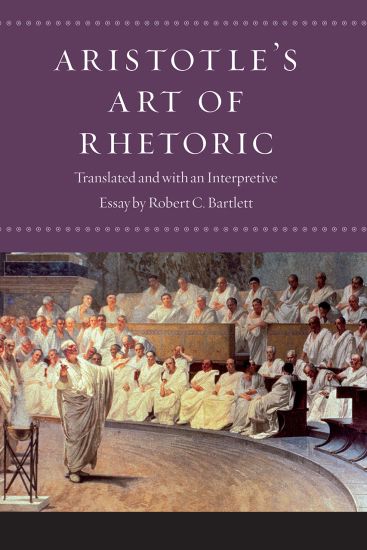
Aristotle's "Art of Rhetoric"

Aristotle's "Art of Rhetoric"

Aristotle

University of Chicago Press
2019
sidottu
For more than two thousand years. Aristotle's "Art of Rhetoric" has shaped thought on the theory and practice of rhetoric, the art of persuasive speech. In three sections, Aristotle discusses what rhetoric is, as well as the three kinds of rhetoric (deliberative, judicial, and epideictic), the three rhetorical modes of persuasion, and the diction, style, and necessary parts of a successful speech. Throughout, Aristotle defends rhetoric as an art and a crucial tool for deliberative politics while also recognizing its capacity to be misused by unscrupulous politicians to mislead or illegitimately persuade others. Here Robert C. Bartlett offers a literal, yet easily readable, new translation of Aristotle's "Art of Rhetoric," one that takes into account important alternatives in the manuscript and is fully annotated to explain historical, literary, and other allusions. Bartlett's translation is also accompanied by an outline of the argument of each book; copious indexes, including subjects, proper names, and literary citations; a glossary of key terms; and a substantial interpretive essay.
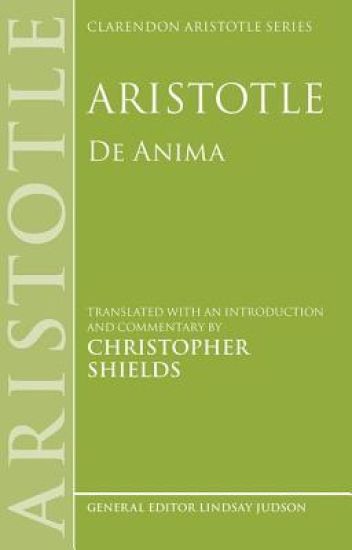
Aristotle: De Anima

Aristotle: De Anima

Aristotle

Clarendon Press
2016
sidottu
The Clarendon Aristotle Series is designed for both students and professionals. It provides accurate translations of selected Aristotelian texts, accompanied by incisive commentaries that focus on philosophical problems and issues, The volumes in the series have been widely welcomed and favourably reviewed. Important new titles are being added to the series, and a number of well-established volumes are being reissued with revisions and/or supplementary material. Christopher Shields presents a new translation and commentary of Aristotle's De Anima, a work of interest to philosophers at all levels, as well as psychologists and students interested in the nature of life and living systems. The volume provides a full translation of the complete work, together with a comprehensive commentary. While sensitive to philological and textual matters, the commentary addresses itself to the philosophical reader who wishes to understand and assess Aristotle's accounts of the soul and body; perception; thinking; action; and the character of living systems. It aims to present controversial aspects of the text in a neutral, fair-minded manner, so that readers can come to be equipped to form their own judgments. This volume includes the crucial first book, which the original translation in the Clarendon Aristotles Series omitted.
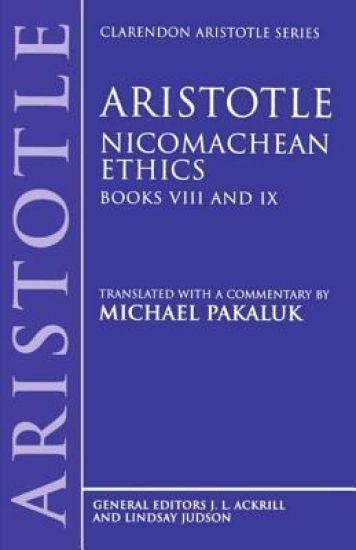
Aristotle: Nicomachean Ethics, Books VIII and IX
In Books VIII and IX of his masterpiece of moral philosophy, the Nicomachean Ethics, Aristotle gives perhaps the most famous of all philosophical discussions of friendship. Michael Pakaluk presents the first systematic study in English of these books, showing how important Aristotle's treatment of friendship is to his ethics as a whole. Pakaluk's fresh and scrupulously accurate translation is accompanied by a detailed philosophical commentary which reveals the remarkably coherent structure of the books and unfolds with lucidity the various arguments contained within Aristotle's terse and compressed text. Pakaluk looks at the logical form of Aristotle's analysis of friendship, at his subtle view of the relationship between friendship and justice, at the role of reciprocity in friendship, at civic friendship and its relation to the family, and at the development of friendship out of self-love and reflexive consciousness. This volume will be a valuable tool for anyone studying Aristotle's ethics, especially readers with no Greek.
De Anima (On the Soul)

De Anima (On the Soul)

Aristotle

Penguin Classics
1987
pokkari
For the Pre-Socratic philosophers the soul was the source of movement and sensation, while for Plato it was the seat of being, metaphysically distinct from the body that it was forced temporarily to inhabit. Plato's student Aristotle was determined to test the truth of both these beliefs against the emerging sciences of logic and biology. His examination of the huge variety of living organisms - the enormous range of their behaviour, their powers and their perceptual sophistication - convinced him of the inadequacy both of a materialist reduction and of a Platonic sublimation of the soul. In De Anima, he sought to set out his theory of the soul as the ultimate reality of embodied form and produced both a masterpiece of philosophical insight and a psychology of perennially fascinating subtlety.