Kirjojen hintavertailu. Mukana 12 595 353 kirjaa ja 12 kauppaa.

Kirjailija

Arjan Van der Schaft

Kirjat ja teokset yhdessä paikassa: 8 kirjaa, julkaisuja vuosilta 1990-2025, suosituimpien joukossa L2-Gain and Passivity Techniques in Nonlinear Control. Vertaile teosten hintoja ja tarkista saatavuus suomalaisista kirjakaupoista.

8 kirjaa

Kirjojen julkaisuhaarukka 1990-2025.

A Course on Optimal Control

A Course on Optimal Control

Gjerrit Meinsma; Arjan van der Schaft

Springer International Publishing AG
2025
nidottu
This text provides a detailed and self-contained introduction to the core topics of optimal control for finite-dimensional deterministic dynamical systems. Skillfully designed to guide the student through the development of the subject, the book provides a rich collection of examples, exercises, illustrations, and applications, to support comprehension of the material. Solutions to odd-numbered exercises are included, while a complete set of solutions is available to instructors who adopt the text for their class. The book is adaptable to coursework for final year undergraduates in (applied) mathematics or beginning graduate students in engineering. Required mathematical background includes calculus, linear algebra, a basic knowledge of differential equations, as well as a rudimentary acquaintance with control systems. The book has developed out of lecture notes that were tested, adapted, and expanded over many years of teaching. Chapters 1-4 constitute thematerial for a basic course on optimal control, covering successively the calculus of variations, minimum principle, dynamic programming, and linear quadratic control. The additional Chapter 5 provides brief views to a number of selected topics related to optimal control, which are meant to peak the reader’s interest. Some mathematical background is summarized in Appendix A for easy review. Appendix B recalls some of the basics of differential equations and also provides a detailed treatment of Lyapunov stability theory including LaSalle’s invariance principle, as occasionally used in Chapters 3 and 4.
A Course on Optimal Control

A Course on Optimal Control

Gjerrit Meinsma; Arjan van der Schaft

Springer International Publishing AG
2024
sidottu
This text provides a detailed and self-contained introduction to the core topics of optimal control for finite-dimensional deterministic dynamical systems. Skillfully designed to guide the student through the development of the subject, the book provides a rich collection of examples, exercises, illustrations, and applications, to support comprehension of the material. Solutions to odd-numbered exercises are included, while a complete set of solutions is available to instructors who adopt the text for their class. The book is adaptable to coursework for final year undergraduates in (applied) mathematics or beginning graduate students in engineering. Required mathematical background includes calculus, linear algebra, a basic knowledge of differential equations, as well as a rudimentary acquaintance with control systems. The book has developed out of lecture notes that were tested, adapted, and expanded over many years of teaching. Chapters 1-4 constitute thematerial for a basic course on optimal control, covering successively the calculus of variations, minimum principle, dynamic programming, and linear quadratic control. The additional Chapter 5 provides brief views to a number of selected topics related to optimal control, which are meant to peak the reader’s interest. Some mathematical background is summarized in Appendix A for easy review. Appendix B recalls some of the basics of differential equations and also provides a detailed treatment of Lyapunov stability theory including LaSalle’s invariance principle, as occasionally used in Chapters 3 and 4.
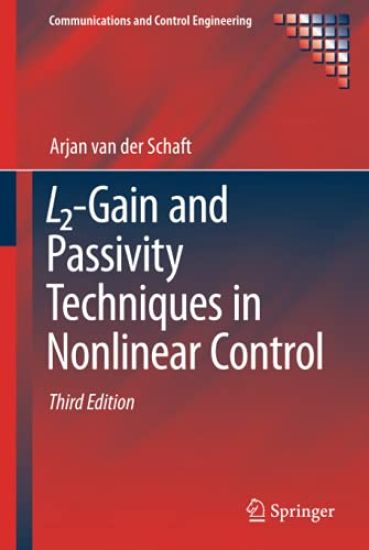
L2-Gain and Passivity Techniques in Nonlinear Control

L2-Gain and Passivity Techniques in Nonlinear Control

Arjan van der Schaft

Springer International Publishing AG
2018
nidottu
This standard text gives a unified treatment of passivity and L2-gain theory for nonlinear state space systems, preceded by a compact treatment of classical passivity and small-gain theorems for nonlinear input-output maps. The synthesis between passivity and L2-gain theory is provided by the theory of dissipative systems. Specifically, the small-gain and passivity theorems and their implications for nonlinear stability and stabilization are discussed from this standpoint. The connection between L2-gain and passivity via scattering is detailed. Feedback equivalence to a passive system and resulting stabilization strategies are discussed. The passivity concepts are enriched by a generalised Hamiltonian formalism, emphasising the close relations with physical modeling and control by interconnection, and leading to novel control methodologies going beyond passivity. The potential of L2-gain techniquesin nonlinear control, including a theory of all-pass factorizations of nonlinear systems, and of parametrization of stabilizing controllers, is demonstrated. The nonlinear H-infinity optimal control problem is also treated and the book concludes with a geometric analysis of the solution sets of Hamilton-Jacobi inequalities and their relation with Riccati inequalities for the linearization. · L2-Gain and Passivity Techniques in Nonlinear Control (third edition) is thoroughly updated, revised, reorganized and expanded. Among the changes, readers will find: · updated and extended coverage of dissipative systems theory · substantial new material regarding converse passivity theorems and incremental/shifted passivity · coverage of recent developments on networks of passive systems with examples · a completely overhauled and succinct introduction to modeling and control of port-Hamiltonian systems, followed by an exposition of port-Hamiltonian formulation of physical network dynamics · updated treatment of all-pass factorization of nonlinear systems The book provides graduate students and researchers in systems and control with a compact presentation of a fundamental and rapidly developing area of nonlinear control theory, illustrated by a broad range of relevant examples stemming from different application areas.
L2-Gain and Passivity Techniques in Nonlinear Control

L2-Gain and Passivity Techniques in Nonlinear Control

Arjan Van der Schaft

Springer International Publishing AG
2016
sidottu
This standard text gives a unified treatment of passivity and L2-gain theory for nonlinear state space systems, preceded by a compact treatment of classical passivity and small-gain theorems for nonlinear input-output maps. The synthesis between passivity and L2-gain theory is provided by the theory of dissipative systems. Specifically, the small-gain and passivity theorems and their implications for nonlinear stability and stabilization are discussed from this standpoint. The connection between L2-gain and passivity via scattering is detailed. Feedback equivalence to a passive system and resulting stabilization strategies are discussed. The passivity concepts are enriched by a generalised Hamiltonian formalism, emphasising the close relations with physical modeling and control by interconnection, and leading to novel control methodologies going beyond passivity. The potential of L2-gain techniquesin nonlinear control, including a theory of all-pass factorizations of nonlinear systems, and of parametrization of stabilizing controllers, is demonstrated. The nonlinear H-infinity optimal control problem is also treated and the book concludes with a geometric analysis of the solution sets of Hamilton-Jacobi inequalities and their relation with Riccati inequalities for the linearization. · L2-Gain and Passivity Techniques in Nonlinear Control (third edition) is thoroughly updated, revised, reorganized and expanded. Among the changes, readers will find: · updated and extended coverage of dissipative systems theory · substantial new material regarding converse passivity theorems and incremental/shifted passivity · coverage of recent developments on networks of passive systems with examples · a completely overhauled and succinct introduction to modeling and control of port-Hamiltonian systems, followed by an exposition of port-Hamiltonian formulation of physical network dynamics · updated treatment of all-pass factorization of nonlinear systems The book provides graduate students and researchers in systems and control with a compact presentation of a fundamental and rapidly developing area of nonlinear control theory, illustrated by a broad range of relevant examples stemming from different application areas.
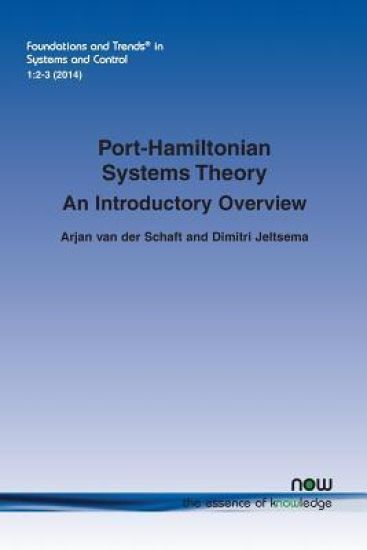
Port-Hamiltonian Systems Theory

Port-Hamiltonian Systems Theory

Arjan Van der Schaft; Dimitri Jeltsema

now publishers Inc
2014
nidottu
Apart from offering a systematic and insightful framework for modeling and analysis of multi-physics systems, port-Hamiltonian systems theory provides a natural starting point for control. Especially in the nonlinear case it is widely recognized that physical properties of the system - such as balance and conservation laws and energy considerations - should be exploited and respected in the design of control laws which are robust and physically interpretable.Port-Hamiltonian Systems Theory provides a concise and easily accessible description of the foundations underpinning the subject, and goes on to emphasize novel developments in the field that will be of interest to a broad range of researchers. The tutorial style makes it suitable for use in a course and by students.
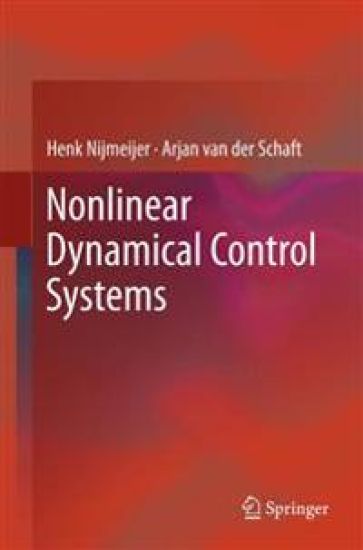
Nonlinear Dynamical Control Systems

Nonlinear Dynamical Control Systems

Henk Nijmeijer; Arjan van der Schaft

Springer-Verlag New York Inc.
2010
nidottu
This book has recently been retypeset in LaTeX for clearer presentation.This textbook on the differential geometric approach to nonlinear control grew out of a set of lecture notes, which were prepared for a course on nonlinear system theory, given by us for the first time during the fall semester of 1988. The audience consisted mostly of graduate students , taking part in the Dutch national Graduate Program on Systems and Control.The course gives a general introduction to modern nonlinear control theory (with an emphasis on the differential geometric approach), as well as providing students specializing in nonlinear control theory with a firm starting point for doing research in this area. One of the authors' primary objectives is to give a self-contained treatment of all the topics covered. Although the amount of work published on nonlinear geometric control theory is expanding rapidly expanding, the authors confine themselves to treating solid and clear-cut achievements of modern nonlinear control, which can be expected to be of remaining interest. The final selection of topics reflects the authors' own judgement of their importance.
L2 - Gain and Passivity Techniques in Nonlinear Control

L2 - Gain and Passivity Techniques in Nonlinear Control

Arjan van der Schaft

Springer London Ltd
1999
sidottu
With respect to the first edition as Volume 218 in the Lecture Notes in Con­ trol and Information Sciences series the basic idea of the second edition has remained the same: to provide a compact presentation of some basic ideas in the classical theory of input-output and closed-loop stability, together with a choice of contributions to the recent theory of nonlinear robust and 1foo control and passivity-based control. Nevertheless, some parts of the book have been thoroughly revised and/or expanded, in order to have a more balanced presen­ tation of the theory and to include some of the new developments which have been taken place since the appearance of the first edition. I soon realized, how­ ever, that it is not possible to give a broad exposition of the existing literature in this area without affecting the spirit of the book, which is precisely aimed at a compact presentation. So as a result the second edition still reflects very much my personal taste and research interests. I trust that others will write books emphasizing different aspects. Major changes with respect to the first edition are the following: • A new section has been added in Chapter 2 relating L2-gain and passivity via scattering, emphasizing a coordinate-free, geometric, treatment. • The section on stability in Chapter 3 has been thoroughly expanded, also incorporating some recent results presented in [182J.
Nonlinear Dynamical Control Systems

Nonlinear Dynamical Control Systems

Henk Nijmeijer; Arjan van der Schaft

Springer-Verlag New York Inc.
1990
sidottu
This book has recently been retypeset in LaTeX for clearer presentation.This textbook on the differential geometric approach to nonlinear control grew out of a set of lecture notes, which were prepared for a course on nonlinear system theory, given by us for the first time during the fall semester of 1988. The audience consisted mostly of graduate students , taking part in the Dutch national Graduate Program on Systems and Control.The course gives a general introduction to modern nonlinear control theory (with an emphasis on the differential geometric approach), as well as providing students specializing in nonlinear control theory with a firm starting point for doing research in this area. One of the authors' primary objectives is to give a self-contained treatment of all the topics covered. Although the amount of work published on nonlinear geometric control theory is expanding rapidly expanding, the authors confine themselves to treating solid and clear-cut achievements of modern nonlinear control, which can be expected to be of remaining interest. The final selection of topics reflects the authors' own judgement of their importance.