Kirjojen hintavertailu. Mukana 12 500 853 kirjaa ja 12 kauppaa.

Kirjailija

Arlie O. Petters

Kirjat ja teokset yhdessä paikassa: 5 kirjaa, julkaisuja vuosilta 2001-2025, suosituimpien joukossa Singularity Theory and Gravitational Lensing. Vertaile teosten hintoja ja tarkista saatavuus suomalaisista kirjakaupoista.

5 kirjaa

Kirjojen julkaisuhaarukka 2001-2025.

Gravitational Lensing in Spacetimes

Gravitational Lensing in Spacetimes

Arlie O. Petters; Marcus Werner

Springer-Verlag New York Inc.
2025
sidottu
Gravitational lensing occupies a central role in astrophysics and cosmology. It addresses some of the most pressing scientific issues: determining the nature of dark matter, constraining the cosmological constant and evolving dark energy, estimating Hubble’s constant, and testing Einstein’s general theory of relativity using the Galactic black hole. All these topics are treated in the book. This unique monograph provides a rigorous, unified, exposition of gravitational lensing in spacetimes with matter (ordinary and dark matter), cosmological constant and evolving dark energy, and black holes (includes rotating black holes with accretion disks). Emphasis is placed on the rigorous analytical aspects of the subject, while at the same time introducing general relativity. This work can be used as a text for a graduate level course or advanced undergraduate seminar in General Relativity or Gravitational Lensing. The work is interdisciplinary and should be of interest to researchers in mathematics, mathematical physics, astrophysics, cosmology, and general relativity.
An Introduction to Mathematical Finance with Applications

An Introduction to Mathematical Finance with Applications

Arlie O. Petters; Xiaoying Dong

Springer-Verlag New York Inc.
2018
nidottu
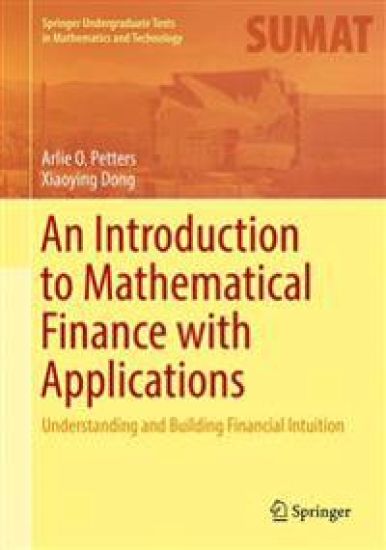
This textbook aims to fill the gap between those that offer a theoretical treatment without many applications and those that present and apply formulas without appropriately deriving them. The balance achieved will give readers a fundamental understanding of key financial ideas and tools that form the basis for building realistic models, including those that may become proprietary. Numerous carefully chosen examples and exercises reinforce the student’s conceptual understanding and facility with applications. The exercises are divided into conceptual, application-based, and theoretical problems, which probe the material deeper.The book is aimed toward advanced undergraduates and first-year graduate students who are new to finance or want a more rigorous treatment of the mathematical models used within. While no background in finance is assumed, prerequisite math courses include multivariable calculus, probability, and linear algebra. The authors introduce additional mathematical tools as needed. The entire textbook is appropriate for a single year-long course on introductory mathematical finance. The self-contained design of the text allows for instructor flexibility in topics courses and those focusing on financial derivatives. Moreover, the text is useful for mathematicians, physicists, and engineers who want to learn finance via an approach that builds their financial intuition and is explicit about model building, as well as business school students who want a treatment of finance that is deeper but not overly theoretical.
An Introduction to Mathematical Finance with Applications

An Introduction to Mathematical Finance with Applications

Arlie O. Petters; Xiaoying Dong

Springer-Verlag New York Inc.
2016
sidottu
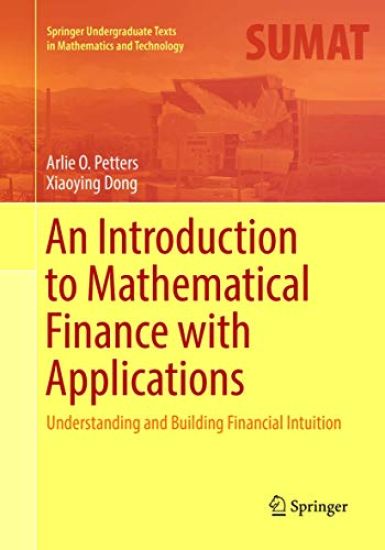
This textbook aims to fill the gap between those that offer a theoretical treatment without many applications and those that present and apply formulas without appropriately deriving them. The balance achieved will give readers a fundamental understanding of key financial ideas and tools that form the basis for building realistic models, including those that may become proprietary. Numerous carefully chosen examples and exercises reinforce the student’s conceptual understanding and facility with applications. The exercises are divided into conceptual, application-based, and theoretical problems, which probe the material deeper.The book is aimed toward advanced undergraduates and first-year graduate students who are new to finance or want a more rigorous treatment of the mathematical models used within. While no background in finance is assumed, prerequisite math courses include multivariable calculus, probability, and linear algebra. The authors introduce additional mathematical tools as needed. The entire textbook is appropriate for a single year-long course on introductory mathematical finance. The self-contained design of the text allows for instructor flexibility in topics courses and those focusing on financial derivatives. Moreover, the text is useful for mathematicians, physicists, and engineers who want to learn finance via an approach that builds their financial intuition and is explicit about model building, as well as business school students who want a treatment of finance that is deeper but not overly theoretical.
Singularity Theory and Gravitational Lensing

Singularity Theory and Gravitational Lensing

Arlie O. Petters; Harold Levine; Joachim Wambsganss

Springer-Verlag New York Inc.
2012
nidottu
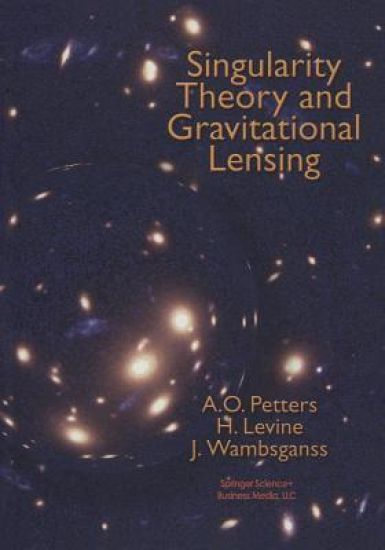
Astronomers do not do experiments. They observe the universe primarily through detect­ ing light emitted by stars and other luminous objects. Since this light must travel through space to reach us, variations in the metric of space affects the appearance of astronomical objects. These variations lead to dramatic changes in the shape and brightness of astronom­ ical sources. Because these variations are sensitive to mass rather than to light, observations of gravitational lensing enable astronomers to probe the mass distribution of the universe. With gravitational lensing observations, astronomers are addressing many of the most important scientific questions in astronomy and physics: • What is the universe made of? Most of the energy and mass in the universe is not in the form of luminous objects. Stars account for less than 1 % of the energy density of the universe. Perhaps, as much as another 3% of the energy density of the universe is in the form of warm gas that fills the space between galaxies. The remaining 96% of the energy density is in some yet unidentified form. Roughly one third of this energy density of the universe is "dark matter," matter that clusters gravitationally but does not emit light. Most cosmologists suspect that this dark matter is composed of weakly interacting subatomic particles. However, most of the energy density of the universe appears to be in an even stranger form: energy associated with empty space.
Singularity Theory and Gravitational Lensing

Singularity Theory and Gravitational Lensing

Arlie O. Petters; Harold Levine; Joachim Wambsganss

Birkhauser Boston Inc
2001
sidottu
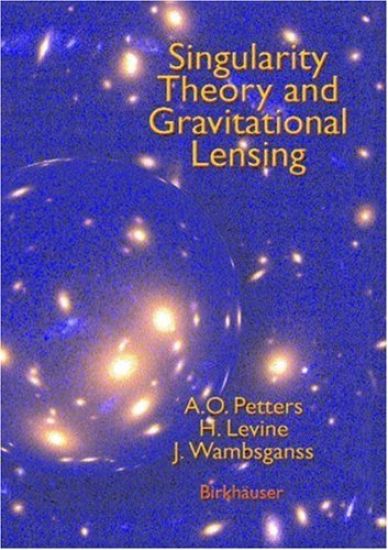
Astronomers do not do experiments. They observe the universe primarily through detect­ ing light emitted by stars and other luminous objects. Since this light must travel through space to reach us, variations in the metric of space affects the appearance of astronomical objects. These variations lead to dramatic changes in the shape and brightness of astronom­ ical sources. Because these variations are sensitive to mass rather than to light, observations of gravitational lensing enable astronomers to probe the mass distribution of the universe. With gravitational lensing observations, astronomers are addressing many of the most important scientific questions in astronomy and physics: • What is the universe made of? Most of the energy and mass in the universe is not in the form of luminous objects. Stars account for less than 1 % of the energy density of the universe. Perhaps, as much as another 3% of the energy density of the universe is in the form of warm gas that fills the space between galaxies. The remaining 96% of the energy density is in some yet unidentified form. Roughly one third of this energy density of the universe is "dark matter," matter that clusters gravitationally but does not emit light. Most cosmologists suspect that this dark matter is composed of weakly interacting subatomic particles. However, most of the energy density of the universe appears to be in an even stranger form: energy associated with empty space.