

Kirjailija
Armin Grunwald
Kirjat ja teokset yhdessä paikassa: 12 kirjaa, julkaisuja vuosilta 2006-2025, suosituimpien joukossa Responsible Nanobiotechnology. Vertaile teosten hintoja ja tarkista saatavuus suomalaisista kirjakaupoista.
12 kirjaa
Kirjojen julkaisuhaarukka 2006-2025.

German-english edition The question of identity has always preoccupied artists. Louisa Clement is no different, her central theme is the human being and the human in the digital. In her art, she starts out from herself, but ventures much further, asking how identity will be shaped in the future and examining forms of transformation. In the series of works Repräsentantinnen (Representatives), she creates AI-equipped, adaptive images of herself, with which visitors can converse. In photographic works, the master pupil of Andreas Gursky continues this examination of the body and its possible optimisations and deals with military legacies under the aspect of transformation. This publication is appearing for an exhibition at the Paula Modersohn-Becker Museum - both artists are united in their search for self-expression, as Paula Modersohn-Becker's Self-portrait on 6th wedding anniversary from 1906 demonstrates in a succinct manner. Look inside https://issuu.com/deutscher_kunstverlag/docs/blick_ins_buch_human_error_louisa_clement?fr=xKAE9_zU1NQ Louisa Clement (born 1987 in Bonn) completed her studies at the Kunstakademie Düsseldorf in 2015 as a master pupil of Andreas Gursky. She has already exhibited in various institutions and museums, including e.g.: Museum Frieder Burda, Baden-Baden (2022); Casino Luxembourg – Forum d'art contemporain (2022); Ludwig Forum Aachen (2019); Sprengel Museum Hanover (2019) One of today’s most popular young artists Current social issues such as AI, questions about body and self-image, and possibilities of digital storage Exhibition, 2 September 2023 to 21 January 2024, Paula Modersohn-Becker Museum, Bremen

Die 3., vollstandig aktualisierte und erweiterte Auflage des Lehrbuchs zeigt unter anderem, wie Technikfolgenabschatzung (TA) vorausschauend und partizipativ zur verantwortlichen, demokratischen und nachhaltigen Gestaltung des technischen Fortschritts beitragt, welcher Leben, Gesellschaft und Umwelt tiefgreifend und schnell verandert. Digitalisierung, Energiewende und Gentechnik sind einige Beispielfelder. Der Klimawandel und die Abhangigkeit von Ressourcen gehoren genauso hierzu wie soziale Folgen durch Automatisierung und Uberwachung. Das Buch erlautert u.a. die historische Entwicklung der TA und geht auf Theoriebildung und -debatten ein. Praxisbeispiele und TA als Projektforschung vermitteln zudem ein Bild davon, wie TA konkret umgesetzt werden kann.


The boundaries between inanimate technology and the realm of the living become increasingly blurred. Deeper and deeper technological interventions into living organisms are possible, covering the entire spectrum of life from bacteria to humans. Simultaneously, digitalization and artificial intelligence (AI) enable increasingly autonomous technologies. Inanimate technologies such as robots begin to show characteristics of life. Contested issues pop up, such as the dignity of life, the enhancement of animals for human purposes, the creation of designer babies, and the granting of robot rights. The book addresses the understanding of the ongoing dissolution of the life/technology borders, the provision of ethical guidance for navigating research and innovation responsibly, and the philosophical reflection on the meaning of the current shifts. It offers three specific perspectives for understanding the challenges and providing orientation. First, the dissolution of the boundaries between technology and life is analyzed and reflected from both sides. Second, the search for orientation is not restricted to ethics but also involves philosophy of technology and of nature, as well as anthropology. Finally, instead of restricting the analysis to specific areas of life, e.g., bacteria or animals, the book presents a comprehensive look at the entire spectrum of living organisms—bacteria and viruses, plants, animals and humans—and robots as possible early forms of emerging technical life.
Technological advance affects almost all areas of human life. Rapid digitization, increased mobility, new biotechnologies, and nanotechnology deeply influence, amongst others, industrial production, entertainment, work, military affairs, and individual life. Besides overwhelmingly positive effects on wealth, comfort, innovation, and development, this also raises questions of unintended effects, of tensions with democracy, of the role of citizens, and of its sustainability facing environmental issues. Tools and procedures are needed to cope with this challenging situation.Technology assessment (TA) has been developed more than fifty years ago to enable science, the economy, and society to harvest the potential of new technology to the maximum extent possible and to deal responsibly with possible adverse effects. It was developed more than 50 years ago in the U.S. Congress and has diversified considerably in the meantime. Parliamentary TA in many European states and at the international level, participatory TA at the local and regional levels worldwide, and TA as part of engineering processes are the most relevant fields today. Technology assessment is a growing field of interdisciplinary research and scientific policy advice.This volume (a) gives an overview of motivations of TA, its history and its current practices, (b) develops a fresh theoretical perspective on TA rooted in social theory and philosophy, and (c) draws conclusions from the theoretical perspective for the further development of TA’s practices. It provides the first comprehensive view on the growing field of TA at the international level.
Technological advance affects almost all areas of human life. Rapid digitization, increased mobility, new biotechnologies, and nanotechnology deeply influence, amongst others, industrial production, entertainment, work, military affairs, and individual life. Besides overwhelmingly positive effects on wealth, comfort, innovation, and development, this also raises questions of unintended effects, of tensions with democracy, of the role of citizens, and of its sustainability facing environmental issues. Tools and procedures are needed to cope with this challenging situation.Technology assessment (TA) has been developed more than fifty years ago to enable science, the economy, and society to harvest the potential of new technology to the maximum extent possible and to deal responsibly with possible adverse effects. It was developed more than 50 years ago in the U.S. Congress and has diversified considerably in the meantime. Parliamentary TA in many European states and at the international level, participatory TA at the local and regional levels worldwide, and TA as part of engineering processes are the most relevant fields today. Technology assessment is a growing field of interdisciplinary research and scientific policy advice.This volume (a) gives an overview of motivations of TA, its history and its current practices, (b) develops a fresh theoretical perspective on TA rooted in social theory and philosophy, and (c) draws conclusions from the theoretical perspective for the further development of TA’s practices. It provides the first comprehensive view on the growing field of TA at the international level.
The book investigates the meaning of RRI if little or no valid knowledge about consequences of innovation and technology is available. It proposes a hermeneutical turn to investigate narratives about possible futures with respect to their contemporary meaning instead of regarding them as anticipations of the future.
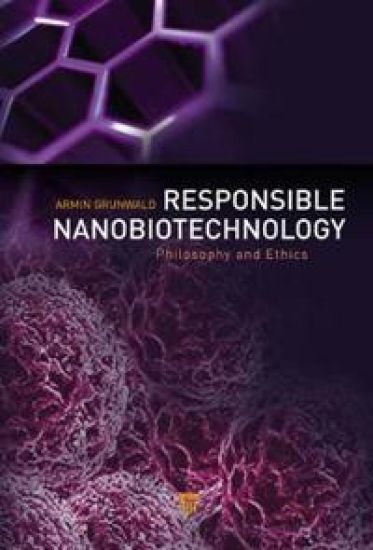
This book comprehensively reviews the considerations of nanotechnology elaborated in philosophy, ethics, and the social sciences and systematizes and develops them further. It focuses on the issues of ethical responsibility regarding chances and risks of nanotechnology and its possible applications in the fields of synthetic nanoparticles, synthetic biology, animal enhancement, and human enhancement. The book has been, thus, put in the context of the keywords "responsible innovation" and "reflective sciences," which have been central concepts in the debates about the relationship between science and society for the last few years.
Nanotechnology
Harald Brune; Holger Ernst; Armin Grunwald; Werner Grünwald; Heinrich Hofmann; Harald Krug; Peter Janich; Marcel Mayor; Wolfgang Rathgeber; Günter Schmid; Ulrich Simon; Viola Vogel; Daniel Wyrwa
Springer-Verlag Berlin and Heidelberg GmbH Co. K
2010
nidottu
Since nanotechnology is considered a key for the 21st century, its promises have been assessed by various scientific communities. By meeting at the nanoscale, various disciplines, from physics via chemistry to biology, from engineering to medicine, contribute synergetically to the newly created knowledge base and the resulting technological advances. Considering that large societal sectors will be impacted, the unique aspect of this two-year study was to assess nanotechnology from various interrelated perspectives: scientific progress, industrial relevance, economic potential, educational needs, potential adverse health effects, and philosophical aspects. The goal of this study was to derive integrated recommendations which consider the large range of societal implications reflecting the different views in an integrative manner. The study attempts to link previously isolated statements, bundling the various concepts and giving unified recommendations to decision makers in relevant society sectors such as politics, economy and research. Special attention was given to the European situation with respect to commercial consequences, an aspect that has not yet received the attention it deserves so far.
Nanotechnology
Harald Brune; Holger Ernst; Armin Grunwald; Werner Grünwald; Heinrich Hofmann; Harald Krug; Peter Janich; Marcel Mayor; Wolfgang Rathgeber; Günter Schmid; Ulrich Simon; Viola Vogel; Daniel Wyrwa
Springer-Verlag Berlin and Heidelberg GmbH Co. K
2006
sidottu
Since nanotechnology is considered a key for the 21st century, its promises have been assessed by various scientific communities. By meeting at the nanoscale, various disciplines, from physics via chemistry to biology, from engineering to medicine, contribute synergetically to the newly created knowledge base and the resulting technological advances. Considering that large societal sectors will be impacted, the unique aspect of this two-year study was to assess nanotechnology from various interrelated perspectives: scientific progress, industrial relevance, economic potential, educational needs, potential adverse health effects, and philosophical aspects. The goal of this study was to derive integrated recommendations which consider the large range of societal implications reflecting the different views in an integrative manner. The study attempts to link previously isolated statements, bundling the various concepts and giving unified recommendations to decision makers in relevant society sectors such as politics, economy and research. Special attention was given to the European situation with respect to commercial consequences, an aspect that has not yet received the attention it deserves so far.