Kirjojen hintavertailu. Mukana 12 595 353 kirjaa ja 12 kauppaa.

Kirjailija

Armin Von Bogdandy

Kirjat ja teokset yhdessä paikassa: 7 kirjaa, julkaisuja vuosilta 1999-2024, suosituimpien joukossa Strukturwandel des öffentlichen Rechts. Vertaile teosten hintoja ja tarkista saatavuus suomalaisista kirjakaupoista.

7 kirjaa

Kirjojen julkaisuhaarukka 1999-2024.

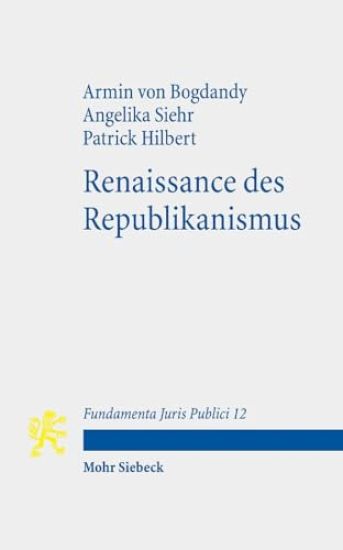
Renaissance des Republikanismus

Renaissance des Republikanismus

Armin von Bogdandy; Angelika Siehr; Patrick Hilbert

Mohr Siebeck
2024
nidottu
Lassen sich im globalen und/oder europäischen Rahmen Anzeichen für eine Wiederbelebung bzw. Neuausrichtung republikanischen Gedankenguts ausmachen? Und falls ja, in welchem Sinne und Maße? Und welcher Stellenwert wäre einer allfälligen Renaissance des Republikanismus im juridischen Denken und Vermessen zuzuweisen? Im Rahmen des "Grundlagen"-Gesprächs anlässlich der Bochumer Staatsrechtslehrertagung im Oktober 2023 haben dazu - im Hauptreferat - Armin von Bogdandy sowie - in Kommentaren - Angelika Siehr und Patrick Hilbert Position bezogen.

The Emergence of European Society through Public Law

The Emergence of European Society through Public Law

Armin von Bogdandy

Oxford University Press
2024
sidottu
Many Europeans struggle to understand where EU-centred Europeanization has led them. The standard response - that their situation is sui generis, one of a kind - no longer holds. Brexit, conflicts over European financial transfers, immigration, or dubious judicial reforms in some Member States demand a more substantial answer. Against that background, The Emergence of European Society Through Public Law: A Hegelian and Anti-Schmittian Approach frames European integration by reconstructing European public law in light of Article 2 of the Treaty on European Union (TEU). According to Article 2, all Europeans today are part of one society. European integration may not have produced a European federal state, but it has helped create a European society. This society is intimately interwoven with European public law, as the Treaty characterizes it with 12 constitutional principles. The book interprets this statement as the manifesto, identity, and constitutional core of a democratic society. Thus, Europeans should understand that European integration has ushered in a European democratic society. Comprehensive and engaging, The Emergence of European Society Through Public Law examines the great debates of European public law and presents them in a new and forward-looking reconstruction. This new narrative of European legal integration will appeal to academics and students of EU law, constitutional and comparative law, sociology, political science, and legal history. The Emergence of European Society Through Public Law is an open access title available under the terms of a CC BY-NC-ND 4.0 International licence. It is free to download from OUP and selected open access locations.
In Whose Name?

In Whose Name?

Armin von Bogdandy; Ingo Venzke

Oxford University Press
2016
nidottu
The vast majority of all international judicial decisions have been issued since 1990. This increasing activity of international courts over the past two decades is one of the most significant developments within the international law. It has repercussions on all levels of governance and has challenged received understandings of the nature and legitimacy of international courts. It was previously held that international courts are simply instruments of dispute settlement, whose activities are justified by the consent of the states that created them, and in whose name they decide. However, this understanding ignores other important judicial functions, underrates problems of legitimacy, and prevents a full assessment of how international adjudication functions, and the impact that it has demonstrably had. This book proposes a public law theory of international adjudication, which argues that international courts are multifunctional actors who exercise public authority and therefore require democratic legitimacy. It establishes this theory on the basis of three main building blocks: multifunctionality, the notion of an international public authority, and democracy. The book aims to answer the core question of the legitimacy of international adjudication: in whose name do international courts decide? It lays out the specific problem of the legitimacy of international adjudication, and reconstructs the common critiques of international courts. It develops a concept of democracy for international courts that makes it possible to constructively show how their legitimacy is derived. It argues that ultimately international courts make their decisions, even if they do not know it, in the name of the peoples and the citizens of the international community.
In Whose Name?

In Whose Name?

Armin von Bogdandy; Ingo Venzke

Oxford University Press
2014
sidottu
The vast majority of all international judicial decisions have been issued since 1990. This increasing activity of international courts over the past two decades is one of the most significant developments within the international law. It has repercussions on all levels of governance and has challenged received understandings of the nature and legitimacy of international courts. It was previously held that international courts are simply instruments of dispute settlement, whose activities are justified by the consent of the states that created them, and in whose name they decide. However, this understanding ignores other important judicial functions, underrates problems of legitimacy, and prevents a full assessment of how international adjudication functions, and the impact that it has demonstrably had. This book proposes a public law theory of international adjudication, which argues that international courts are multifunctional actors who exercise public authority and therefore require democratic legitimacy. It establishes this theory on the basis of three main building blocks: multifunctionality, the notion of an international public authority, and democracy. The book aims to answer the core question of the legitimacy of international adjudication: in whose name do international courts decide? It lays out the specific problem of the legitimacy of international adjudication, and reconstructs the common critiques of international courts. It develops a concept of democracy for international courts that makes it possible to constructively show how their legitimacy is derived. It argues that ultimately international courts make their decisions, even if they do not know it, in the name of the peoples and the citizens of the international community.
European Integration and International Co-ordination

European Integration and International Co-ordination

Armin Von Bogdandy; Petros C. Mavroidis

Kluwer Law International
2002
sidottu
Among the prominent legal roles Claus-Dieter Ehlermann has played in his career, his leadership of the Legal Service of the European Commission is perhaps the best known. This liber amicorum appears as his term at the Appellate Body of the World Trade Organization draws to a close. In this book 30 of his colleagues offer fresh and provocative insights into many of the areas of international law on which Professor Dr Ehlermann has left his stamp. Topics include: the WTO dispute settlement system; regulation of trade barriers; the first signs of a global jurisprudence; the principle of proportionality; enforcement of competition law; and the place of human rights in European and global integration. This book's evaluations and proposals should find thought-provoking echoes in the minds of all those concerned with any of the integration processes under way in today's interdependent world.
Gubernative Rechtsetzung

Gubernative Rechtsetzung

Armin von Bogdandy

Mohr Siebeck
1999
sidottu
Armin von Bogdandy formuliert eine Konzeption der Rechtsetzung, die die Rechtsregime der deutschen Rechtssatzformen im Vergleich mit der Rechtslage in vier anderen europäischen Staaten unter Einbeziehung politikwissenschaftlicher und philosophischer Erkenntnisse neu entfaltet. Er zeigt, daß das Rechtsregime der Rechtsetzung treffender formuliert werden kann, wenn drei Eckpunkte der herkömmlichen Dogmatik aufgegeben und durch drei neue ersetzt werden. Dazu gehört erstens, daß die politische Gestaltung der Rechtsordnung nicht vom Parlament, sondern von der Regierung aus zu verstehen ist. Außerdem kann zweitens das Recht der Rechtsetzung nicht in der Zweiteilung Gesetz - Verordnung entworfen werden, sondern muß als ein System unterschiedlich aufwendiger Regime betrachtet werden, die aufeinander arbeitsteilig abgestimmt sind. Und drittens muß Rechtsetzung nicht allein als ein einseitiger Hoheitsakt, sondern auch als ein Ergebnis umfänglicher kooperativer Prozesse unter Einbeziehung einer Vielzahl von Beteiligten konzipiert werden.Armin von Bogdandy zeigt, wie in dieser Konzeption die verfassungsrechtlichen Partizipations-, Schutz- und Bewirkungsaufträge besser als im traditionellen Modell realisiert werden können.