
Kirjojen hintavertailu. Mukana 12 595 353 kirjaa ja 12 kauppaa.

Kirjailija

Arnold F. Nikiforov

Kirjat ja teokset yhdessä paikassa: 2 kirjaa, julkaisuja vuosilta 2005-2012, suosituimpien joukossa Classical Orthogonal Polynomials of a Discrete Variable. Vertaile teosten hintoja ja tarkista saatavuus suomalaisista kirjakaupoista.

2 kirjaa

Kirjojen julkaisuhaarukka 2005-2012.

Classical Orthogonal Polynomials of a Discrete Variable

Classical Orthogonal Polynomials of a Discrete Variable

Arnold F. Nikiforov; Sergei K. Suslov; Vasilii B. Uvarov

Springer-Verlag Berlin and Heidelberg GmbH Co. K
2012
nidottu
Mathematical modelling of many physical processes involves rather complex dif- ferential, integral, and integro-differential equations which can be solved directly only in a number of cases. Therefore, as a first step, an original problem has to be considerably simplified in order to get a preliminary knowledge of the most important qualitative features of the process under investigation and to estimate the effect of various factors. Sometimes a solution of the simplified problem can be obtained in the analytical form convenient for further investigation. At this stage of the mathematical modelling it is useful to apply various special functions. Many model problems of atomic, molecular, and nuclear physics, electrody- namics, and acoustics may be reduced to equations of hypergeometric type, a(x)y" + r(x)y' + AY = 0 , (0.1) where a(x) and r(x) are polynomials of at most the second and first degree re- spectively and A is a constant [E7, AI, N18]. Some solutions of (0.1) are functions extensively used in mathematical physics such as classical orthogonal polyno- mials (the Jacobi, Laguerre, and Hermite polynomials) and hypergeometric and confluent hypergeometric functions.
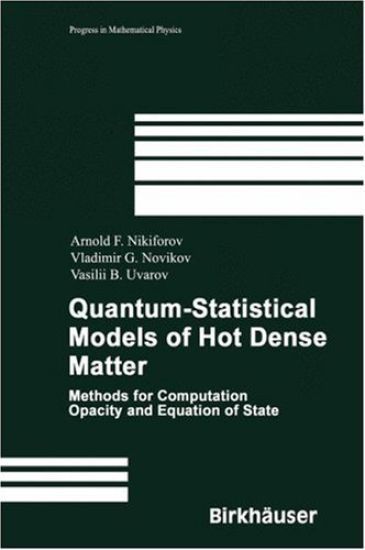
Quantum-Statistical Models of Hot Dense Matter

Quantum-Statistical Models of Hot Dense Matter

Arnold F. Nikiforov; Vladimir G. Novikov; Vasili B. Uvarov

Birkhauser Verlag AG
2005
sidottu
In the processes studied in contemporary physics one encounters the most diverse conditions: temperatures ranging from absolute zero to those found in the cores of stars, and densities ranging from those of gases to densities tens of times larger than those of a solid body. Accordingly, the solution of many problems of modern physics requires an increasingly large volume of information about the propertiesofmatterundervariousconditions,includingextremeones. Atthesame time, there is a demand for an increasing accuracy of these data, due to the fact thatthereliabilityandcomputationalsubstantiationofmanyuniquetechnological devices and physical installations depends on them. The relatively simple models ordinarily described in courses on theoretical physics are not applicable when we wish to describe the properties of matter in a su?ciently wide range of temperatures and densities. On the other hand, expe- ments aimed at generating data on properties of matter under extreme conditions usually face considerably technical di?culties and in a number of instances are exceedingly expensive. It is precisely for these reasons that it is important to - velop and re?ne in a systematic manner quantum-statistical models and methods for calculating properties of matter, and to compare computational results with data acquired through observations and experiments. At this time, the literature addressing these issues appears to be insu?cient. If one is concerned with opacity, which determines the radiative heat conductivity of matter at high temperatures, then one can mention, for example, the books of D. A. Frank-Kamenetskii [67], R. D. Cowan [49], and also the relatively recently published book by D.