Kirjojen hintavertailu. Mukana 12 497 173 kirjaa ja 12 kauppaa.

Kirjailija

Arrow Kenneth J.

Kirjat ja teokset yhdessä paikassa: 3 kirjaa, julkaisuja vuosilta 1974-2022, suosituimpien joukossa Public Interest Law. Vertaile teosten hintoja ja tarkista saatavuus suomalaisista kirjakaupoista.

3 kirjaa

Kirjojen julkaisuhaarukka 1974-2022.

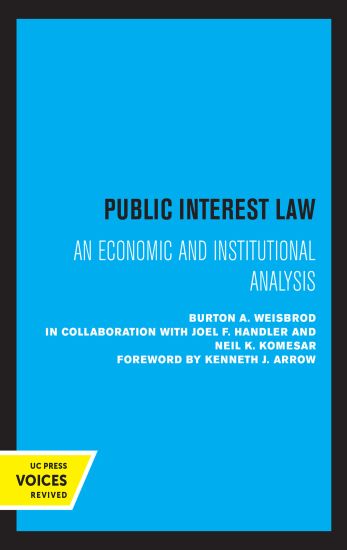
Public Interest Law

Public Interest Law

Burton A. Weisbrod; Joel F. Handler; Komesar Neil K.; Arrow Kenneth J.

University of California Press
2022
sidottu
What is public interest law? How effective is it? What are the limits to litigation as a mechanism for conflict resolution? In this study, economists, lawyers, and sociologists evaluate an institutional form that is new to American society and, indeed, to the world--the public interest law (PIL) organization. The book introduces the reader to the structure, resources, and activities of this "nonprofit industry," and also to the factors that affect PIL firms in their choices of cases and methods of handling them. The authors examine PIL's vast range of contemporary public policy concerns. These incude such general topics as the environment, consumerism, housing, employment discrimination, medical care, occupational health and safety, education finance, and taxation. A number of base studies are presented, and a method for economic analysis and evaluation is introduced and applied. The study points to PIL's success in advocating under-represented interests, in winning courtroom decisions, and in translating legal victories into reallocations of resources. At the same time, it notes the bias of PIL towards test-case litigation, a propensity to focus on judicial victories rather than on real social change, and a tendency to use lawyers even when other types of professionals might be more effective. Many of these problems stem from uncertainty of funding and legal restrictions on "nonprofit" organizations. The result is a set of hurdles that distracts PIL firms from their principal goals. The authors do not limit themselves to PIL, but comment on the effectiveness of legal instruments as devices for social change, and on the behavior of the voluntary nonprofit sector, a little-studied portion of the economy. The book presents a fresh approach to the study of both collective-type economic problems and institutional setting in which public interest law works. This title is part of UC Press's Voices Revived program, which commemorates University of California Press's mission to seek out and cultivate the brightest minds and give them voice, reach, and impact. Drawing on a backlist dating to 1893, Voices Revived makes high-quality, peer-reviewed scholarship accessible once again using print-on-demand technology. This title was originally published in 1978.
Public Interest Law

Public Interest Law

Burton A. Weisbrod; Joel F. Handler; Komesar Neil K.; Arrow Kenneth J.

University of California Press
2022
pokkari
What is public interest law? How effective is it? What are the limits to litigation as a mechanism for conflict resolution? In this study, economists, lawyers, and sociologists evaluate an institutional form that is new to American society and, indeed, to the world--the public interest law (PIL) organization. The book introduces the reader to the structure, resources, and activities of this "nonprofit industry," and also to the factors that affect PIL firms in their choices of cases and methods of handling them. The authors examine PIL's vast range of contemporary public policy concerns. These incude such general topics as the environment, consumerism, housing, employment discrimination, medical care, occupational health and safety, education finance, and taxation. A number of base studies are presented, and a method for economic analysis and evaluation is introduced and applied. The study points to PIL's success in advocating under-represented interests, in winning courtroom decisions, and in translating legal victories into reallocations of resources. At the same time, it notes the bias of PIL towards test-case litigation, a propensity to focus on judicial victories rather than on real social change, and a tendency to use lawyers even when other types of professionals might be more effective. Many of these problems stem from uncertainty of funding and legal restrictions on "nonprofit" organizations. The result is a set of hurdles that distracts PIL firms from their principal goals. The authors do not limit themselves to PIL, but comment on the effectiveness of legal instruments as devices for social change, and on the behavior of the voluntary nonprofit sector, a little-studied portion of the economy. The book presents a fresh approach to the study of both collective-type economic problems and institutional setting in which public interest law works. This title is part of UC Press's Voices Revived program, which commemorates University of California Press's mission to seek out and cultivate the brightest minds and give them voice, reach, and impact. Drawing on a backlist dating to 1893, Voices Revived makes high-quality, peer-reviewed scholarship accessible once again using print-on-demand technology. This title was originally published in 1978.
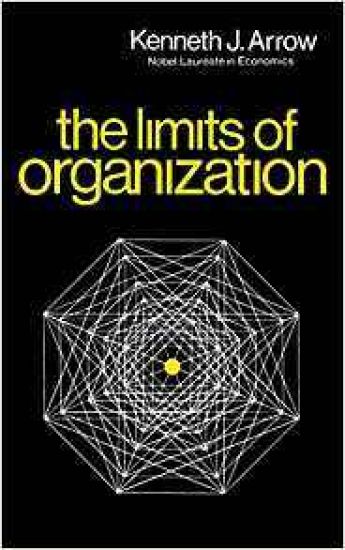
The Limits of Organization

The Limits of Organization

Arrow Kenneth J.

WW NORTON CO
1974
nidottu
The tension between what we wish for and what we can get, between values and opportunities, exists even at the purely individual level. A hermit on a mountain may value warm clothing and yet be hard-pressed to make it from the leaves, bark, or skins he can find. But when many people are competing with each other for satisfaction of their wants, learning how to exploit what is available becomes more difficult. In this volume, Nobel Laureate Kenneth J. Arrow analyzes why - and how - human beings organize their common lives to overcome the basic economic problem: the allocation of scarce resources. The price system is one means of organizing society to mediate competition, and Arrow analyzes its successes and failures. Alternative modes of achieving efficient allocation of resources are explored: government, the internal organization of the firm, and the 'invisible institutions' of ethical and moral principles. Professor Arrow shows how these systems create channels to make decisions, and discusses the costs of information acquisition and retrieval. He investigates the factors determining which potential decision variables are recognized as such. Finally, he argues that organizations must achieve some balance between the power of the decision makers and their obligation to those who carry out their decisions - between authority and responsibility.