Kirjojen hintavertailu. Mukana 12 657 676 kirjaa ja 12 kauppaa.

Kirjailija

Artemis Alexiadou

Kirjat ja teokset yhdessä paikassa: 3 kirjaa, julkaisuja vuosilta 2007-2015, suosituimpien joukossa External Arguments in Transitivity Alternations. Vertaile teosten hintoja ja tarkista saatavuus suomalaisista kirjakaupoista.

3 kirjaa

Kirjojen julkaisuhaarukka 2007-2015.

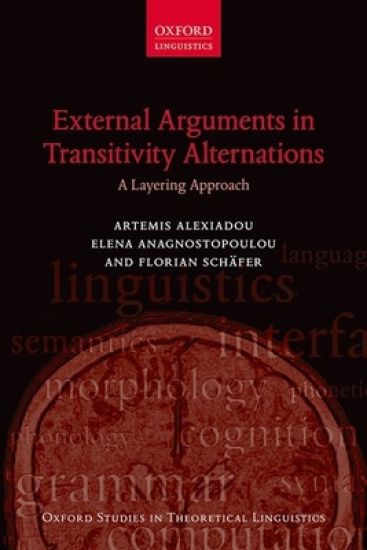
External Arguments in Transitivity Alternations

External Arguments in Transitivity Alternations

Artemis Alexiadou; Elena Anagnostopoulou; Florian Schäfer

Oxford University Press
2015
sidottu
This book is an exploration of the syntax of external arguments in transitivity alternations from a cross-linguistic perspective. It focuses particularly on the causative/anticausative alternation, which the authors take to be a Voice alternation, and the formation of adjectival participles. The authors use data principally from English, German, and Greek to demonstrate that the presence of anticausative morphology does not have any truth-conditional effects, but that marked anticausatives involve more structure than their unmarked counterparts. This morphology is therefore argued to be associated with a semantically inert Voice head that the authors call 'expletive Voice'. The authors also propose that passive formation is not identical across languages, and that the distinction between target vs. result state participles is crucial in understanding the contribution of Voice in adjectival passives. The book provides the tools required to investigate the morphosyntactic structure of verbs and participles, and to identify the properties of verbal alternations across languages. It will be of interest to theoretical linguists from graduate level upwards, particularly those specializing in morphosyntax and typology.
External Arguments in Transitivity Alternations

External Arguments in Transitivity Alternations

Artemis Alexiadou; Elena Anagnostopoulou; Florian Schäfer

Oxford University Press
2015
nidottu
This book is an exploration of the syntax of external arguments in transitivity alternations from a cross-linguistic perspective. It focuses particularly on the causative/anticausative alternation, which the authors take to be a Voice alternation, and the formation of adjectival participles. The authors use data principally from English, German, and Greek to demonstrate that the presence of anticausative morphology does not have any truth-conditional effects, but that marked anticausatives involve more structure than their unmarked counterparts. This morphology is therefore argued to be associated with a semantically inert Voice head that the authors call 'expletive Voice'. The authors also propose that passive formation is not identical across languages, and that the distinction between target vs. result state participles is crucial in understanding the contribution of Voice in adjectival passives. The book provides the tools required to investigate the morphosyntactic structure of verbs and participles, and to identify the properties of verbal alternations across languages. It will be of interest to theoretical linguists from graduate level upwards, particularly those specializing in morphosyntax and typology.
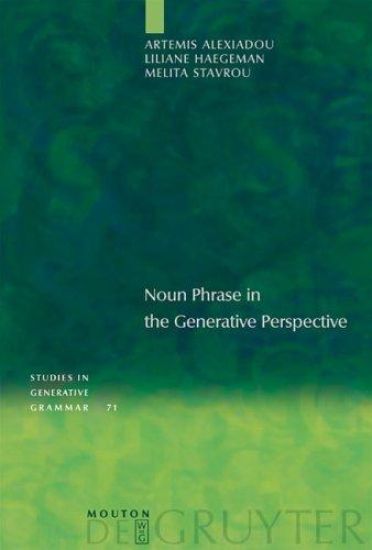
Noun Phrase in the Generative Perspective

Noun Phrase in the Generative Perspective

Artemis Alexiadou; Liliane Haegeman; Melita Stavrou

De Gruyter Mouton
2007
sidottu
The goal of this book is twofold. On the one hand we want to offer a discussion of some of the more important properties of the nominal projection, on the other hand we want to provide the reader with tools for syntactic analysis which apply to the structure of DP but which are also relevant for other domains of syntax. In order to achieve this dual goal we will discuss phenomena which are related to the nominal projection in relation to other syntactic phenomena (e.g. pro drop will be related to N-ellipsis, the classification of pronouns will be applied to the syntax of possessive pronouns, N-movement will be compared to V-movement, the syntax of the genitive construction will be related to that of predicate inversion etc.). In the various chapters we will show how recent theoretical proposals (distributed morphology, anti-symmetry, checking theory) can cast light on aspects of the syntax of the NP. When necessary, we will provide a brief introduction of these theoretical proposals. We will also indicate problems with these analyses, whether they be inherent to the theories as such (e.g. what is the trigger for movement in antisymmetric approaches) or to the particular instantiations. The book cannot and will not provide the definitive analysis of the syntax of noun phrases. We consider that this would not be possible, given the current flux in generative syntax, with many new theoretical proposals being developed and explored, but the book aims at giving the reader the tools with which to conduct research and to evaluate proposals in the literature. In the discussion of various issues, we will apply the framework that is most adequate to deal with problems at hand. We will therefore not necessarily use the same approach throughout the discussion. Though proposals in the literature will be referred to when relevant, we cannot attempt to provide a critical survey of the literature. We feel that such a survey would be guided too strongly by theoretical choices, which would not be compatible with the pedagogical purposes this book has. The book is comparative in its approach, and data from different languages will be examined, including English, German, Dutch (West-Flemish), Greek, Romance, Semitic, Slavic, Albanian, Hungarian, Gungbe.