Kirjojen hintavertailu. Mukana 12 496 430 kirjaa ja 12 kauppaa.

Kirjailija

Arthur C. Danto

Kirjat ja teokset yhdessä paikassa: 27 kirjaa, julkaisuja vuosilta 1983-2022, suosituimpien joukossa Andy Warhol. Vertaile teosten hintoja ja tarkista saatavuus suomalaisista kirjakaupoista.

27 kirjaa

Kirjojen julkaisuhaarukka 1983-2022.

The Abuse of Beauty

The Abuse of Beauty

Arthur C. Danto

Open Court Publishing Co ,U.S.
2003
pokkari
Danto simply and entertainingly traces the evolution of the concept of beauty over the past century and explores how it was removed from the definition of art. Beauty then came to be regarded as a serious aesthetic crime, whereas a hundred years ago it was almost unanimously considered the supreme purpose of art. Beauty is not, and should not be, the be-all and end-all of art, but it has an important place, and is not something to be avoided.Danto draws eruditely upon the thoughts of artists and critics such as Rimbaud, Fry, Matisse, the Dadaists, Duchamp, and Greenberg, as well as on that of philosophers like Hume, Kant, and Hegel. Danto agrees with the dethroning of beauty as the essence of art, and maintains with telling examples that most art is not, in fact, beautiful. He argues, however, for the partial rehabilitation of beauty and the removal of any critical taboo against beauty. Beauty is one among the many modes through which thoughts are presented to human sensibility in art: disgust, horror, sublimity, and sexuality being among other such modes.
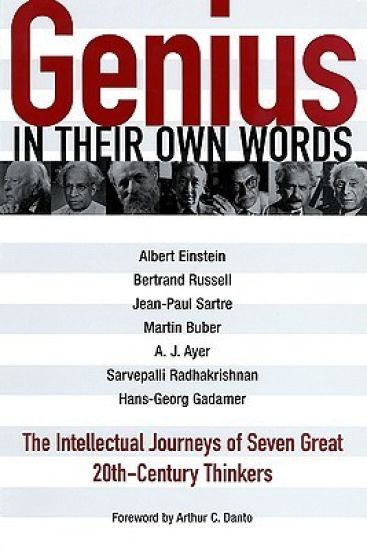
Genius in Their Own Words

Genius in Their Own Words

Arthur C. Danto

Open Court Publishing Co ,U.S.
2002
pokkari
Seven of the twentieth century's greatest thinkers describe how they arrived at the ideas for which they are known. In their own words, universally admired intellectuals such as Jean-Paul Sartre, Albert Einstein. Bertrand Russell, and Martin Buber trace the paths that led to their contributions in the field: A.J. Ayer shares what led to the logical positivist manifesto Language, Truth, and Logic and his subsequent retreat from and criticism of those early ideas, analytic philosophy founder Bertrand Russell's acerbic wit and self-deprecating manner are omnipresent in his narrative describing his intellectual development from childhood on. These carefully selected personal stories provide readers with a broad survey of the intellectual achievements of the 20th century, through the words and reflections of the thinkers themselves. Of interest to any reader curious about the nature of genius and how great minds work, this book is a window into the private world of an intellectual working toward ideas that have defined our time. The seven great thinkers are: A.J. Ayer; Martin Buber; Albert Einstein; Hans-Georg Gadamer; Sarvepalli Radhakrishnan; Bertrand Russell; Jean-Paul Sartre
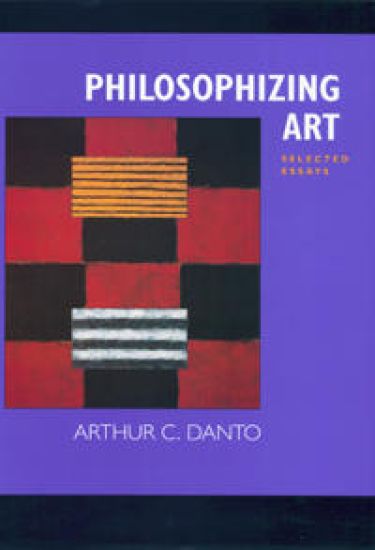
Philosophizing Art

Philosophizing Art

Arthur C. Danto

University of California Press
2001
pokkari
Arthur Danto's work has always affirmed a deep relationship between philosophy and art. These essays explore this relationship through a number of concrete cases in which either artists are driven by philosophical agendas or their art is seen as solving philosophical problems in visual terms. The essays cover a varied terrain, with subjects including Giotto's use of olfactory data in "The Raising of Lazarus"; chairs in art and chairs as art; Mel Bochner's Wittgenstein drawings; the work of Robert Motherwell, Andy Warhol, and Robert Irwin; Louis Kahn as "Archai-Tekt"; and, visual truth in film. Also featured are a meditation on the battle of Gettysburg; and a celebration of the Japanese artist Shiko Munakata, an essay that is partly autobiographical. Arthur C. Danto is one of the most original and multitalented philosophers writing today, a thinker whose interests traverse the boundaries of traditional understandings of philosophy. Best known for his contributions to the philosophy of art and aesthetics, Danto is also esteemed for his work in the history of philosophy, the philosophy of history, philosophical psychology, and action theory. These two volumes, each with an introduction by the author, contain essays spanning more than twenty-five years that have been selected to highlight the inseparability of philosophy and art in Danto's work. Together they present the thinking of Arthur C. Danto at his very best.
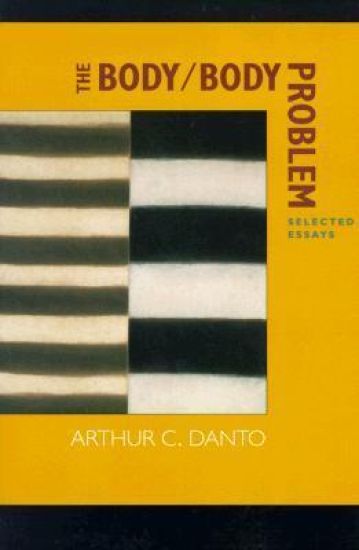
The Body/Body Problem

The Body/Body Problem

Arthur C. Danto

University of California Press
2001
pokkari
The overall subject of the essays in "The Body/Body Problem" is the traditional one of what our ultimate makeup is, as creatures with minds and bodies. The central thesis is that we are beings who represent - and misrepresent - actual and possible worlds. Addressing philosophical questions of mental representation, Danto presents his distinctive approach to some of the most enduring topics in philosophy. He is concerned with the nature of description, the status of the external world, action theory, the philosophy of history, and the philosophical status of psychoanalytic explanation. Representation is a central concept in philosophy, says Danto, with differences among philosophers arising in the ways they account for how representations connect to the world or to the individuals possessing them, and how they connect with one another to form systems of beliefs, feelings, and attitudes. In these essays Danto's own voice, with his arguments and speculations, provides rich philosophical pleasures that will endure, to borrow from Santayana, 'under whatever sky'. Arthur C. Danto is one of the most original and multitalented philosophers writing today, a thinker whose interests traverse the boundaries of traditional understandings of philosophy. Best known for his contributions to the philosophy of art and aesthetics, Danto is also esteemed for his work in the history of philosophy, the philosophy of history, philosophical psychology, and action theory. These two volumes, each with an introduction by the author, contain essays spanning more than twenty-five years that have been selected to highlight the inseparability of philosophy and art in Danto's work. Together they present the thinking of Arthur C. Danto at his very best.
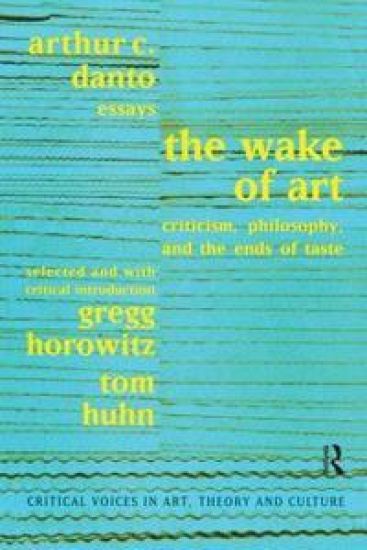
Wake of Art

Wake of Art

Arthur C. Danto; Gregg Horowitz; Tom Huhn; Saul Ostrow

Routledge
1998
sidottu
Since the mid-1980s, Arthur C. Danto has been increasingly concerned with the implications of the demise of modernism. Out of the wake of modernist art, Danto discerns the emergence of a radically pluralistic art world. His essays illuminate this novel art world as well as the fate of criticism within it. As a result, Danto has crafted the most compelling philosophy of art criticism since Clement Greenberg. Gregg Horowitz and Tom Huhn analyze the constellation of philosophical and critical elements in Danto's new- Hegelian art theory. In a provocative encounter, they employ themes from Kantian aesthetics to elucidate the continuing persistence of taste in shaping even this most sophisticated philosophy of art.
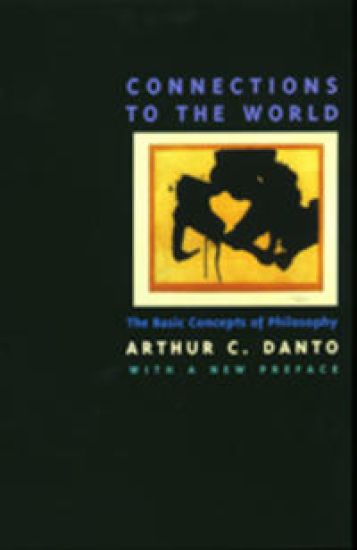
Connections to the World

Connections to the World

Arthur C. Danto

University of California Press
1997
pokkari
Arthur C. Danto's lucid introduction to the central topics of Western philosophical thought remains an unparalleled guide to problems in metaphysics and epistemology that have engaged philosophers for several millennia. Examining the work of Plato, Berkeley, Descartes, Hume, and Wittgenstein, Danto explores debates about empiricism, the mind/body problem, the nature of matter, and the status of language, consciousness, and scientific explanation. In a new preface to this edition he considers the current relationship between philosophy and the humanities.
The Transfiguration of the Commonplace

The Transfiguration of the Commonplace

Arthur C. Danto

Harvard University Press
1983
nidottu
Arthur C. Danto argues that recent developments in the art world, in particular the production of works of art that cannot be told from ordinary things, make urgent the need for a new theory of art and make plain the factors such a theory can and cannot involve. In the course of constructing such a theory, he seeks to demonstrate the relationship between philosophy and art, as well as the connections that hold between art and social institutions and art history.The book distinguishes what belongs to artistic theory from what has traditionally been confused with it, namely aesthetic theory and offers as well a systematic account of metaphor, expression, and style, together with an original account of artistic representation. A wealth of examples, drawn especially from recent and contemporary art, illuminate the argument.