Kirjojen hintavertailu. Mukana 12 595 353 kirjaa ja 12 kauppaa.

Kirjailija

Arthur D. Anastopoulos

Kirjat ja teokset yhdessä paikassa: 6 kirjaa, julkaisuja vuosilta 2001-2023, suosituimpien joukossa ADHD Rating Scale—5 for Children and Adolescents. Vertaile teosten hintoja ja tarkista saatavuus suomalaisista kirjakaupoista.

6 kirjaa

Kirjojen julkaisuhaarukka 2001-2023.

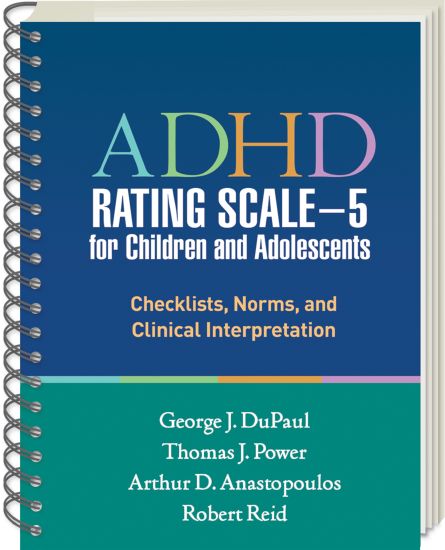
ADHD Rating Scale—5 for Children and Adolescents

ADHD Rating Scale—5 for Children and Adolescents

George J. DuPaul; Thomas J. Power; Arthur D. Anastopoulos; Robert Reid

Guilford Press
2016
nidottu
Grounded in more than 20 years of research, this valid, reliable, easy-to-administer instrument is widely used by mental health, educational, and medical practitioners in screening, diagnosis, and treatment evaluation. Parent questionnaires on home behaviors (English and Spanish) and teacher questionnaires on classroom behaviors are keyed to DSM-5 diagnostic criteria for attention-deficit/hyperactivity disorder (ADHD). Each scale takes just 5 minutes to complete and comes in both a child (5-10) and adolescent (11-17) version, with developmentally appropriate symptom descriptions. Complete instructions are provided for scoring and interpretation, including separate scoring profiles for symptoms and impairments in boys and girls.New to This Edition: *Updated for DSM-5. *Separate adolescent versions of both home and school rating scales. *Includes functional impairment items linked to each symptom dimension (inattention symptoms and hyperactive-impulsive symptoms). *Full analysis of the revised scale's psychometric properties.QUICK VIEWWhat does it do?: Quickly determines the frequency and severity of ADHD symptoms and impairments.Age Range: 5-17Administration Time: 5 minutes for each scale.Format: Parent-report and teacher-report rating scales (includes parent forms in English and Spanish).Cost of Additional Forms: No cost--purchasers get permission to reproduce the forms and score sheets for repeated use.Includes Permission to Photocopy: Enhancing the convenience and value of the [ital]ADHD Rating Scale-5[/ital], the limited duplication license allows individual purchasers to reproduce the forms and score sheets for use with their clients or patients, yielding considerable cost savings over other available scales. The large format and sturdy wire binding facilitate photocopying.Age range: 5-17.Rating Scales and Scoring Sheets ADHD Rating Scale-5, Home Version: Child (English) ADHD Rating Scale-5, Home Version: Adolescent (English) ADHD Rating Scale-5, Home Version: Child (Spanish) ADHD Rating Scale-5, Home Version: Adolescent (Spanish) ADHD Rating Scale-5, Home Version: Symptom Scoring Sheet for Boys ADHD Rating Scale-5, Home Version: Symptom Scoring Sheet for Girls ADHD Rating Scale-5, Home Version: Impairment Scoring Sheet for Boys ADHD Rating Scale-5, Home Version: Impairment Scoring Sheet for Girls ADHD Rating Scale-5, School Version: Child ADHD Rating Scale-5, School Version: Adolescent ADHD Rating Scale-5, School Version: Symptom Scoring Sheet for Boys ADHD Rating Scale-5, School Version: Symptom Scoring Sheet for Girls ADHD Rating Scale-5, School Version: Impairment Scoring Sheet for Boys ADHD Rating Scale-5, School Version: Impairment Scoring Sheet for Girls Visit the publisher's website (www.guilford.com/p/dupaul2) for technical information.
CBT für College-Studenten mit ADHD

CBT für College-Studenten mit ADHD

Arthur D. Anastopoulos; Joshua M. Langberg; Laura Hennis Besecker; Laura D. Eddy

Springer International Publishing AG
2023
nidottu
Dieses Buch bietet einen Überblick über das ACCESS-Programm, ein Programm für die psychische Gesundheit, das als wirksame Behandlung für Studenten mit ADHS entwickelt und getestet wurde. Dieses Programm ist auf dem neuesten Stand der klinischen Forschung und beinhaltet Behandlungsstrategien, die eine Verbreitung in realen Umgebungen ermöglichen, um College-Studenten, die Schwierigkeiten in ihrem akademischen, persönlichen, sozialen und emotionalen Funktionieren haben, wirksam zu unterstützen. Da sich kognitiv-behaviorale Ansätze als die bisher erfolgreichsten psychologischen Behandlungen erwiesen haben, folgen die Techniken in diesem Band diesem Modell auf detaillierte und nuancierte Weise. Die Autoren bieten eine wochenweise Aufschlüsselung des Programms, ergänzt durch Handouts und Arbeitsblätter, die ein besseres Verständnis der vom Programm angesprochenen Bereiche ermöglichen. CBT for College Students with ADHD füllt eine bemerkenswerte Forschungslücke in Bezug auf ADHS-Studentenund ist eine wichtige Ressource für Psychotherapeuten auf dem Campus sowie für ein breites Spektrum von Ärzten, die mit jungen Erwachsenen arbeiten.
CBT for College Students with ADHD

CBT for College Students with ADHD

Arthur D. Anastopoulos; Joshua M. Langberg; Laura Hennis Besecker; Laura D. Eddy

Springer Nature Switzerland AG
2021
nidottu
This book provides an overview of the ACCESS program, a mental health program that has been developed and tested as an efficacious treatment for college students with ADHD. This program is at the cutting edge of clinical research, incorporating treatment strategies that allow for dissemination in real world settings in order to effectively assist college students experiencing difficulties in their academic, personal, social, and emotional functioning. As cognitive behavioral approaches have proved to be the most successful psychological treatments to date, the techniques in this volume follow that model in a detailed and nuanced fashion. The authors provide a week by week breakdown of the program, supplemented by handouts and worksheets designed to facilitate better understanding of the areas targeted by the program. Filling a notable gap in research addressing the ADHD college student population, CBT for College Students with ADHD is a crucial resource for campus mental health practitioners as well as a broad range of clinicians dealing with emerging adults.
CBT for College Students with ADHD

CBT for College Students with ADHD

Arthur D. Anastopoulos; Joshua M. Langberg; Laura Hennis Besecker; Laura D. Eddy

Springer Nature Switzerland AG
2020
sidottu
This book provides an overview of the ACCESS program, a mental health program that has been developed and tested as an efficacious treatment for college students with ADHD. This program is at the cutting edge of clinical research, incorporating treatment strategies that allow for dissemination in real world settings in order to effectively assist college students experiencing difficulties in their academic, personal, social, and emotional functioning. As cognitive behavioral approaches have proved to be the most successful psychological treatments to date, the techniques in this volume follow that model in a detailed and nuanced fashion. The authors provide a week by week breakdown of the program, supplemented by handouts and worksheets designed to facilitate better understanding of the areas targeted by the program. Filling a notable gap in research addressing the ADHD college student population, CBT for College Students with ADHD is a crucial resource for campus mental health practitioners as well as a broad range of clinicians dealing with emerging adults.
Assessing Attention-Deficit/Hyperactivity Disorder

Assessing Attention-Deficit/Hyperactivity Disorder

Arthur D. Anastopoulos; Terri L. Shelton

Springer-Verlag New York Inc.
2013
nidottu
Over the past two decades, the assessment of Attention-Deficit/Hyperactivity Disorder (AD/HD) has evolved into a sophisticated balance of science and clinical judgement essential for arriving at reliable and valid diagnostic de- sions. Because of the precarious mix of clinical and empirical skill needed to evaluate children with this disorder, diagnostic practice in this area has been found wanting by many critics. In fact, a 1998 National Institutes of Health consensus panel concluded that “existing diagnostic treatment practices … point to the need for improved awareness by the health service sector conce- ing an appropriate assessment, treatment, and follow-up. A more consistent set of diagnostic procedures and practice guidelines is of utmost importance” (p. 21). Drs. Arthur D. Anastopoulos and Terri L. Shelton have designed a book that addresses this need. A number of themes are highlighted throughout the text. Perhaps the most important is that the assessment guidelines set forth in this book represent a balance between science and practice. The authors account for the realities of clinical practice in an age of managed care while challenging clinicians to heed the lessons of empirical research. Although the use of empirically based asse- ment procedures may at times fly in the face of cost constraints (e. g. , systematic evaluation of medication effects), the authors present a strong argument for them. Further, they call upon their vast clinical experience to provide concrete suggestions for translating research findings into effective evaluations.
Assessing Attention-Deficit/Hyperactivity Disorder

Assessing Attention-Deficit/Hyperactivity Disorder

Arthur D. Anastopoulos; Terri L. Shelton

Kluwer Academic/Plenum Publishers
2001
sidottu
Over the past two decades, the assessment of Attention-Deficit/Hyperactivity Disorder (AD/HD) has evolved into a sophisticated balance of science and clinical judgement essential for arriving at reliable and valid diagnostic de- sions. Because of the precarious mix of clinical and empirical skill needed to evaluate children with this disorder, diagnostic practice in this area has been found wanting by many critics. In fact, a 1998 National Institutes of Health consensus panel concluded that “existing diagnostic treatment practices … point to the need for improved awareness by the health service sector conce- ing an appropriate assessment, treatment, and follow-up. A more consistent set of diagnostic procedures and practice guidelines is of utmost importance” (p. 21). Drs. Arthur D. Anastopoulos and Terri L. Shelton have designed a book that addresses this need. A number of themes are highlighted throughout the text. Perhaps the most important is that the assessment guidelines set forth in this book represent a balance between science and practice. The authors account for the realities of clinical practice in an age of managed care while challenging clinicians to heed the lessons of empirical research. Although the use of empirically based asse- ment procedures may at times fly in the face of cost constraints (e. g. , systematic evaluation of medication effects), the authors present a strong argument for them. Further, they call upon their vast clinical experience to provide concrete suggestions for translating research findings into effective evaluations.