Kirjojen hintavertailu. Mukana 12 390 323 kirjaa ja 12 kauppaa.

Kirjailija

Arthur E. Martell

Kirjat ja teokset yhdessä paikassa: 4 kirjaa, julkaisuja vuosilta 1992-2013, suosituimpien joukossa Metal Complexes in Aqueous Solutions. Vertaile teosten hintoja ja tarkista saatavuus suomalaisista kirjakaupoista.

4 kirjaa

Kirjojen julkaisuhaarukka 1992-2013.

Critical Stability Constants

Critical Stability Constants

Arthur E. Martell; Robert M. Smith

Springer-Verlag New York Inc.
2013
nidottu
Over the past twenty five years the Commission on Equilibrium Data of the Analytical Division of the International Union of Pure and Applied Chemistry has been sponsoring a noncritical compilation of metal complex formation constants and related equilibrium constants. This work was extensive in scope and resulted in publication of two large volumes of Stability Constants by the Chemical Society (London). The first volume, edited by L. G. Sillen (for inorganic ligands) and by A. E. Martell (for organic ligands), was published in 1964 and covered the literature through 1962. The second volume, subtitled Supplement No. 1, edited by L. G. Sillen and E. Hogfeldt (for inorganic ligands), and A. E. Martell and R. M. Smith (for organic ligands), was published in 1971 and covered the literature up to 1969. These two large compilations attempted to cover all papers in the field related to metal complex equilibria (heats, entropies, and free energies). Most recently a noncritical compilation of organic ligands by D. D. Perrin (Pergamon Press) extended coverage of the literature through 1973 and a similar volume for inorganic ligands by E. Hogfeldt covered through 1974. Since it was the policy of the Commission during that period to avoid decisions concerning the quality and reliability of the published work, th~ compilation would frequently contain from ten to twenty values for a single equilibrium constant.
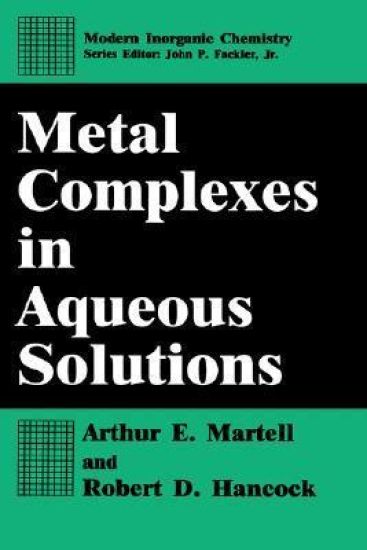
Metal Complexes in Aqueous Solutions

Metal Complexes in Aqueous Solutions

Arthur E. Martell; Robert D. Hancock

Springer-Verlag New York Inc.
2013
nidottu
Stability constants are fundamental to understanding the behavior of metal ions in aqueous solution. Such understanding is important in a wide variety of areas, such as metal ions in biology, biomedical applications, metal ions in the environment, extraction metallurgy, food chemistry, and metal ions in many industrial processes. In spite of this importance, it appears that many inorganic chemists have lost an appreciation for the importance of stability constants, and the thermodynamic aspects of complex formation, with attention focused over the last thirty years on newer areas, such as organometallic chemistry. This book is an attempt to show the richness of chemistry that can be revealed by stability constants, when measured as part of an overall strategy aimed at understanding the complexing properties of a particular ligand or metal ion. Thus, for example, there are numerous crystal structures of the Li+ ion with crown ethers. What do these indicate to us about the chemistry of Li+ with crown ethers? In fact, most of these crystal structures are in a sense misleading, in that the Li+ ion forms no complexes, or at best very weak complexes, with familiar crown ethers such as l2-crown-4, in any known solvent. Thus, without the stability constants, our understanding of the chemistry of a metal ion with any particular ligand must be regarded as incomplete. In this book we attempt to show how stability constants can reveal factors in ligand design which could not readily be deduced from any other physical technique.
Metal Complexes in Aqueous Solutions

Metal Complexes in Aqueous Solutions

Arthur E. Martell; Robert D. Hancock

Kluwer Academic/Plenum Publishers
1996
sidottu
Stability constants are fundamental to understanding the behavior of metal ions in aqueous solution. Such understanding is important in a wide variety of areas, such as metal ions in biology, biomedical applications, metal ions in the environment, extraction metallurgy, food chemistry, and metal ions in many industrial processes. In spite of this importance, it appears that many inorganic chemists have lost an appreciation for the importance of stability constants, and the thermodynamic aspects of complex formation, with attention focused over the last thirty years on newer areas, such as organometallic chemistry. This book is an attempt to show the richness of chemistry that can be revealed by stability constants, when measured as part of an overall strategy aimed at understanding the complexing properties of a particular ligand or metal ion. Thus, for example, there are numerous crystal structures of the Li+ ion with crown ethers. What do these indicate to us about the chemistry of Li+ with crown ethers? In fact, most of these crystal structures are in a sense misleading, in that the Li+ ion forms no complexes, or at best very weak complexes, with familiar crown ethers such as l2-crown-4, in any known solvent. Thus, without the stability constants, our understanding of the chemistry of a metal ion with any particular ligand must be regarded as incomplete. In this book we attempt to show how stability constants can reveal factors in ligand design which could not readily be deduced from any other physical technique.
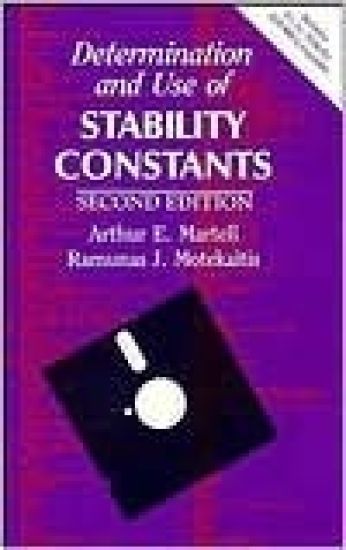
Determination and Use of Stability Constants

Determination and Use of Stability Constants

Arthur E. Martell; Ramunas J. Motekaitis

John Wiley Sons Inc
1992
sidottu
This book describes potentiometric methods for determining stability constants and explains how these constants can be used to describe metal ion speciation in complex environmental and biological systems. It also provides three original computer programs on a disk for calculating stability constants and for using stability constants to calculate concentrations of molecular species in solution. The author gives examples of calculations for simple metal chelates, for metal complexes of large organic molecules, and for mixtures containing several metal ions and complexing agents in aqueous solution. They also describe common errors in calculating stability constants and how to avoid them. This carefully revised second edition is now even more useful to the reader, and, in particular, to those who make use of the program disk. Each program has been revised to improve speed, control, and error trapping.