Kirjojen hintavertailu. Mukana 12 390 323 kirjaa ja 12 kauppaa.

Kirjailija

Arthur I. Miller

Kirjat ja teokset yhdessä paikassa: 5 kirjaa, julkaisuja vuosilta 1997-2020, suosituimpien joukossa The Artist in the Machine. Vertaile teosten hintoja ja tarkista saatavuus suomalaisista kirjakaupoista.

5 kirjaa

Kirjojen julkaisuhaarukka 1997-2020.

The Artist in the Machine

The Artist in the Machine

Arthur I. Miller

MIT Press
2020
nidottu
An authority on creativity introduces us to AI-powered computers that are creating art, literature, and music that may well surpass the creations of humans.Today's computers are composing music that sounds “more Bach than Bach,” turning photographs into paintings in the style of Van Gogh's Starry Night, and even writing screenplays. But are computers truly creative—or are they merely tools to be used by musicians, artists, and writers? In this book, Arthur I. Miller takes us on a tour of creativity in the age of machines. Miller, an authority on creativity, identifies the key factors essential to the creative process, from “the need for introspection” to “the ability to discover the key problem.” He talks to people on the cutting edge of artificial intelligence, encountering computers that mimic the brain and machines that have defeated champions in chess, Jeopardy!, and Go. In the central part of the book, Miller explores the riches of computer-created art, introducing us to artists and computer scientists who have, among much else, unleashed an artificial neural network to create a nightmarish, multi-eyed dog-cat; taught AI to imagine; developed a robot that paints; created algorithms for poetry; and produced the world's first computer-composed musical, Beyond the Fence, staged by Android Lloyd Webber and friends.But, Miller writes, in order to be truly creative, machines will need to step into the world. He probes the nature of consciousness and speaks to researchers trying to develop emotions and consciousness in computers. Miller argues that computers can already be as creative as humans—and someday will surpass us. But this is not a dystopian account; Miller celebrates the creative possibilities of artificial intelligence in art, music, and literature.
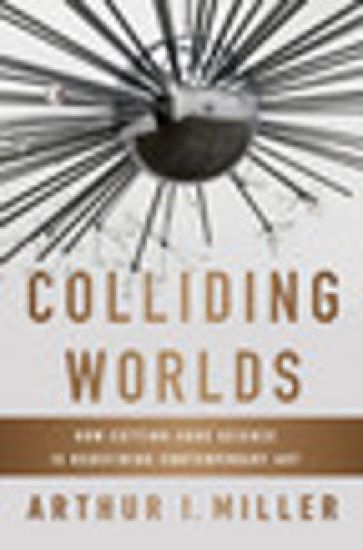
Colliding Worlds

Colliding Worlds

Arthur I. Miller

WW Norton Co
2014
sidottu
In recent decades, an exciting new art movement has emerged in which artists utilize and illuminate the latest advances in science. Some of their provocative creations—a live rabbit implanted with the fluorescent gene of a jellyfish, a gigantic glass-and-chrome sculpture of the Big Bang (pictured on the cover)—can be seen in traditional art museums and magazines, while others are being made by leading designers at Pixar, Google’s Creative Lab, and the MIT Media Lab. In Colliding Worlds, Arthur I. Miller takes readers on a wild journey to explore this new frontier. Miller, the author of Einstein, Picasso and other celebrated books on science and creativity, traces the movement from its seeds a century ago—when Einstein’s theory of relativity helped shape the thinking of the Cubists—to its flowering today. Through interviews with innovative thinkers and artists across disciplines, Miller shows with verve and clarity how discoveries in biotechnology, cosmology, quantum physics, and beyond are animating the work of designers like Neri Oxman, musicians like David Toop, and the artists-in-residence at CERN’s Large Hadron Collider. From NanoArt to Big Data, Miller reveals the extraordinary possibilities when art and science collide.
Insights of Genius

Insights of Genius

Arthur I. Miller

Copernicus Books
2013
nidottu
Since the Enlightenment, science has been seen as an objective, true method of explanation about the physical and mathematical laws that explain and govern the universe. The 20th Century has shown that science is also a human enterprise, informed by idealogy and other assumptions. In this book, distinguished historian and philosopher of science Arthur Miller examines these and other important questions about what and how we know about the world. Dr. Miller also discusses, in non-technical language, our current ideas about the nature of scientific thought and explanation, its relation to truth, and the relationship between scientific and common sense. Does science, in its historical claim as an exalted endeavor, stand above other human activities?
137

137

Arthur I. Miller

WW Norton Co
2010
nidottu
Is there a number at the root of the universe? A primal number that everything in the world hinges on? This question exercised many great minds of the twentieth century, among them the groundbreaking physicist Wolfgang Pauli and the famous psychoanalyst Carl Jung. Their obsession with the power of certain numbers—including 137, which describes the atom’s fine-structure constant and has great Kabbalistic significance—led them to develop an unlikely friendship and to embark on a joint mystical quest reaching deep into medieval alchemy, dream interpretation, and the Chinese Book of Changes. 137 explores the profound intersection of modern science with the occult, but above all it is the tale of an extraordinary, fruitful friendship between two of the greatest thinkers of our times. Originally published in hardcover as Deciphering the Cosmic Number.
Albert Einstein’s Special Theory of Relativity

Albert Einstein’s Special Theory of Relativity

Arthur I. Miller

Springer-Verlag New York Inc.
1997
nidottu
This book analyzes one of the three great papers Einstein published in 1905, each of which would alter forever the field it dealt with. The second of these papers, "On the Electrodynamics of Moving Bodies," had an impact in a much broader field than electrodynamics: it established what Einstein sometimes referred to (after 1906) as the "so-called Theory of Relativity." Miller uses the paper to provide a window into the intense intellectual struggles of physicists in the first decade of the 20th century: the interplay between physical theory and empirical data, the fiercely held notions that could not be articulated clearly or verified experimentally, the great intellectual investment in existing theories, data, and interpretations -- and associated intellectual inertia -- and the drive to the long-sought- for unification of the sciences. Since its original publication, this book has become a standard reference and sourcebook for the history and philosophy of science; however, it can equally well serve as a text in the history of ideas or of twentieth-century philosophy. From reviews of the previous edition: ÄMillerÜ has written a superb, perhaps definitive, historical study of Einstein's special theory of relativity.... One comes away from the book with a respect for both the creative genius of the man and his nerve: he simply brushed aside much of the work that was going on around him. - The New Yorker