Kirjojen hintavertailu. Mukana 12 247 736 kirjaa ja 12 kauppaa.

Kirjailija

Arthur J. Dyck

Kirjat ja teokset yhdessä paikassa: 5 kirjaa, julkaisuja vuosilta 2001-2020, suosituimpien joukossa When Killing is Wrong: Physician-Assisted Suicide and the Courts. Vertaile teosten hintoja ja tarkista saatavuus suomalaisista kirjakaupoista.

5 kirjaa

Kirjojen julkaisuhaarukka 2001-2020.

Achieving Justice in the U.S. Healthcare System

Achieving Justice in the U.S. Healthcare System

Arthur J. Dyck

Springer Nature Switzerland AG
2020
nidottu
This book focuses on justice and its demands in the way of providing people with medical care. Building on recent insights on the nature of moral perceptions and motivations from the neurosciences, it makes a case for the traditional medical ethic and examines its financial feasibility. The book starts out by giving an account of the concept of justice and tracing it back to the practices and tenets of Hippocrates and his followers, while taking into account findings from the neurosciences. Next, it considers whether the claim that it is just to limit medical care for everyone to some basic minimum is justifiable. The book then addresses finances and expenditures of the US health care system and shows that the growth of expenditures and the percentage of the gross national product spent on health care make for an unsustainable trajectory. In light of the question what should be changed, the book suggests that overdiagnosis and medicalizing normal behavior lead to harmful, costly andunnecessary interventions and are the result of unethical behavior on the part of the pharmaceutical industry and extensive ethical failures of the FDA. The book ends with suggestions about what can be done to put the U.S. health care system on the path to sustainability, better medical care, and compliance with the demands of justice.
Achieving Justice in the U.S. Healthcare System

Achieving Justice in the U.S. Healthcare System

Arthur J. Dyck

Springer Nature Switzerland AG
2019
sidottu
This book focuses on justice and its demands in the way of providing people with medical care. Building on recent insights on the nature of moral perceptions and motivations from the neurosciences, it makes a case for the traditional medical ethic and examines its financial feasibility. The book starts out by giving an account of the concept of justice and tracing it back to the practices and tenets of Hippocrates and his followers, while taking into account findings from the neurosciences. Next, it considers whether the claim that it is just to limit medical care for everyone to some basic minimum is justifiable. The book then addresses finances and expenditures of the US health care system and shows that the growth of expenditures and the percentage of the gross national product spent on health care make for an unsustainable trajectory. In light of the question what should be changed, the book suggests that overdiagnosis and medicalizing normal behavior lead to harmful, costly andunnecessary interventions and are the result of unethical behavior on the part of the pharmaceutical industry and extensive ethical failures of the FDA. The book ends with suggestions about what can be done to put the U.S. health care system on the path to sustainability, better medical care, and compliance with the demands of justice.
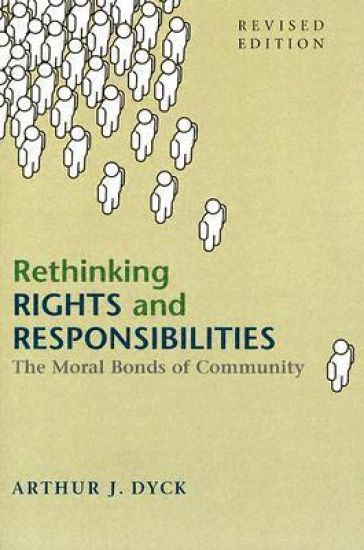
Rethinking Rights and Responsibilities

Rethinking Rights and Responsibilities

Arthur J. Dyck

Georgetown University Press
2005
pokkari
As members of various and often conflicting communities, how do we reconcile what we have come to understand as our human rights with our responsibilities toward one another? With the bright thread of individualism woven through the American psyche, where can our sense of duty toward others be found? What has happened to our love - even our concern - for our neighbor? In this revised edition of his magisterial exploration of these critical questions, renowned ethicist Arthur Dyck revisits and profoundly hones his call for the moral bonds of community. In all areas of contemporary life, be it in business, politics, health care, religion - and even in family relationships - the "right" of individuals to consider themselves first has taken precedence over our responsibilities toward others. Dyck contends that we must recast the language of rights to take into account our once natural obligations to all the communities of which we are a part. Rethinking Rights and Responsibilities, at the nexus of ethics, political theory, public policy, and law, traces how the peculiarly American formulations of the rights of the individual have assaulted our connections with, and responsibilities for, those around us. Dyck critically examines contemporary society and the relationship between responsibilities and rights, particularly as they are expressed in medicine and health care, to maintain that while indeed rights and responsibilities form the moral bonds of community, we must begin with the rudimentary task of taking better care of one another.
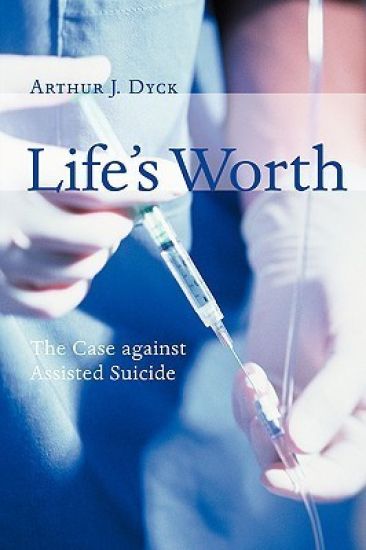
Life's Worth

Life's Worth

Arthur J. Dyck

William B Eerdmans Publishing Co
2002
pokkari
Today there is growing acceptance of the idea of physician-assisted suicide. Even Christians are beginning to factor the possibility into their ethical understandings. Would it not be compassionate to acquiesce in a terminally ill patient's request to end it all? This sentiment seems reasonable, even humane. But as Harvard ethicist Arthur J. Dyck shows in this powerful work, there are solid moral and practical bases for the existing laws against assisted suicide in the United States and elsewhere. Over the course of four interconnected, tightly reasoned arguments, Dyck takes readers from a basic concern for human suffering -- the main focus of those who support assisted suicide -- to the deeper truths of life's inherent worth. Dyck begins by examining the arguments of some physicians, moral philosophers, and theologians for making assisted suicide available. He also discusses the alternative practice of comfort-only care, explaining why it differs morally from assisted suicide and euthanasia.Dyck then explores and defends the moral structure underlying the West's long tradition of homicide law as well as current law against assisted suicide and euthanasia -- laws designed to protect both freedom and human life. Finally, Dyck shows that the moral structure undergirding our system of law is compatible with the views of Christianity, and he points to certain Christian beliefs that provide comfort and hope to those who are suffering, dying, or experiencing the death of loved ones. Throughout the book, Dyck staunchly maintains that assisted suicide is unacceptable in any and all circumstances. The practice denies terminally ill patients the possibility of recovery and robs them ofthe chance to rethink the meaning of their lives or to achieve spiritual growth. Furthermore, because it undermines the shared moral structure that makes community possible, assisted suicide bodes ill for society as a whole. "Life's Worth" is a must-read for anyone grappling with this hotly debated issue.