Kirjojen hintavertailu. Mukana 12 595 353 kirjaa ja 12 kauppaa.
Kirjailija
Arthur L. Caplan
Kirjat ja teokset yhdessä paikassa: 14 kirjaa, julkaisuja vuosilta 1985-2023, suosituimpien joukossa Compelled Compassion. Vertaile teosten hintoja ja tarkista saatavuus suomalaisista kirjakaupoista.
In April 1982, an infant boy was born in Bloomington, Indiana, with Down syndrome and a defective, but surgically correctable, esophagus. His parents refused to consent to surgery or intravenous feeding. The hospital unsuccessfully sought a court order to force treatment, and appeals to higher courts also failed. The child, identified as Baby Doe by the news media, subsequently died. The events in Bloomington became the catalyst for action by the Reagan administration, the courts, and Congress that culminated in a federal policy that makes failure to treat newborns with disabilities a form of child neglect. This book centers on the public policy aspects of withholding treatment from critically ill newborns who are disabled. Specifically, it deals with why the policy was enacted and what impact it has had on health care workers, families, and infants. Some of the contributors to this book spearheaded the early debate on withholding treatment. Anthony Shaw's New York Times Magazine article in 1972 was the first to address these issues in the popular press. The following year, he published a related article in the New England Journal of Medicine. Also appearing in this same issue of NEJM, was the pathbreaking study, coauthored by A. G. M. Campbell, on withholding treatment in the special care nursery at Yale-New Haven Hospital. Each of these articles promoted much public and professional discussion.
Arthur L. Caplan It is commonly said, especially when the subject is assisted reproduction, that medical technology has out stripped our morality. Yet, as the essays in this volume make clear, that is not an accurate assessment of the situ ation. Medical technology has not overwhelmed our moral ity. It would be more accurate to say that our society has not yet achieved consensus about the complex ethical iss ues that arise when medicine tries to assist those who seek its services in order to reproduce. Nevertheless, there is no shortage of ethical opinion about what we ought to do with respect to the use of surrogate mothers, in vitro fertil ization, embryo transfer, artificial insemination, or fertil ity drugs. Nor is it entirely accurate to describe assisted repro duction as technology. The term "technology" carries with it connotations of machines buzzing and technicians scurrying about trying to control a vast array of equip ment. Yet, most of the methods used to assist reproduc tion that are discussed in this volume do not involve exotic technologies or complicated hardware. It is technique, more than technology, that dominates the field of assisted reproduction. Efforts to help the infertile by means of the manipu lation of human reproductive materials and organs date 1 2 Caplan back at least to Biblical times. Human beings have en gaged in all manner of sexual practices and manipulations in attempts to achieve reproduction when nature has balked at allowing life to begin.
In these 25 true stories, a widely published philosopher recounts 60 years of interaction with people in all walks of life – some extremely famous, others complete strangers – from hospitals to restaurants, concert halls to airplanes, in private conversations and nationally broadcast interviews. Stories can be heartbreaking, distracting, funny, shocking, inspiring, revealing, and sometimes unforgettable – and all those attributes appear here. There’s no substitute for learning what it’s like to be someone else, to see the world as that other person does and reconsider our own views in light of that learning. These compelling and accessible stories motivate and enable us to do that, illuminating the unexpected relationships among all domains of human concern, the wellsprings of creativity, the elusive character of good judgment, and the pathways to social justice. They help us see more clearly what we care most about: deep features of human character and difficult choices, of social structures, of the power of imagination, of how to take account of the importance of what cannot be counted, and of bogus boundaries and assumptions that can repress clear thinking in any domain. These stories will make the reader more powerful in service of those values.
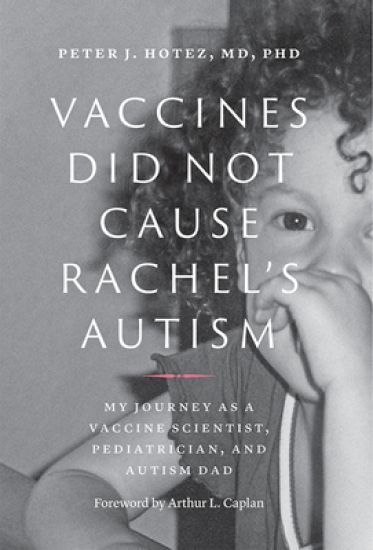
Internationally renowned medical scientist, frequent media contributor, and autism dad Dr. Peter J. Hotez explains why vaccines do not cause autism.In 1994, Peter J. Hotez's nineteen-month-old daughter, Rachel, was diagnosed with autism. Dr. Hotez, a pediatrician-scientist who develops vaccines for neglected tropical diseases affecting the world's poorest people, became troubled by the decades-long rise of the influential anti-vaccine community and its inescapable narrative around childhood vaccines and autism. In Vaccines Did Not Cause Rachel's Autism, Hotez draws on his experiences as a pediatrician, vaccine scientist, and father of an autistic child. Outlining the arguments on both sides of the debate, he examines the science that refutes the concerns of the anti-vaccine movement, debunks current conspiracy theories alleging a cover-up by the Centers for Disease Control and Prevention, and critiques the scientific community's failure to effectively communicate the facts about vaccines and autism to the general public, all while sharing his very personal story of raising a now-adult daughter with autism.A uniquely authoritative account, this important book persuasively provides evidence for the genetic basis of autism and illustrates how the neurodevelopmental pathways of autism are under way before birth. Dr. Hotez reminds readers of the many victories of vaccines over disease while warning about the growing dangers of the anti-vaccine movement, especially in the United States and Europe. Now, with the anti-vaccine movement reenergized in our COVID-19 era, this book is especially timely. Vaccines Did Not Cause Rachel's Autism is a must-read for parent groups, child advocates, teachers, health-care providers, government policymakers, health and science policy experts, and anyone caring for a family member or friend with autism."When Peter Hotez—an erudite, highly trained scientist who is a true hero for his work in saving the world's poor and downtrodden—shares his knowledge and clinical insights along with his parental experience, when his beliefs in the value of what he does are put to the test of a life guiding his own child's challenges, then you must pay attention. You should. This book brings to an end the link between autism and vaccination."—from the foreword by Arthur L. Caplan, NYU School of Medicine
Genetic counseling is fairly new. The fact that the field is an accepted professional enterprise in universities, clinics, and hospitals throughout the United States is remarkable. The contributors argue that genetics and medicine rest on beliefs widely held in American society. Scientific progress is good, and highly sophisticated technologies are appropriate means to solving medical problems. The better understanding they gain about the nature and evolution of disease, the more prepared clinicians will be to treat and prevent future occurrence of disease. A belief that medicine, including genetic medicine, is clear, factually based, and objective undergirds the strategies and norms of genetic counseling. This collection of original papers explores the history, values, and norms of that process, with focus on the value of non-directiveness in counseling practice. The contributors' examination of genetic counseling issues serves as a foundation from which to address the ethical, legal, and policy considerations of clinical genetics.
Arthur L. Caplan It is commonly said, especially when the subject is assisted reproduction, that medical technology has out stripped our morality. Yet, as the essays in this volume make clear, that is not an accurate assessment of the situ ation. Medical technology has not overwhelmed our moral ity. It would be more accurate to say that our society has not yet achieved consensus about the complex ethical iss ues that arise when medicine tries to assist those who seek its services in order to reproduce. Nevertheless, there is no shortage of ethical opinion about what we ought to do with respect to the use of surrogate mothers, in vitro fertil ization, embryo transfer, artificial insemination, or fertil ity drugs. Nor is it entirely accurate to describe assisted repro duction as technology. The term "technology" carries with it connotations of machines buzzing and technicians scurrying about trying to control a vast array of equip ment. Yet, most of the methods used to assist reproduc tion that are discussed in this volume do not involve exotic technologies or complicated hardware. It is technique, more than technology, that dominates the field of assisted reproduction. Efforts to help the infertile by means of the manipu lation of human reproductive materials and organs date 1 2 Caplan back at least to Biblical times. Human beings have en gaged in all manner of sexual practices and manipulations in attempts to achieve reproduction when nature has balked at allowing life to begin.
In When Medicine Went Mad, one of the nation's leading bioethicists-and an extraordinary panel of experts and concentration camp survivors-examine problems first raised by Nazi medical experimentation that remain difficult and relevant even today. The importance of these issues to contemporary bioethical disputes-particularly in the thorny areas of medical genetics, human experimentation, and euthanasia-are explored in detail and with sensitivity.
The fate of seriously ill newborns has captured the atten tion of the public, of national and state legislators, and of powerful interest groups. For the most part, the debate has been cast in the narrowest possible terms: "discrimination against the handicapped"; "physician authority"; "family autonomy." We believe that something much more profound is happening: the debate over the care of sick and dying babies appears to be both a manifestation of great changes in our feelings about infants, children, and families, and a reflection of deep and abiding attitudes toward the newborn, the handi capped, and perhaps other humans who are "less than" nor mal, rational adults. How could we cast some light on those feelings and attitudes that seemed to determine silently the course of the public debate? We chose to enlist the humanities-the dis players and critics of our cultural forms. Rather than closing down the public discussion, we wanted to open it up, to illuminate it with the light of history, religion, philosophy, literature, jurisprudence, and humanistically oriented sociol ogy. This book is a first effort to place the hotly contested Baby Doe debate into a broader cultural context.
Genetic counseling is fairly new. The fact that the field is an accepted professional enterprise in universities, clinics, and hospitals throughout the United States is remarkable. The contributors argue that genetics and medicine rest on beliefs widely held in American society. Scientific progress is good, and highly sophisticated technologies are appropriate means to solving medical problems. The better understanding they gain about the nature and evolution of disease, the more prepared clinicians will be to treat and prevent future occurrence of disease. A belief that medicine, including genetic medicine, is clear, factually based, and objective undergirds the strategies and norms of genetic counseling. This collection of original papers explores the history, values, and norms of that process, with focus on the value of non-directiveness in counseling practice. The contributors' examination of genetic counseling issues serves as a foundation from which to address the ethical, legal, and policy considerations of clinical genetics.
If scientists can successfully clone sheep, will humans be next? Today's headlines read like a science fiction novel! Due Consideration takes a poignant look at the rapidly changing field of biomedicine and the consequences it will have on our lives. Arthur Caplan, one of this nation's leading bioethicists, explores these issues and analyzes moral questions including: * Will we retain our essential humanity if we modify our biological blueprint? * Would it be irresponsible to procreate without a thorough genetic examination? * Who will decide if physical traits like short stature and baldness are considered diseases? * Can biomedicine make our lives better? You'll also learn about the most current and controversial topics such as: * Cloning, abortion and assisted suicide. * Genetically engineering a human to be immune from infectious diseases. * The ability to "design" our children from head to toe. * Diagnosing and treating illnesses during fetal development. * Programs to prevent the transmission of HIV. No other book on the market today combines this analytic clarity with the latest from medical journals and media headlines. Now, you can decide for yourself what the future ought to hold in store.
"An important contribution to a debate that will continue for some time." —Health and Canadian Society "Insightful and thought-provoking. . . . As Caplan has demonstrated so clearly . . . we would all be better off if the ethicists spoke first and not last." —The Washington Post "Caplan's views are important and instructive. . . . [This] book represents some of his best work." —New England Journal of Medicine "Caplan's [book] is thought provoking, insightful, and well argued. I recommend it highly." —The Journal of the American Medical Association " . . . a generously illustrated discourse on method in medical and practical ethics." —Ethics A member of the President's Task Force on National Health Care Reform examines some of the most controversial biomedical issues of our time.
In When Medicine Went Mad, one of the nation's leading bioethicists-and an extraordinary panel of experts and concentration camp survivors-examine problems first raised by Nazi medical experimentation that remain difficult and relevant even today. The importance of these issues to contemporary bioethical disputes-particularly in the thorny areas of medical genetics, human experimentation, and euthanasia-are explored in detail and with sensitivity.
The fate of seriously ill newborns has captured the atten tion of the public, of national and state legislators, and of powerful interest groups. For the most part, the debate has been cast in the narrowest possible terms: "discrimination against the handicapped"; "physician authority"; "family autonomy." We believe that something much more profound is happening: the debate over the care of sick and dying babies appears to be both a manifestation of great changes in our feelings about infants, children, and families, and a reflection of deep and abiding attitudes toward the newborn, the handi capped, and perhaps other humans who are "less than" nor mal, rational adults. How could we cast some light on those feelings and attitudes that seemed to determine silently the course of the public debate? We chose to enlist the humanities-the dis players and critics of our cultural forms. Rather than closing down the public discussion, we wanted to open it up, to illuminate it with the light of history, religion, philosophy, literature, jurisprudence, and humanistically oriented sociol ogy. This book is a first effort to place the hotly contested Baby Doe debate into a broader cultural context.