Kirjojen hintavertailu. Mukana 12 256 917 kirjaa ja 12 kauppaa.

Kirjailija

Arvind Panagariya

Kirjat ja teokset yhdessä paikassa: 9 kirjaa, julkaisuja vuosilta 1998-2024, suosituimpien joukossa Regionalism In Trade Policy: Essays On Preferential Trading. Vertaile teosten hintoja ja tarkista saatavuus suomalaisista kirjakaupoista.

9 kirjaa

Kirjojen julkaisuhaarukka 1998-2024.

The Nehru-Era Economic History and Thought & Their Lasting Impact

The Nehru-Era Economic History and Thought & Their Lasting Impact

Arvind Panagariya

OXFORD UNIVERSITY PRESS INC
2024
sidottu
India's economic model underwent transformational change following independence in 1947. The country's first Prime Minister, Jawaharlal Nehru, embarked upon two foundational projects to build modern India: a political project aimed at establishing democracy with universal suffrage, and an economic one aimed at ending poverty. Three-quarters of a century later, his political project is a resounding success, but the opposite is true of the economic one. The Nehru-Era Economic History and Thought & Their Lasting Impact examines the evolution of Nehru's economic philosophy with socialism, self-sufficiency, and heavy-industry development at its core. Through extensive archival research, Arvind Panagariya reconstructs and reinterprets this history, paying particular attention to the administrative processes deployed to implement policies, contemporary economic thought, and important historical events not adequately covered in the existing literature. He assesses the evolution of Nehru's own political beliefs and the construction of the Nehru development model, the resulting regime and exclusionary nature of economic growth, and the lasting intellectual legacy of the Nehru-era socialism on politicians, civil servants, policy analysts, and businesspeople in the six decades since Nehru's death. This book is the fascinating tale of a model with the near-unanimous approval of experts from all around the world at its inception and the impact of its failure.
New India

New India

Arvind Panagariya

Oxford University Press Inc
2020
sidottu
With a GDP that just reached $2.6 trillion, India is poised to become the world's third largest economy in less than a decade. In doing so, it will have moved one step closer to reclaiming its pre-industrial glory when it accounted for one-sixth of the global output and ranked second in economic size. This rapid movement in the absolute size of the economy will be insufficient, however, to bring prosperity to India's vast population. Today, 44% of the country's workforce remains in agriculture and another 42% in small enterprises with fewer than twenty workers. Labor productivity of both sets of workers remains low and they live overwhelmingly on subsistence-level incomes. In New India: Reclaiming the Lost Glory, Arvind Panagariya outlines a concise strategy to transform India from a primarily rural and agricultural economy to an urban and industrial economy with well-paid jobs for those with limited skills. Panagariya argues that the creation of good jobs requires the emergence of medium and large enterprises in industry and services, especially labor-intensive sectors such as apparel, footwear, and other light manufactures. He explains that India needs policies conducive to the growth of firms from small to medium, medium to large, and large to larger still. Such policies include greater outward orientation; more flexible land, labor, and capital markets; concerted effort to improve the quality of higher education; faster urbanization; and improved governance at all levels. Written by a preeminent authority on the Indian economy, New India: Reclaiming the Lost Glory provides a data-driven and persuasive roadmap for India to eliminate abject poverty, accelerate economic growth, and return to its historically prominent position in the global economy.
Free Trade and Prosperity

Free Trade and Prosperity

Arvind Panagariya

Oxford University Press Inc
2019
sidottu
Arguments for protection and against free trade have seen a revival in developed countries such as the United States and Great Britain as well as developing countries such as India. Given the clear benefits trade openness has brought everywhere, this is a surprising development. The benefits of free trade are especially great for emerging market economies. FreeTrade and Prosperityoffers the first full-scale defense of pro-free-trade policies with developing countries at its center. Arvind Panagariya, a professor at Columbia University and former top economic advisor to the government of India, supplies a historically informed analysis of many longstanding but flawed arguments for protection. He starts with an insightful overview of the positive case for free trade, and then closely examines the various contentions of protectionists. One protectionist argument is that "infant" industries need time to grow and become competitive, and thus should be sheltered. Other arguments are that emerging markets are especially prone to coordination failures, they are in need of diversification of their production structures, and they suffer from market imperfections. The panoply of protectionist arguments, including those for import substitution industrialization, fails when subject to close logical and empirical scrutiny. Free trade and outward-oriented policies are preconditions to both sustained rapid growth and poverty alleviation in developing countries. Panagariya provides compelling evidence demonstrating the failures of protectionism and the promise of free trade using detailed case studies of successful countries such as Singapore, Taiwan, South Korea, China and India. Low or declining barriers to free trade and high or rising shares of trade in total income have been key elements in the sustained rapid growth and poverty alleviation in these countries and many others. Free trade is like oxygen: the benefits are ubiquitous and not noticed until they are no longer there. This important book is an essential reminder of the costs of protectionism.
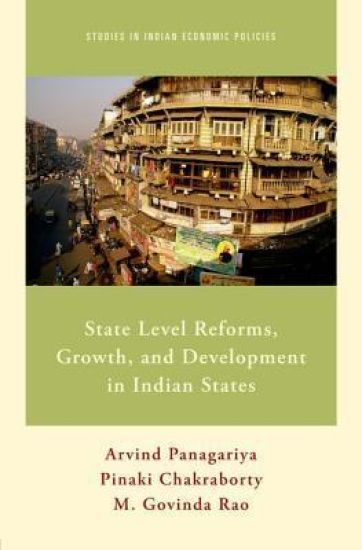
State Level Reforms, Growth, and Development in Indian States

State Level Reforms, Growth, and Development in Indian States

Arvind Panagariya; Pinaki Chakraborty; M. Govinda Rao

Oxford University Press Inc
2014
sidottu
Most discussions of India's substantive economic growth since the 1990s tend to focus on national level statistics or on particular sectors such as the financial and call service sectors or on the pharmaceutical industry. But with a population of 1.2 billion, India demands to be treated like a collection of individual "countries, " rather than a unified nation. Ten of its states have populations equaling or exceeding that of the United Kingdom. If the state of Uttar Pradesh were a country, it would be the fourth largest, behind China, India, and the United States. These facts pointedly tell us that if we are to understand the ongoing experiment in economic reforms and poverty alleviation, we must study India at the level of the state. In this spirit, State Level Reforms and Growth and Development in Indian States provides the first-ever comprehensive analysis of growth at the highly diverse state level. The authors argue that when the national government loosened its stronghold on industry and services, state governments were able to shape the fortunes of their citizens through state-level policy reforms. Because of this, every Indian state experienced accelerated growth, unlike China during the first two decades of its development when the eastern half flourished as the western half lagged. Every Indian state has grown faster in the last decade than any other decade in the post-independence era. In fact, some of the poorest states, notably Bihar and Orissa, have been growing the fastest. Professors Panagariya and Chakraborty and Dr. Rao refute the common assumptions that growth has not occurred or that poverty has not been reduced in all Indian states. The recent reforms have also led to improved access in every state to basic amenities such as permanent houses, electricity, water, and sanitation. These accomplishments notwithstanding, regional inequality on a per capita basis has grown as well. Reforms in state-controlled sectors such as agriculture, industry, healthcare, and education have not advanced as far as some analysts previously predicted. The authors outline the reforms in these areas and draw on the experience of states that have successfully carried out some of them. The authors pay special attention to reforms in the areas of education and health while recognizing that the Indian constitution vests in the states much of this legislative and other authority and while considering the real absolute rise in income, literacy, and health status across all the states.
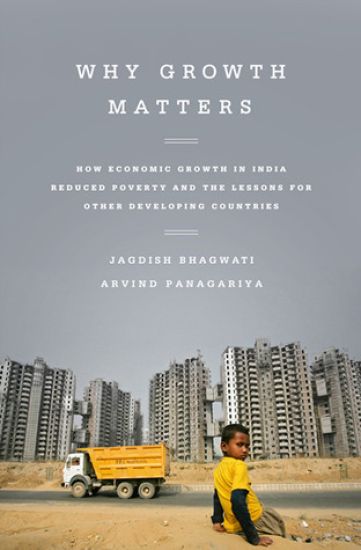
Why Growth Matters

Why Growth Matters

Arvind Panagariya; Jagdish Bhagwati

PublicAffairs,U.S.
2014
pokkari
In its history since Independence, India has seen widely different economic experiments: from Jawharlal Nehru's pragmatism to the rigid state socialism of Indira Gandhi to the brisk liberalization of the 1990s. So which strategy best addresses India's, and by extension the world's, greatest moral challenge: lifting a great number of extremely poor people out of poverty?Bhagwati and Panagariya argue forcefully that only one strategy will help the poor to any significant effect: economic growth, led by markets overseen and encouraged by liberal state policies. Their radical message has huge consequences for economists, development NGOs and anti-poverty campaigners worldwide. There are vital lessons here not only for Southeast Asia, but for Africa, Eastern Europe, and anyone who cares that the effort to eradicate poverty is more than just good intentions. If you want it to work, you need growth. With all that implies.
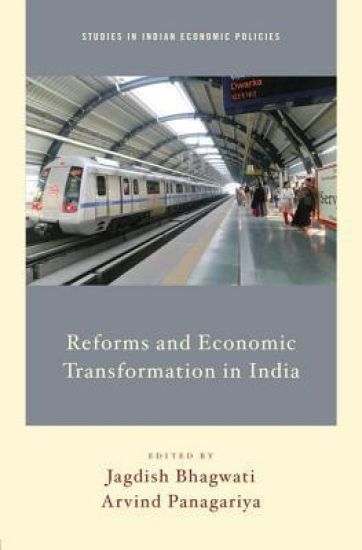
Reforms and Economic Transformation in India

Reforms and Economic Transformation in India

Jagdish Bhagwati; Arvind Panagariya

Oxford University Press Inc
2014
sidottu
Reforms and Economic Transformation in India is the second volume in the series Studies in Indian Economic Policies. The first volume, India's Reforms: How They Produced Inclusive Growth (OUP, 2012), systematically demonstrated that reforms-led growth in India led to reduced poverty among all social groups. They also led to shifts in attitudes whereby citizens overwhelmingly acknowledge the benefits that accelerated growth has brought them and as voters, they now reward the governments that deliver superior economic outcomes and punish those that fail to do so. This latest volume takes as its starting point the fact that while reforms have undoubtedly delivered in terms of poverty reduction and associated social objectives, the impact has not been as substantial as seen in other reform-oriented economies such as South Korea and Taiwan in the 1960s and 1970s, and more recently, in China. The overarching hypothesis of the volume is that the smaller reduction in poverty has been the result of slower transformation of the economy from a primarily agrarian to a modern, industrial one. Even as the GDP share of agriculture has seen rapid decline, its employment share has declined very gradually. More than half of the workforce in India still remains in agriculture. In addition, non-farm workers are overwhelmingly in the informal sector. Against this background, the nine original essays by eminent economists pursue three broad themes using firm level data in both industry and services. The papers in part I ask why the transformation in India has been slow in terms of the movement of workers out of agriculture, into industry and services, and from informal to formal employment. They address what India needs to do to speed up this transformation. They specifically show that severe labor-market distortions and policy bias against large firms has been a key factor behind the slow transformation. The papers in part II analyze the transformation that reforms have brought about within and across enterprises. For example, they investigate the impact of privatization on enterprise profitability. Part III addresses the manner in which the reforms have helped promote social transformation. Here the papers analyze the impact the reforms have had on the fortunes of the socially disadvantaged groups in terms of wage and education outcomes and as entrepreneurs.
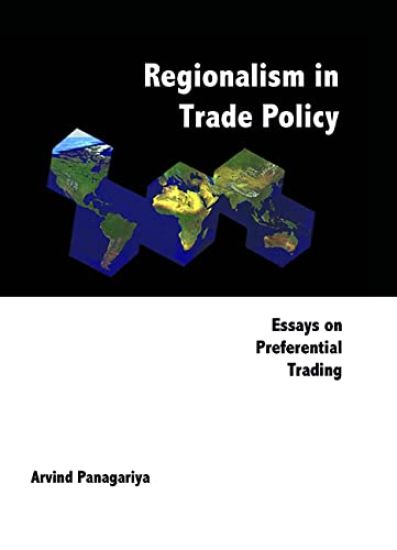
Regionalism In Trade Policy: Essays On Preferential Trading

Regionalism In Trade Policy: Essays On Preferential Trading

Arvind Panagariya

World Scientific Publishing Co Pte Ltd
1999
sidottu
The signing of the North American Free Trade Agreement (NAFTA) and recent expansions of the European Union have led to renewed efforts to create preferential trade areas (PTAs) around the world including Asia, Africa and Latin America. Because PTAs liberalize trade with union members but not the rest of the world, they are not necessarily a healthy development. By dividing the world into trade blocs, they also threaten to undermine the multilateral trading system.This collection of recently published essays by a leading critic of regionalism offers an assessment of the economic impact of PTAs on member countries and the world. The first set of essays present a theoretical analysis of the issues using simple economic models, and study the relationship between regionalism and multilateralism. Subsequent essays evaluate the role of PTAs in Asia, North America and Latin America. The general theme of the book is that, on balance, trade liberalization through PTAs is a mistake. Trade diversion, and the creation of complicated and discriminatory tariff regimes with increased tariffs for non-member countries — the consequences of PTAs — are likely to undermine the multilateral trading system.The book will be useful to academics as well as policy makers and policy analysts. Many of the essays have been featured in newspapers and journals such as the Financial Times, Economist, Journal of Commerce and International Herald Tribune. Some of these essays are already on many reading lists in the United States.
Lectures on International Trade

Lectures on International Trade

Jagdish N. Bhagwati; Arvind Panagariya; T. N. Srinivasan

MIT Press
1998
pokkari
The greatest strength of this thoroughly revised and expanded edition of Lectures on International Trade is its rigorous algebraic and geometric treatment of the various models and results of trade theory. The authors, who now include Arvind Panagariya, offer both policy insights and empirical applications. They have added nine entirely new chapters as well as new sections to several existing chapters (e.g., a greatly expanded treatment of the growing theory of preferential trade agreements).