Kirjojen hintavertailu. Mukana 12 366 687 kirjaa ja 12 kauppaa.

Kirjailija

Asef Bayat

Kirjat ja teokset yhdessä paikassa: 11 kirjaa, julkaisuja vuosilta 1991-2021, suosituimpien joukossa Revolution Without Revolutionaries. Vertaile teosten hintoja ja tarkista saatavuus suomalaisista kirjakaupoista.

11 kirjaa

Kirjojen julkaisuhaarukka 1991-2021.

Revolutionary Life

Revolutionary Life

Asef Bayat

Harvard University Press
2021
sidottu
From a leading scholar of the Middle East and North Africa comes a new way of thinking about the Arab Spring and the meaning of revolution.From the standpoint of revolutionary politics, the Arab Spring can seem like a wasted effort. In Tunisia, where the wave of protest began, as well as in Egypt and the Gulf, regime change never fully took hold. Yet if the Arab Spring failed to disrupt the structures of governments, the movement was transformative in farms, families, and factories, souks and schools.Seamlessly blending field research, on-the-ground interviews, and social theory, Asef Bayat shows how the practice of everyday life in Egypt and Tunisia was fundamentally altered by revolutionary activity. Women, young adults, the very poor, and members of the underground queer community can credit the Arab Spring with steps toward equality and freedom. There is also potential for further progress, as women’s rights in particular now occupy a firm place in public discourse, preventing retrenchment and ensuring that marginalized voices remain louder than in prerevolutionary days. In addition, the Arab Spring empowered workers: in Egypt alone, more than 700,000 farmers unionized during the years of protest. Labor activism brought about material improvements for a wide range of ordinary people and fostered new cultural and political norms that the forces of reaction cannot simply wish away.In Bayat’s telling, the Arab Spring emerges as a paradigmatic case of “refolution”—revolution that engenders reform rather than radical change. Both a detailed study and a moving appeal, Revolutionary Life identifies the social gains that were won through resistance.
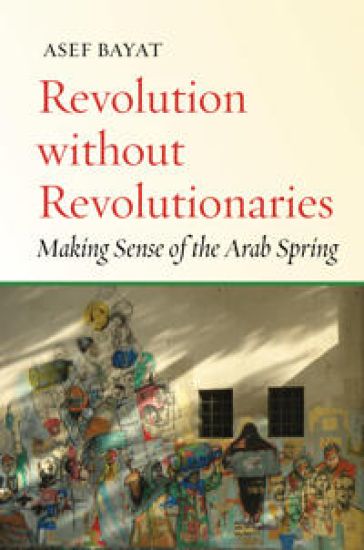
Revolution Without Revolutionaries

Revolution Without Revolutionaries

Asef Bayat

Stanford University Press
2017
pokkari
The revolutionary wave that swept the Middle East in 2011 was marked by spectacular mobilization, spreading within and between countries with extraordinary speed. Several years on, however, it has caused limited shifts in structures of power, leaving much of the old political and social order intact. In this book, noted author Asef Bayat—whose Life as Politics anticipated the Arab Spring—uncovers why this occurred, and what made these uprisings so distinct from those that came before. Revolution without Revolutionaries is both a history of the Arab Spring and a history of revolution writ broadly. Setting the 2011 uprisings side by side with the revolutions of the 1970s, particularly the Iranian Revolution, Bayat reveals a profound global shift in the nature of protest: as acceptance of neoliberal policy has spread, radical revolutionary impulses have diminished. Protestors call for reform rather than fundamental transformation. By tracing the contours and illuminating the meaning of the 2011 uprisings, Bayat gives us the book needed to explain and understand our post–Arab Spring world.
Revolution Without Revolutionaries

Revolution Without Revolutionaries

Asef Bayat

Stanford University Press
2017
sidottu
The revolutionary wave that swept the Middle East in 2011 was marked by spectacular mobilization, spreading within and between countries with extraordinary speed. Several years on, however, it has caused limited shifts in structures of power, leaving much of the old political and social order intact. In this book, noted author Asef Bayat—whose Life as Politics anticipated the Arab Spring—uncovers why this occurred, and what made these uprisings so distinct from those that came before. Revolution without Revolutionaries is both a history of the Arab Spring and a history of revolution writ broadly. Setting the 2011 uprisings side by side with the revolutions of the 1970s, particularly the Iranian Revolution, Bayat reveals a profound global shift in the nature of protest: as acceptance of neoliberal policy has spread, radical revolutionary impulses have diminished. Protestors call for reform rather than fundamental transformation. By tracing the contours and illuminating the meaning of the 2011 uprisings, Bayat gives us the book needed to explain and understand our post–Arab Spring world.
Life As Politics

Life As Politics

Asef Bayat

Stanford University Press
2013
pokkari
Prior to 2011, popular imagination perceived the Muslim Middle East as unchanging and unchangeable, frozen in its own traditions and history. In Life as Politics, Asef Bayat argues that such presumptions fail to recognize the routine, yet important, ways in which ordinary people make meaningful change through everyday actions. First published just months before the Arab Spring swept across the region, this timely and prophetic book sheds light on the ongoing acts of protest, practice, and direct daily action. The second edition includes three new chapters on the Arab Spring and Iran's Green Movement and is fully updated to reflect recent events. At heart, the book remains a study of agency in times of constraint. In addition to ongoing protests, millions of people across the Middle East are effecting transformation through the discovery and creation of new social spaces within which to make their claims heard. This eye-opening book makes an important contribution to global debates over the meaning of social movements and the dynamics of social change.
Life As Politics

Life As Politics

Asef Bayat

Stanford University Press
2013
sidottu
Prior to 2011, popular imagination perceived the Muslim Middle East as unchanging and unchangeable, frozen in its own traditions and history. In Life as Politics, Asef Bayat argues that such presumptions fail to recognize the routine, yet important, ways in which ordinary people make meaningful change through everyday actions. First published just months before the Arab Spring swept across the region, this timely and prophetic book sheds light on the ongoing acts of protest, practice, and direct daily action. The second edition includes three new chapters on the Arab Spring and Iran's Green Movement and is fully updated to reflect recent events. At heart, the book remains a study of agency in times of constraint. In addition to ongoing protests, millions of people across the Middle East are effecting transformation through the discovery and creation of new social spaces within which to make their claims heard. This eye-opening book makes an important contribution to global debates over the meaning of social movements and the dynamics of social change.
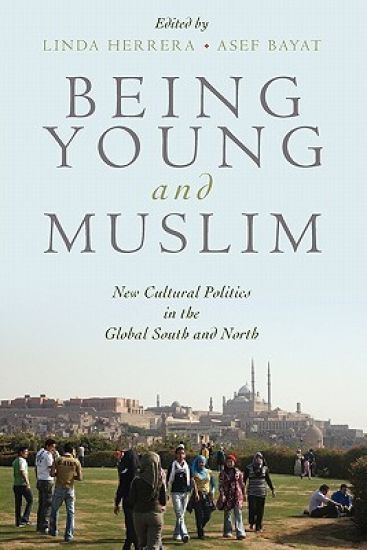
Being Young and Muslim

Being Young and Muslim

Linda Herrera; Asef Bayat

Oxford University Press Inc
2010
nidottu
"This is an excellent collection of essays on youth in a number of Muslim majority (and minority) societies in the context of globalization and modernity. A particular strength of this volume is its ability to highlight the multiple and contested roles of religion and personal faith in the fashioning of contemporary youthful Muslim identities. Such insights often challenge secular Western master narratives of modernity and suggest credible reconceptualizations of what it means to be young and modern in a broad swath of the world today." -- Asma Afsaruddin, Professor of Islamic Studies, Indiana University In recent years, there has been a proliferation of interest in youth issues and Muslim youth in particular. Young Muslims have been thrust into the global spotlight in relation to questions about security and extremism, work and migration, and rights and citizenship. This book interrogates the cultures and politics of Muslim youth in the global South and North to understand their trajectories, conditions, and choices. Drawing on wide-ranging research from Indonesia to Iran and Germany to the U.S., it shows that while the majority of young Muslims share many common social, political, and economic challenges, they exhibit remarkably diverse responses to them. Far from being "exceptional," young Muslims often have as much in common with their non-Muslim global generational counterparts as they share among themselves. As they migrate, forge networks, innovate in the arts, master the tools of new media, and assert themselves in the public sphere, Muslim youth have emerged as important cultural and political actors on a world stage.
Being Young and Muslim

Being Young and Muslim

Linda Herrera; Asef Bayat

Oxford University Press Inc
2010
sidottu
"This is an excellent collection of essays on youth in a number of Muslim majority (and minority) societies in the context of globalization and modernity. A particular strength of this volume is its ability to highlight the multiple and contested roles of religion and personal faith in the fashioning of contemporary youthful Muslim identities. Such insights often challenge secular Western master narratives of modernity and suggest credible reconceptualizations of what it means to be young and modern in a broad swath of the world today." -- Asma Afsaruddin, Professor of Islamic Studies, Indiana University In recent years, there has been a proliferation of interest in youth issues and Muslim youth in particular. Young Muslims have been thrust into the global spotlight in relation to questions about security and extremism, work and migration, and rights and citizenship. This book interrogates the cultures and politics of Muslim youth in the global South and North to understand their trajectories, conditions, and choices. Drawing on wide-ranging research from Indonesia to Iran and Germany to the U.S., it shows that while the majority of young Muslims share many common social, political, and economic challenges, they exhibit remarkably diverse responses to them. Far from being "exceptional," young Muslims often have as much in common with their non-Muslim global generational counterparts as they share among themselves. As they migrate, forge networks, innovate in the arts, master the tools of new media, and assert themselves in the public sphere, Muslim youth have emerged as important cultural and political actors on a world stage.
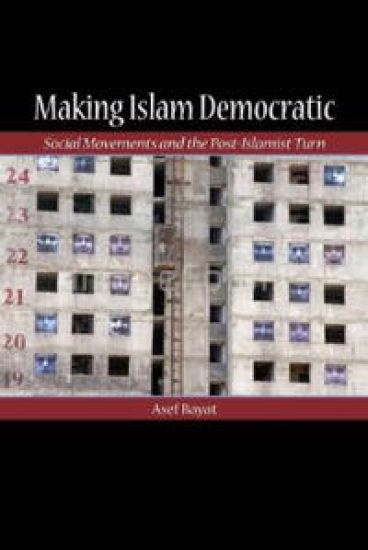
Making Islam Democratic

Making Islam Democratic

Asef Bayat

Stanford University Press
2007
pokkari
Whether Islam is compatible with democracy is an increasingly asked question, but ultimately a misguided one. In this book, Asef Bayat proposes that democratic ideals have less to do with the essence of any religion than with how it is practiced. He offers a new approach to Islam and democracy, outlining how the social struggles of student organizations, youth and women's groups, the intelligentsia, and other social movements can make Islam democratic. Making Islam Democratic examines in detail those social movements that have used religion to unleash social and political change, either to legitimize authoritarian rule or, in contrast, to construct an inclusive faith that embraces a democratic polity. It provides a fresh analysis of Iran's 1979 Islamic revolution—how it has evolved into the pervasive, post-Islamist reform movement of the early twenty-first century, and how it differed from Egypt's religious "passive revolution." Focusing on events from the Iranian Revolution to the current day, with a comparative focus on Islamism, post-Islamism, and active religious expression across the region, Bayat explores the highly contested relationship between religion, politics, and the quotidian in the Middle East. His book provides an important understanding of the great anxiety of our time—the global march of "Muslim rage"—and offers a hopeful picture of a democratic Middle East.
Islam and Democracy

Islam and Democracy

Asef Bayat

Amsterdam University Press
2007
nidottu
Is Islam compatible with democracy? The text examines one of the most frequently-asked and yet misguided questions. Democratic ethos should not and cannot be deduced from some essence of religions supposedly inscribed in the scriptures. Rather, they are the outcome of political struggles that push Islam toward democratic or authoritarian directions. Asef Bayat offers a new approach to examine Islam and democracy arguing how the social struggles of diverse Muslim populations, those with different interests and orientation, render Islam to embrace democratic ideas or authoritarian disposition. “Islamism” and “post-Islamism” are discussed as representing two contrasting movements which have taken Islam into different, authoritarian and inclusive, political directions.
Street Politics

Street Politics

Asef Bayat

Columbia University Press
1997
pokkari
In the late 1970s and throughout the 1980s, an active political movement emerged on the streets of Iran's largest cities. Poor people began to construct their own communities on unused urban lands, creating an infrastructure--roads, electricity, running water, garbage collection, and shelters--all their own. As the Iranian government attempted to evict these illegal settlers, they resisted--fiercely and ultimately successfully. This is the story of their economic and political strategies.