Kirjojen hintavertailu. Mukana 12 595 353 kirjaa ja 12 kauppaa.
Kirjailija
Ashok Kumar Yadav
Kirjat ja teokset yhdessä paikassa: 33 kirjaa, julkaisuja vuosilta 2012-2026, suosituimpien joukossa Accessibility as a Human Right in Online Retail. Vertaile teosten hintoja ja tarkista saatavuus suomalaisista kirjakaupoista.
Reimagine the future of healthcare with a deep dive into hyperscale computing and distributed networks In AI-Driven Smart Healthcare: Powered by Hyperscale Computing and Next Generation Networks, a team of distinguished researchers delivers an insightful and practical discussion of the healthcare applications of artificial intelligence and fog-enabled next-generation networks. The book provides practical insights and methodologies for the design, development, and deployment of these technologies throughout the healthcare industry. Readers will explore key areas of recent advancement, including the Internet of Things, fog computing, artificial intelligence, machine learning, serverless computing, and blockchain in a way that allows them to assess the feasibility and scalability of a variety of technological healthcare solutions. The book also includes: A thorough introduction to the integration of AI and fog computing into smart healthcare systemsComprehensive explorations of how these technologies enhance healthcare delivery, with examples like remote patient monitoring and advanced diagnostic modelsPractical discussions of the advantages, challenges, and potential solutions associated with AI and fog computingAn interdisciplinary focus for professionals working at the intersection of AI, machine learning, fog computing, and healthcare Perfect for researchers, practitioners, and other healthcare stakeholders, AI-Driven Smart Healthcare will also benefit technologists, educators, hospital administrators, and other professionals with an interest in the application of the latest technologies to recurrent and significant issues in the field of healthcare.
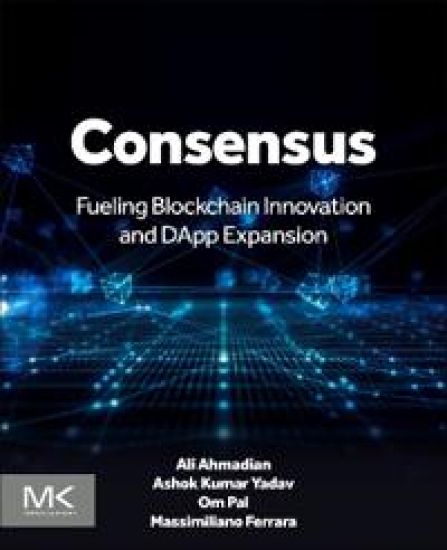
Consensus: Fueling Blockchain Innovation and DApp Expansion explores the complexities of consensus mechanisms in order to shed light on emerging trends, best practices, and real-world applications that can fuel blockchain innovation while encouraging the dissemination of DApps across various industries. Additionally, the book bridges a crucial gap in the literature by providing in-depth insights into the role of consensus mechanisms in shaping the future of blockchain technology and decentralized applications. This book delves into the fundamentals of blockchain technology along with the roles and significance of vital consensus mechanisms, their underlying principles, formal specifications, functional characteristics, architecture, frameworks, and potential across diverse blockchain applications. Moreover, the book meticulously explores classification, performance metrics, and design parameters. It offers a comprehensive comparative analysis of these mechanisms, shedding light on their computational and communication complexity, strengths, weaknesses, and suitability. Additionally, the book delves into future research directions, highlighting emerging trends and areas requiring further investigation. It also addresses the efforts underway to address existing challenges and open issues within the realm of consensus mechanisms, ensuring a comprehensive understanding of the state-of-the-art in this pivotal aspect of blockchain technology. Due to the wide range of availability and evolving new consensus mechanisms, selecting an optimal and suitable consensus for a specific blockchain application is one of the crucial challenges in the development and innovation of blockchain systems. This book has also a discussion on appropriate selection algorithms based on multi-attribute decision-making for specific blockchain systems and DApps development.
Building Accessible Web Experiences with AI was conceived as more than a technical manual-it is a bridge between disciplines, generations of technology, and philosophies of design. At its heart lies a simple conviction: that technology should serve everyone, not merely those who can adapt to its conventions. For decades, digital accessibility was framed primarily as a matter of compliance-a box to be checked to meet legal standards such as the Americans with Disabilities Act (ADA) or the Web Content Accessibility Guidelines (WCAG). While compliance remains critical, it does not capture the full essence of inclusion. True accessibility is about equity, empathy, and awareness. It is about designing systems that acknowledge the full spectrum of human diversity-visual, auditory, motor, cognitive, and situational. This book invites developers, designers, and digital professionals to rethink accessibility not as a constraint but as a catalyst for creativity. It presents artificial intelligence not as a threat or shortcut but as an ally-a means to scale inclusion, enhance efficiency, and illuminate patterns that human perception alone might miss. The primary goal of Building Accessible Web Experiences with AI is educational: to equip practitioners at every level with the conceptual understanding and technical tools to create inclusive, intelligent experiences that evolve with their users.
In questo studio stato misurato l'effetto della saldatura per attrito sulla microstruttura, la durezza e il tasso di usura della lega Al-Cu. Sono state condotte prove di usura su giunti in lega di alluminio fuso su una macchina a disco e perno con carichi diversi compresi tra 2 e 4 kg a velocit di scorrimento costante. I perni sono stati preparati da billette di alluminio fuso usurate su acciaio En31 come controcorpo. Sono stati determinati il comportamento all'usura e la durezza delle parti saldate e non saldate del giunto. Il valore di durezza pi elevato si riscontra al centro della zona saldata, seguito da una graduale diminuzione attraverso la TMAZ e la HAZ fino a raggiungere il valore di durezza del materiale di base. La durezza di ciascun campione stata correlata al comportamento di attrito e usura della lega di alluminio fuso di FSW. stata inoltre ottenuta la microstruttura di FSW per il confine della zona di saldatura (zona di fusione) (tra la zona di saldatura e la HAZ), la zona termicamente alterata e la regione del metallo di base.
W niniejszym badaniu zmierzono wplyw zgrzewania tarciowego z mieszaniem na mikrostrukturę, twardośc i szybkośc zużycia stopu Al-Cu. Badania zużycia polączeń odlew w stopu aluminium przeprowadzono na maszynie z dyskiem i sworzniem przy r żnych obciążeniach od 2 do 4 kg i stalej prędkości poślizgu. Sworznie przygotowano z odlewanych kęs w aluminium zużytych na stali En31 jako przeciwcialo. Określono zachowanie podczas zużycia i twardośc spawanej i nespawanej części polączenia. Najwyższa wartośc twardości występuje w środku strefy spawanej, a następnie stopniowo maleje w strefie TMAZ i HAZ, aż do osiągnięcia wartości twardości materialu podstawowego. Twardośc każdej pr bki byla skorelowana z zachowaniem podczas tarcia i zużyciem stopu aluminium odlewanego metodą FSW. Uzyskano r wnież mikrostrukturę FSW dla strefy spawania (strefa stopienia), granicy (między strefą spawania a HAZ), strefy wplywu ciepla i obszaru metalu podstawowego.
Cette tude a mesur l'effet du soudage par friction-malaxage sur la microstructure, la duret et le taux d'usure d'un alliage Al-Cu. Des essais d'usure sur des joints en alliage d'aluminium moul ont t r alis s sur une machine disque et broche avec diff rentes charges de 2 4 kg vitesse de glissement constante. Les broches ont t pr par es partir de billettes d'aluminium moul us es sur de l'acier En31 servant de contre-corps. Le comportement l'usure et la duret des parties soud es et non soud es ont t d termin s pour le joint. La valeur de duret la plus lev e se trouve au centre de la zone soud e, suivie d'une diminution progressive travers la TMAZ et la HAZ jusqu' atteindre la valeur de duret du mat riau de base. La duret de chaque chantillon a t corr l e avec le comportement au frottement et l'usure de l'alliage d'aluminium coul par FSW. La microstructure du FSW a galement t obtenue pour la zone de soudure (zone de fusion), la limite (entre la zone de soudure et la HAZ), la zone affect e par la chaleur et la r gion du m tal de base.
In dieser Studie wurde der Einfluss des Reibr hrschwei ens auf die Mikrostruktur, H rte und Verschlei rate einer Al-Cu-Legierung untersucht. Verschlei tests f r Verbindungen aus Aluminiumgusslegierungen wurden auf einer Stift-Scheiben-Maschine bei verschiedenen Belastungen von 2-4 kg und konstanter Gleitgeschwindigkeit durchgef hrt. Die Stifte wurden aus Aluminiumgussbl cken hergestellt, die auf En31-Stahl als Gegenk rper verschlissen waren. Das Verschlei verhalten und die H rte der geschwei ten und ungeschwei ten Bereiche der Verbindung wurden bestimmt. Der h chste H rtewert tritt in der Mitte der Schwei zone auf, gefolgt von einem allm hlichen Abfall ber die TMAZ und HAZ bis zum Erreichen des H rtewerts des Grundmaterials. Die H rte jeder Probe wurde mit dem Reibungs- und Verschlei verhalten der FSW-Aluminiumgusslegierung in Beziehung gesetzt. Die Mikrostruktur der FSW wurde auch f r die Schwei zone (Schmelzzone), die Grenze zwischen Schwei zone und HAZ, die W rmeeinflusszone und den Grundmetallbereich ermittelt.
Ein Einzylinder-Viertakt-Dieselmotor (Kirloskar) wurde unter Volllast mit dem gemischten Kraftstoff bei einer Nenndrehzahl von 1500 U/min getestet. Als Kraftstoff wurden MOME, MOEE und WCME in Anteilen von 5, 10, 15 und 20 Volumenprozent mit Diesel und reinem Diesel gemischt. Die Motorleistung (spezifischer Kraftstoffverbrauch, thermischer Bremswirkungsgrad und Bremsleistung) und die Abgasemissionen (HC, CO, CO2 und NOx) wurden gemessen, um das Verhalten des mit Biodiesel betriebenen Dieselmotors zu bewerten und zu berechnen. Die Ergebnisse zeigen, dass der thermische Wirkungsgrad des Dieselmotors bei allen Lasten h her ist, gefolgt von Mischungen aus Mahua-Methylester und Diesel. Experimentell wurden der maximale thermische Wirkungsgrad und der minimale spezifische Kraftstoffverbrauch f r Mischungen bis zu 20 % Mahua- lmethylester bei allen Lasten ermittelt. Der spezifische Kraftstoffverbrauch war bei Mischungen bis B20 sogar niedriger als der von herk mmlichem Diesel. Die CO-Emissionen waren geringer als bei Diesel, w hrend die Rauchtr bung und die NOx-Emissionen leicht zunahmen. Die Verringerung des spezifischen Kraftstoffverbrauchs und der CO-Emissionen machen die Biodieselmischung B20 zu einem geeigneten alternativen Kraftstoff f r Dieselmotoren.
Um motor diesel monocil ndrico a quatro tempos (Kirloskar) foi testado a plena carga com o combust vel misturado velocidade nominal de 1500 rpm. Foram utilizados como combust vel MOME, MOEE e WCME misturados com gas leo em propor es de 5%, 10%, 15% e 20%, em volume, e gas leo puro. O desempenho do motor (consumo espec fico de combust vel, efici ncia t rmica de travagem e pot ncia de travagem) e as emiss es de escape (HC, CO, CO2 e NOx) foram medidos para avaliar e calcular o comportamento do motor diesel a funcionar com biodiesel. Os resultados mostram que a efici ncia t rmica de travagem do diesel mais elevada em todas as cargas, seguida das misturas de ster met lico de Mahua e diesel. Experimentalmente, a efici ncia t rmica m xima do trav o e o consumo espec fico m nimo de combust vel foram encontrados para misturas at 20% de ster met lico de leo de mahua a todas as cargas entre as misturas. Verificou-se que o consumo espec fico de combust vel era ainda mais baixo do que o do gas leo convencional para misturas at B20. As emiss es de CO foram inferiores s do gas leo, tendo-se registado um ligeiro aumento da opacidade dos fumos e dos NOx. As redu es no consumo espec fico de combust vel na travagem e nas emiss es de CO tornaram a mistura de biodiesel B20 um combust vel alternativo adequado para o motor diesel.
Un motore diesel monocilindrico a quattro tempi (Kirloskar) stato testato a pieno carico con il carburante miscelato alla velocit nominale di 1500 giri/min. Come carburante sono stati utilizzati MOME, MOEE e WCME miscelati al diesel in proporzioni del 5%, 10%, 15% e 20% in volume e diesel puro. Le prestazioni del motore (consumo specifico di carburante, efficienza termica al freno e potenza al freno) e le emissioni di scarico (HC, CO, CO2 e NOx) sono state misurate per valutare e calcolare il comportamento del motore diesel alimentato a biodiesel. I risultati mostrano che l'efficienza termica al freno del diesel maggiore a tutti i carichi, seguita dalle miscele di estere metilico di Mahua e diesel. Sperimentalmente, l'efficienza termica al freno massima e il consumo specifico di carburante minimo sono stati riscontrati per miscele fino al 20% di estere metilico di olio di Mahua a tutti i carichi tra le miscele. Il consumo specifico di carburante risultato addirittura inferiore a quello del diesel convenzionale per miscele fino al B20. Le emissioni di CO sono risultate inferiori a quelle del diesel, mentre si registrato un leggero aumento dell'opacit dei fumi e degli NOx. Le riduzioni del consumo specifico di carburante al freno e delle emissioni di CO rendono la miscela di biodiesel B20 un carburante alternativo adatto al motore diesel.