Kirjojen hintavertailu. Mukana 12 595 353 kirjaa ja 12 kauppaa.

Kirjailija

Astrid Ley

Kirjat ja teokset yhdessä paikassa: 4 kirjaa, julkaisuja vuosilta 2015-2021, suosituimpien joukossa Housing and Human Settlements in a World of Change. Vertaile teosten hintoja ja tarkista saatavuus suomalaisista kirjakaupoista.

4 kirjaa

Kirjojen julkaisuhaarukka 2015-2021.

Housing and Human Settlements in a World of Change

Housing and Human Settlements in a World of Change

Astrid Ley; Ashiq Ur Rahman; Josefine Fokdal; Rachel Rolnik; Mohammed El Soufi

Transcript Verlag
2021
nidottu
The challenge of housing is increasingly recognised in international policy discussions in connection to the processes of migration, climate change, and economic globalisation. This book addresses the challenges of housing and emerging solutions along the lines of three major dynamics: migration, climate change, and neo-liberalism. It explores the outcomes of neo-liberal »enabling« ideas, responses to extreme climate events with different housing approaches, and how the dynamics of migration reshape the urban housing provision in a changing world. The aim is to contextualise the theoretical discourses by reflecting on the case study context of the eleven papers published in this book.With forewords by Raquel Rolnik (University Sao Paulo) and Mohammed El Sioufi (UN-Habitat).

The First into the Dark

The First into the Dark

Michael Robertson; Astrid Ley; Edwina Light

Ubiquity Press (Uts Epress)
2019
nidottu
Under the Nazi regime a secret program of 'euthanasia' was undertaken against the sick and disabled. Known as the Krankenmorde (the murder of the sick) 300,000 people were killed. A further 400,000 were sterilised against their will. Many Complicit doctors, nurses, soldiers and bureaucrats would then perpetrate the holocaust.From eyewitness accounts, records and case files, The First into the Dark narrates a history of the victims, perpetrators, opponents to and witnesses of the Krankenmorde, and reveals deeper implications for contemporary society: moral values and ethical challenges in end of life decisions, reproduction and contemporary genetics, disability and human rights, and in remembrance and atonement for the past.
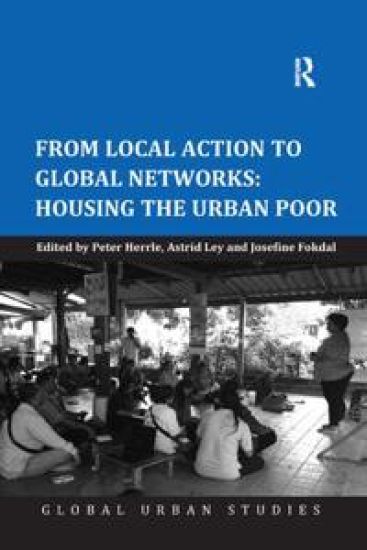
From Local Action to Global Networks: Housing the Urban Poor
Over the past two decades it has become widely recognized that housing issues have to be placed in a broader framework acknowledging that civil society in the form of Community Based Organizations (CBOs) and their allies are increasingly networking and emerging as strong players that cannot easily be overlooked. Some of these networks have crossed local and national boundaries and have jumped political scales. This implies that housing issues have to be looked at from new angles: they can no longer simply be addressed through localized projects, but rather at multiple scales. The current debate is largely limited to statements about the relevance of individual organizations for local housing processes and tends to overlook the innovativeness in terms of re-scaling those processes and of influencing institutional change at various levels by transcending national boundaries. There is a significant lack of a systemic understanding of such globally operating grassroots networks and how they function in the housing process. This book brings together different perspectives on multi-scalar approaches within the housing field and on grassroots’ engagement with formal agencies including local government, higher levels of government and international agencies. By moving away from romanticizing local self-initiatives, it focuses on understanding the emerging potential once local initiatives are interlinked and scaled-up to transnational networks.
From Local Action to Global Networks: Housing the Urban Poor
Over the past two decades it has become widely recognized that housing issues have to be placed in a broader framework acknowledging that civil society in the form of Community Based Organizations (CBOs) and their allies are increasingly networking and emerging as strong players that cannot easily be overlooked. Some of these networks have crossed local and national boundaries and have jumped political scales. This implies that housing issues have to be looked at from new angles: they can no longer simply be addressed through localized projects, but rather at multiple scales. The current debate is largely limited to statements about the relevance of individual organizations for local housing processes and tends to overlook the innovativeness in terms of re-scaling those processes and of influencing institutional change at various levels by transcending national boundaries. There is a significant lack of a systemic understanding of such globally operating grassroots networks and how they function in the housing process. This book brings together different perspectives on multi-scalar approaches within the housing field and on grassroots’ engagement with formal agencies including local government, higher levels of government and international agencies. By moving away from romanticizing local self-initiatives, it focuses on understanding the emerging potential once local initiatives are interlinked and scaled-up to transnational networks.