Kirjojen hintavertailu. Mukana 12 595 353 kirjaa ja 12 kauppaa.

Kirjailija

Atef Abu Saif

Kirjat ja teokset yhdessä paikassa: 11 kirjaa, julkaisuja vuosilta 2014-2025, suosituimpien joukossa This Is Not a Border. Vertaile teosten hintoja ja tarkista saatavuus suomalaisista kirjakaupoista.

11 kirjaa

Kirjojen julkaisuhaarukka 2014-2025.

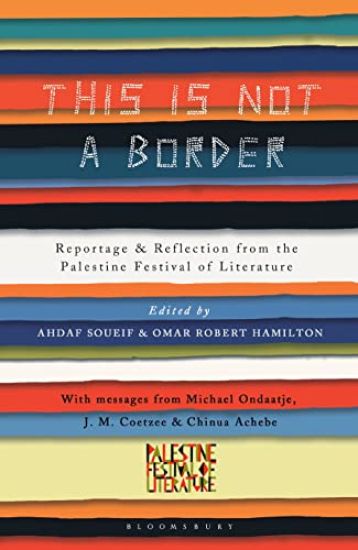
This Is Not a Border

This Is Not a Border

J.M. Coetzee; William Sutcliffe; Michael Ondaatje; Teju Cole; Alice Walker; Michael Palin; Deborah Moggach; China Miéville; Jeremy Harding; Henning Mankell; Molly Crabapple; Linda Spalding; Adam Foulds; Gillian Slovo; Geoff Dyer; Chinua Achebe; Mahmoud Darwish; Yasmin El-Rifae; Suheir Hammad; Mercedes Kemp; Najwan Darwish; Susan Abulhawa; Suad Amiry; Sabrina Mahfouz; John Horner; Bridget Keenan; Pankaj Mishra; Kamila Shamsie; Atef Abu Saif; Selma Dabbagh; Jehan Bseiso; Omar El-Khairy; Remi Kanazi; Maath Musleh; Ghada Karmi

Bloomsbury Publishing PLC
2017
pokkari
________________'This anthology will help turn your intellectual understanding of oppression into an emotional one' - New Statesman'Thanks for being who you are and for giving us such exposure to wonderful people. Palestine is proud of you' - Suad Amiry________________The Palestine Festival of Literature was established in 2008. Bringing together writers from all corners of the globe, it aims to help Palestinians break the cultural siege imposed by the Israeli military occupation, to strengthen their artistic links with the rest of the world, and to reaffirm, in the words of Edward Said, ‘the power of culture over the culture of power’.Celebrating the tenth anniversary of PalFest, This Is Not a Border is a collection of essays, poems and stories from some of the world’s most distinguished artists, responding to their experiences at this unique festival. Both heartbreaking and hopeful, their gathered work is a testament to the power of literature to promote solidarity and courage in the most desperate of situations.Contributors: Susan Abulhawa, Suad Amiry, Victoria Brittain, Jehan Bseiso, Teju Cole, Molly Crabapple, Selma Dabbagh, Mahmoud Darwish, Najwan Darwish, Geoff Dyer, Yasmin El-Rifae, Adam Foulds, Ru Freeman, Omar Robert Hamilton, Suheir Hammad, Nathalie Handal, Mohammed Hanif, Jeremy Harding, Rachel Holmes, John Horner, Remi Kanazi, Brigid Keenan, Mercedes Kemp, Omar El-Khairy, Nancy Kricorian, Sabrina Mahfouz, Jamal Mahjoub, Henning Mankell, Claire Messud, China Miéville, Pankaj Mishra, Deborah Moggach, Muiz, Maath Musleh, Michael Palin, Ed Pavlic, Atef Abu Saif, Kamila Shamsie, Raja Shehadeh, Gillian Slovo, Ahdaf Soueif, Linda Spalding, Will Sutcliffe, Alice WalkerWith messages from China Achebe, Michael Ondaatje and J. M. Coetzee________________'Every literary act, whether it is a great epic poem or an honest piece of journalism or a simple nonsense tale for children is a blow against the forces of stupidity and ignorance and darkness … The Palestine Festival of Literature exists to do just that – and I salute it for its work. Not only this year but for as long as it is necessary' - Philip Pullman
Jeg vil være våken når jeg dør!
Dette er en utgivelse til støtte for Gazas herjede folk, hvor medvirkende til den norske utgaven har arbeidet pro bono, og hvor alt overskudd tilfaller NORWAC, som sender norske frivillige helsearbeidere for å hjelpe. Atef Abu Saif var tilfeldigvis i Gaza under den israelske inva­sjonen høsten 2023. Hver dag skrev han dagbok om hva han opplevde; om husene som ble lagt i ruiner, om vennene som døde foran øynene pa° ham og om savnet av familien pa° Vestbredden og lengselen tilbake til et normalt liv. Tekstene ble publisert i New York Times og Slate Magazine, og senere utgitt i bokform. Tekstene til Atef Abu Saif gir et rystende innblikk i hva som skjedde i disse høstdagene, da store deler av Gaza ble lagt i ruiner og innbyggerne ble drevet pa° flukt, for sa° a° bli samlet i flyktningleirer under uverdige forhold og med trusselen om nær foresta°ende død hengende over seg.
Don't Look Left

Don't Look Left

Atef Abu Saif

Comma Press
2024
nidottu
On October 7, Israeli territory around the Erez border of Gaza Strip was invaded in a surprise attack by Hamas's Al Qassam Brigades. In response to this, the people of Gaza have been subjected to nearly three months of wholesale genocide. Over 20,000 civilians have been killed, an estimated million made homeless and displaced, tens of thousands injured, and an entire population traumatised. Never in living history has such an atrocity been perpetrated in plain sight of the world's leaders and mainstream media, who have all somehow managed to give it their complete backing. Images and video clips of hourly horrors and tragedies have spread around the world, combatted by fake news propagated not by dark conspiratorial corners on the web, but by corporate media outlets and politicians. Baseless Israeli propaganda and deliberately-biased framing has been fed to journalists and repeated, without question, on the front pages of the world's newspapers and in the mouths of TV pundits and politicians. One of the few voices of Gaza to make it out into Western media has been that of writer Atef Abu Saif', whose diary entries have been occasionally serialised (with edits and framing) in places like The New York Times, Washington Post, Le Monde and elsewhere. Here, the complete, unedited diaries show the journey of a man who arrived in Gaza just a few days before October 7 as a government minister and ended the period, like most other Palestinians, living in a tent in a refugee camp. If we allow our understanding of world events to be corrupted and spun by lazy, compliant journalism, we will never understand them, even those happening in real-time, before our very eyes. These diaries give us a rare exit ramp from this state of ignorance. WITH A FOREWORD BY PULITZER PRIZE WINNER CHRIS HEDGES
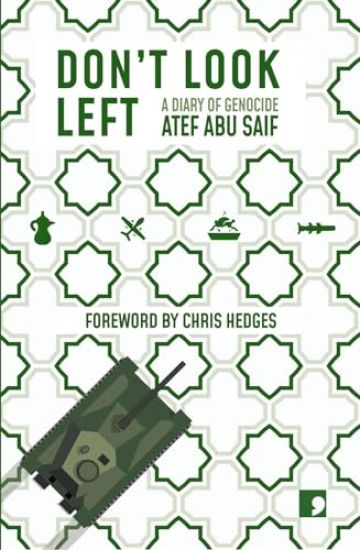
Don't Look Left: A Diary of Genocide

Don't Look Left: A Diary of Genocide

Atef Abu Saif

BEACON PRESS
2024
nidottu
A harrowing and indispensable first-hand account of the experience of the first 85 days of the Israeli invasion of Gaza, from a prominent Palestinian writer In the morning I read the news. The news is about us. But it's designed for people reading it far, far away, who couldn't possibly imagine they could ever know anyone involved. It's for people who read the news to comfort themselves, to tell themselves: it's still far, far away. I read the news for different reasons: I read it to know I"m not dead. Early in the morning of Oct 7, 2023, Atef Abu Saif went swimming. It was a beautiful morning: sunny with a cool breeze. The Palestinian Authority's Minister for Culture, he was on a combined work and pleasure trip to Gaza, visiting his extended family with his 15 year old son, Yasser, and participating in National Heritage Day. Then the bombing started. Don't Look Left takes us into the day to day experiences of Gazan civilians trying to survive Israel's war against Hamas, its detail and extended narrative showing us what brief reports and video clips cannot. In a war that has taken an extraordinarily high toll on civilians, it is a crucial document--a day-to-day testimony and a deeply moving depiction of a people's fight to survive and maintain their humanity amid the chaos and trauma of mass destruction. It is also, remarkably, a powerful literary experience. Atef Abu Saif was born in Jabalia refugee camp in Gaza in 1973, and, as he writes, his first war broke out when he was two months old. He writes as only someone who knows Gaza deeply can, and only as someone who knows war can, picking out the details of ordinary life and survival amidst the possibility of death coming at any moment: washing the only shirt he has and waiting naked for three hours for it dry; noticing a cat, as terrified as the people on the street around it, hiding under a bistro table; visiting his sister-in-law's daughter in the hospital, who tells him in her dream she has no legs, and asks him if it is true. It is: she has lost her legs and a hand when her home was hit by a bomb. Trying to figure out the best place to sleep each night, and when and where to flee as the destruction intensifies. This is not like past wars with Israel, Abu Saif soon realizes--thinking of the Nakba, and of images of bombed cities from World War II. Profits from the sale of this book will go to two Palestinian charities: Medical Aid for Palestinians and the Middle East Children's Alliance.
Under dronene

Under dronene

Atef Abu Saif

Spartacus
2018
nidottu
Søndag 6. juli 2014 lanserer Israel en større militæroperasjon, «Protective Edge». Målet er «å stoppe palestinske raketter, ødelegge tuneller i Israel, og ramme Hamas' lederskap hardt». Forfatteren Atef Abu Saif sitter i en blå sofa i leiligheten sin i Jabalia, nord for Gaza by. I lyset fra rakettilden skriver han dagbok: om lengsel og frykt for døden, om kjærligheten til den smale stripen land inneklemt mellom mur og hav, om håp og menneskelig mot. Og han gjør som de fleste andre ville ha gjort når en militærmakt angriper. Han beskytter barna sine og sin elskede, og håper at de alle er i live den dagen bombene slutter å falle. I løpet av de femti dagene det israelske angrepet på Gazastripen varer, blir 2131 palestinere drept, av disse over 500 barn. 10 100 blir skadet, av disse er 3374 barn. Forord ved Odd Karsten Tveit.
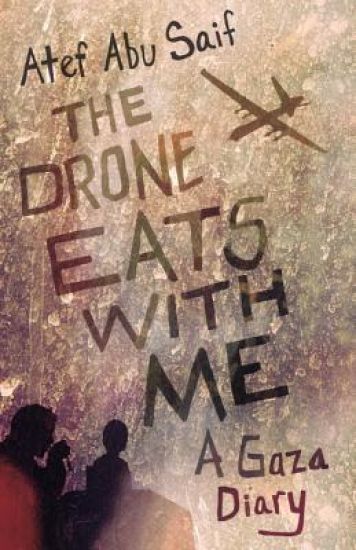
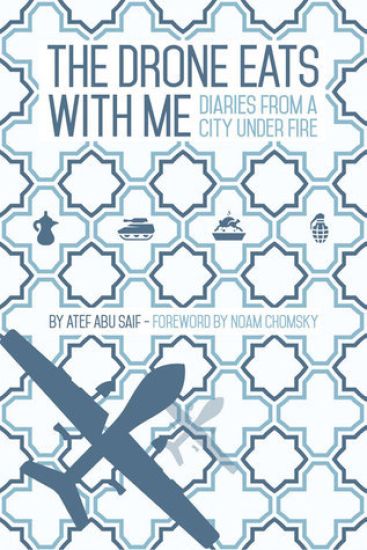
The Drone Eats with Me: A Gaza Diary

The Drone Eats with Me: A Gaza Diary

Atef Abu Saif

BEACON PRESS
2016
nidottu
An ordinary Gazan's "devastating contemporary war journal" that chronicles his fear, sadness, and boredom during Israel's 2014 invasion of Gaza (Michael Ondaatje, author of The English Patient) The Drone Eats with Me is an unforgettable rendering of everyday civilian life shattered by the realities of twenty-first-century warfare. Israel's 2014 invasion of Gaza lasted 51 days, killed 2,145 Palestinians (578 of them children), injured over 11,000 people, and demolished more than 17,000 homes. Atef Abu Saif, a young father and novelist, puts an indelibly human face on these statistics, providing a rare window into the texture of a community and the realities of a conflict that is too often obscured by politics.
The Drone Eats with Me

The Drone Eats with Me

Atef Abu Saif; Noam Chomsky

Comma Press
2015
nidottu
On 7 July 2014, in an apparent response to the murder of three teenagers, Israel launched a major offensive against the Gaza Strip, lasting 51 days, killing 2145 Palestinians (578 of them children), injuring over 11,000, and demolishing 17,200 homes. The usual news machine rolled up, and the same distressing images and entrenched political rhetoric were broadcast, yet almost nothing was reported of the on-going lives of ordinary Gazans – the real victims of the war. One of the few voices to make it out was that of Atef Abu Saif, a writer and teacher from Jabalia Refugee Camp, whose eye-witness accounts (published in The Guardian, The New York Times, and elsewhere) offered a rare window into the conflict for Western readers. Here, Atef’s complete diaries of the war allow us to witness the full extent of last summer’s atrocities from the most humble of perspectives: that of a young father, fearing for his family’s safety, trying to stay sane in an insanely one-sided war.
The Book of Gaza

The Book of Gaza

Atef Abu Saif; Abdallah Tayeh; Ghareeb Asqalani; Asmaa Al Ghul; Garin Askalani; Nayrouz Qarmout; Talal Abu Shawish; Najlaa Ataallah; Yusra Al Khatib

Comma Press
2014
nidottu
Under the Israeli occupation of the '70s and '80s, writers in Gaza had to go to considerable lengths to ever have a chance of seeing their work in print. Manuscripts were written out longhand, invariably under pseudonyms, and smuggled out of the Strip to Jerusalem, Cairo or Beirut, where they then had to be typed up. Consequently, fiction grew shorter, novels became novellas, and short stories flourished as the city's form of choice. Indeed, to Palestinians elsewhere, Gaza became known as 'the exporter of oranges and short stories'. This anthology brings together some of the pioneers of the Gazan short story from that era, as well as younger exponents of the form, with ten stories that offer glimpses of life in the Strip that go beyond the global media headlines; stories of anxiety, oppression, and violence, but also of resilience and hope, of what it means to be a Palestinian, and how that identity is continually being reforged; stories of ordinary characters struggling to live with dignity in what many have called 'the largest prison in the world'.