Kirjojen hintavertailu. Mukana 12 595 353 kirjaa ja 12 kauppaa.

Kirjailija

Aura Reggiani

Kirjat ja teokset yhdessä paikassa: 5 kirjaa, julkaisuja vuosilta 2012-2020, suosituimpien joukossa Interaction, Evolution and Chaos in Space. Vertaile teosten hintoja ja tarkista saatavuus suomalaisista kirjakaupoista.

5 kirjaa

Kirjojen julkaisuhaarukka 2012-2020.

Network Developments in Economic Spatial Systems

Network Developments in Economic Spatial Systems

Aura Reggiani; Daniele Fabbri

Routledge
2020
nidottu
First published in 1999, the main feature of this book is its multidisciplinary nature, since the book focuses on the complexity of spatial/ economic networks from several methodological points of view. For this purpose both theoretical and empirical works have been included. The aim of the book is to provide an updated and fresh look at the mentioned issue with innovative and creative papers coming from leading experts belonging to different disciplines. Therefore the book could be considered as an expert and critical guide - through different methodological approaches - to the topic of (complex) networks in the space-economy. All the contributions provide innovative and in some cases provocative elements to the understanding of networks and development over space.

New Analytical Advances in Transportation and Spatial Dynamics
This title was first published in 2001. A delightfully oriented selection of international state-of-the-art research in applied regional science, this informative volume places particular emphasis on the use of qualitative/quantitative methodologies in transportation and spatial dynamics. It presents new theoretical contributions in the context of spatial competition dynamics, particularly illustrating various combinations of methods and models regarding new measures of competition/cohesion in the two main fields of transportation and spatial dynamics.
Network Developments in Economic Spatial Systems

Network Developments in Economic Spatial Systems

Aura Reggiani; Daniele Fabbri

Routledge
2018
sidottu
First published in 1999, the main feature of this book is its multidisciplinary nature, since the book focuses on the complexity of spatial/ economic networks from several methodological points of view. For this purpose both theoretical and empirical works have been included. The aim of the book is to provide an updated and fresh look at the mentioned issue with innovative and creative papers coming from leading experts belonging to different disciplines. Therefore the book could be considered as an expert and critical guide - through different methodological approaches - to the topic of (complex) networks in the space-economy. All the contributions provide innovative and in some cases provocative elements to the understanding of networks and development over space.

New Analytical Advances in Transportation and Spatial Dynamics
This title was first published in 2001. A delightfully oriented selection of international state-of-the-art research in applied regional science, this informative volume places particular emphasis on the use of qualitative/quantitative methodologies in transportation and spatial dynamics. It presents new theoretical contributions in the context of spatial competition dynamics, particularly illustrating various combinations of methods and models regarding new measures of competition/cohesion in the two main fields of transportation and spatial dynamics.
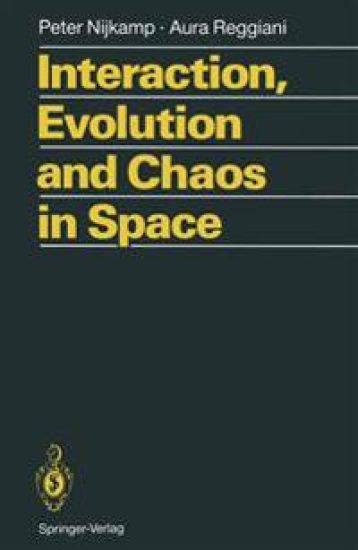
Interaction, Evolution and Chaos in Space

Interaction, Evolution and Chaos in Space

Peter Nijkamp; Aura Reggiani

Springer-Verlag Berlin and Heidelberg GmbH Co. K
2012
nidottu
For many decades scholars from various disciplines have been intrigued by the question whether there are unifying principles or models that have a validity in different disciplines. The building of such analytical frameworks bridging the gaps between scientific traditions is a very ambitious task and has not been very successful up till now. In the past - in a static context - several such principles have been defined and advocated at the edge of the natural sciences on the one hand and social sciences (in particular, economics and geography) on the other hand, mainly based on the paradigm of 'social physics'. Some important contributions to the integration of the spatial systems sciences and physics can be found in gravity theory and entropy theory, which have formed the comer stones of interaction models in space. This book is about spatial interaction models. It describes the origin, the history and the correspondence of such models from a 'social physics' perspective. It is emphasized that such models need a clear behavioural underpinning as a sine qua non for a valid use in spatial systems analysis. This view also explains the use of micro-based disaggregate choice models as a tool for analyzing spatial systems. This is mainly analyzed in Part A of this book.