Kirjojen hintavertailu. Mukana 12 595 353 kirjaa ja 12 kauppaa.

Kirjailija

Avner Greif

Kirjat ja teokset yhdessä paikassa: 3 kirjaa, julkaisuja vuosilta 1998-2025, suosituimpien joukossa Two Paths to Prosperity. Vertaile teosten hintoja ja tarkista saatavuus suomalaisista kirjakaupoista.

3 kirjaa

Kirjojen julkaisuhaarukka 1998-2025.

Two Paths to Prosperity

Two Paths to Prosperity

Avner Greif; Joel Mokyr; Guido Tabellini

PRINCETON UNIVERSITY PRESS
2025
sidottu
How the social organization of Europe and China shaped their divergent economic and political trajectories over the past millenniumIn the eleventh century, when Europe was still backward and poor, China was a rich and sophisticated civilization. Yet Europe became the birthplace of democracy and the Industrial Revolution, driving the Great Enrichment, while China stagnated until the end of the twentieth century and was always ruled by autocracies. Two Paths to Prosperity traces the emergence of two very different social organizations in premodern China and Europe—the clan and the corporation—showing how they were key factors in the economic and political divergence of these two great civilizations.In this landmark book, three leading economists offer a bold new account of why Europe and China evolved along such different trajectories. In the early Middle Ages, public goods like risk sharing, religious worship, education, and conflict resolution were provided by nonstate organizations in both societies. China increasingly relied on kin-based cooperation within clans, while weaker kinship ties in Europe gave rise to corporations such as guilds, universities, and self-governing towns. Despite performing similar functions, clans and corporations were built on very different principles—with lasting consequences until today.Providing a novel answer to a fundamental question in economic and political history, Two Paths to Prosperity shows how extended kinship in Chinese society facilitated the consolidation of autocracy and hindered innovation and economic development, and how corporations in Europe influenced emerging state institutions and set the stage for the Industrial Revolution.

Institutions and the Path to the Modern Economy

Institutions and the Path to the Modern Economy

Avner Greif

Cambridge University Press
2006
sidottu
It is widely believed that current disparities in economic, political, and social outcomes reflect distinct institutions. Institutions are invoked to explain why some countries are rich and others poor, some democratic and others dictatorial. But arguments of this sort gloss over the question of what institutions are, how they come about, and why they persist. They also fail to explain why institutions are influenced by the past, why it is that they can sometimes change, why they differ so much from society to society, and why it is hard to study them empirically and devise a policy aimed at altering them. This 2006 book seeks to overcome these problems, which have exercised economists, sociologists, political scientists, and a host of other researchers who use the social sciences to study history, law, and business administration. It presents a multi-disciplinary perspective to study endogenous institutions and their dynamics.
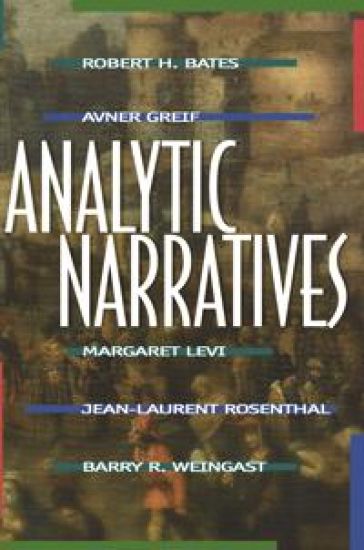
Analytic Narratives

Analytic Narratives

Robert H. Bates; Avner Greif; Margaret Levi; Jean-Laurent Rosenthal; Barry R. Weingast

Princeton University Press
1998
pokkari
Students of comparative politics have long faced a vexing dilemma: how can social scientists draw broad, applicable principles of political order from specific historical examples? In Analytic Narratives, five senior scholars offer a new and ambitious methodological response to this important question. By employing rational-choice and game theory, the authors propose a way of extracting empirically testable, general hypotheses from particular cases. The result is both a methodological manifesto and an applied handbook that political scientists, economic historians, sociologists, and students of political economy will find essential. In their jointly written introduction, the authors frame their approach to the origins and evolution of political institutions. The individual essays that follow demonstrate the concept of the analytic narrative--a rational-choice approach to explain political outcomes--in case studies. Avner Greif traces the institutional foundations of commercial expansion in twelfth-century Genoa. Jean-Laurent Rosenthal analyzes how divergent fiscal policies affected absolutist European governments, while Margaret Levi examines the transformation of nineteenth-century conscription laws in France, the United States, and Prussia. Robert Bates explores the emergence of a regulatory organization in the international coffee market. Finally, Barry Weingast studies the institutional foundations of democracy in the antebellum United States and its breakdown in the Civil War. In the process, these studies highlight the economic role of political organizations, the rise and deterioration of political communities, and the role of coercion, especially warfare, in political life. The results are both empirically relevant and theoretically sophisticated. Analytic Narratives is an innovative and provocative work that bridges the gap between the game-theoretic and empirically driven approaches in political economy. Political historians will find the use of rational-choice models novel; theorists will discover arguments more robust and nuanced than those derived from abstract models. The book improves on earlier studies by advocating--and applying--a cross-disciplinary approach to explain strategic decision making in history.