Kirjojen hintavertailu. Mukana 12 595 353 kirjaa ja 12 kauppaa.
Kirjailija
Axel Polleres
Kirjat ja teokset yhdessä paikassa: 4 kirjaa, julkaisuja vuosilta 2006-2021, suosituimpien joukossa Enabling Semantic Web Services. Vertaile teosten hintoja ja tarkista saatavuus suomalaisista kirjakaupoista.
Aidan Hogan; Eva Blomqvist; Michael Cochez; Claudia d’Amato; Gerard de Melo; Claudio Gutierrez; Sabrina Kirrane; Jose Emilio Labra Gayo; Roberto Navigli; Sebastian Neumaier; Axel Polleres; Sabbir Rashid; Anisa Rula; Antoine Zimmermann; Lukas Schmelzeisen; Axel-Cyrille Ngonga Ngomo; Juan Sequeda; Steffen Staab
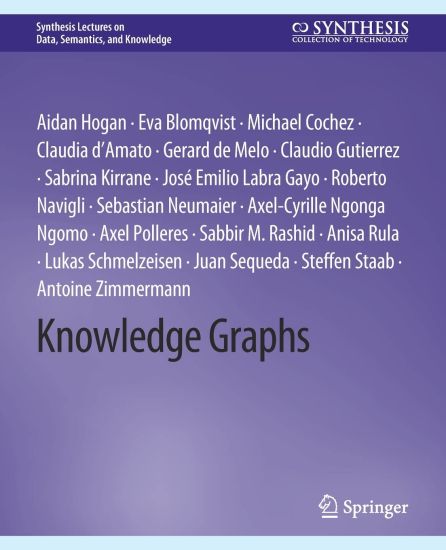
This book provides a comprehensive and accessible introduction to knowledge graphs, which have recently garnered notable attention from both industry and academia. Knowledge graphs are founded on the principle of applying a graph-based abstraction to data, and are now broadly deployed in scenarios that require integrating and extracting value from multiple, diverse sources of data at large scale. The book defines knowledge graphs and provides a high-level overview of how they are used. It presents and contrasts popular graph models that are commonly used to represent data as graphs, and the languages by which they can be queried before describing how the resulting data graph can be enhanced with notions of schema, identity, and context. The book discusses how ontologies and rules can be used to encode knowledge as well as how inductive techniques—based on statistics, graph analytics, machine learning, etc.—can be used to encode and extract knowledge. It covers techniques for the creation, enrichment, assessment, and refinement of knowledge graphs and surveys recent open and enterprise knowledge graphs and the industries or applications within which they have been most widely adopted. The book closes by discussing the current limitations and future directions along which knowledge graphs are likely to evolve. This book is aimed at students, researchers, and practitioners who wish to learn more about knowledge graphs and how they facilitate extracting value from diverse data at large scale. To make the book accessible for newcomers, running examples and graphical notation are used throughout. Formal definitions and extensive references are also provided for those who opt to delve more deeply into specific topics.
Aidan Hogan; Eva Blomqvist; Michael Cochez; Claudia d'Amato; Gerard de Melo; Claudio Gutierrez; Sabrina Kirrane; Jose Emilio Labra Gayo; Roberto Navigli; Sebastian Neumaier; Axel-Cyrille Ngonga Ngomo; Axel Polleres; Sabbir M. Rashid; Anisa Rula; Juan Sequeda; Lukas Schmelzeisen; Steffen Staab; Antoine Zimmermann
This book provides a comprehensive and accessible introduction to knowledge graphs, which have recently garnered notable attention from both industry and academia. Knowledge graphs are founded on the principle of applying a graph-based abstraction to data, and are now broadly deployed in scenarios that require integrating and extracting value from multiple, diverse sources of data at large scale.The book defines knowledge graphs and provides a high-level overview of how they are used. It presents and contrasts popular graph models that are commonly used to represent data as graphs, and the languages by which they can be queried before describing how the resulting data graph can be enhanced with notions of schema, identity, and context. The book discusses how ontologies and rules can be used to encode knowledge as well as how inductive techniques—based on statistics, graph analytics, machine learning, etc.—can be used to encode and extract knowledge. It covers techniques for the creation, enrichment, assessment, and refinement of knowledge graphs and surveys recent open and enterprise knowledge graphs and the industries or applications within which they have been most widely adopted. The book closes by discussing the current limitations and future directions along which knowledge graphs are likely to evolve.This book is aimed at students, researchers, and practitioners who wish to learn more about knowledge graphs and how they facilitate extracting value from diverse data at large scale. To make the book accessible for newcomers, running examples and graphical notation are used throughout. Formal definitions and extensive references are also provided for those who opt to delve more deeply into specific topics.
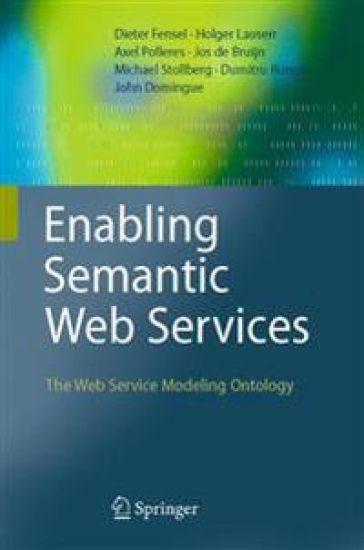
Service-oriented computing has become one of the predominant factors in current IT research and development. Web services seem to be the middleware solution of the future for highly interoperable distributed software solutions. In parallel, research on the Semantic Web provides the results required to exploit distributed machine-processable data. To combine these two research lines into industrial-strength applications, a number of research projects have been set up by organizations like W3C and the EU. Dieter Fensel and his coauthors deliver a profound introduction into one of the most promising approaches – the Web Service Modeling Ontology (WSMO). After a brief presentation of the underlying basic technologies and standards of the World Wide Web, the Semantic Web, and Web Services, they detail all the elements of WSMO from basic concepts to possible applications in e-commerce, e-government and e-banking, and they also describe its relation to other approaches like OWL-S or WSDL-S. While many of the related technologies and standards are still under development, this book already offers both a broad conceptual introduction and lots of pointers to future application scenarios for researchers in academia and industry as well as for developers of distributed Web applications.