Kirjojen hintavertailu. Mukana 12 253 448 kirjaa ja 12 kauppaa.

Kirjailija

Ba-Ngu Vo

Kirjat ja teokset yhdessä paikassa: 6 kirjaa, julkaisuja vuosilta 2001-2013, suosituimpien joukossa Random Finite Sets for Robot Mapping & SLAM. Vertaile teosten hintoja ja tarkista saatavuus suomalaisista kirjakaupoista.

6 kirjaa

Kirjojen julkaisuhaarukka 2001-2013.

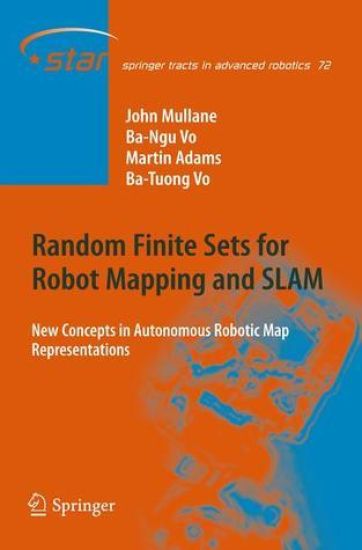
Random Finite Sets for Robot Mapping & SLAM

Random Finite Sets for Robot Mapping & SLAM

John Stephen Mullane; Ba-Ngu Vo; Martin David Adams; Ba-Tuong Vo

Springer-Verlag Berlin and Heidelberg GmbH Co. K
2013
nidottu
The monograph written by John Mullane, Ba-Ngu Vo, Martin Adams and Ba-Tuong Vo is devoted to the field of autonomous robot systems, which have been receiving a great deal of attention by the research community in the latest few years. The contents are focused on the problem of representing the environment and its uncertainty in terms of feature based maps. Random Finite Sets are adopted as the fundamental tool to represent a map, and a general framework is proposed for feature management, data association and state estimation. The approaches are tested in a number of experiments on both ground based and marine based facilities.
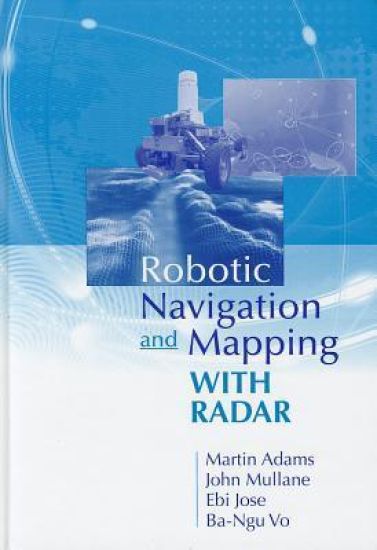
Robotic Navigation and Mapping with Radar

Robotic Navigation and Mapping with Radar

Martin Adams; Ebi Jose; Ba-Ngu Vo

Artech House Publishers
2012
sidottu
Focusing on autonomous robotic applications, this cutting-edge resource offers a practical treatment of short-range radar processing for reliable object detection at the ground level. This unique book demonstrates probabilistic radar models and detection algorithms specifically for robotic land vehicles. Engineers and researchers may find detailed coverage of Simultaneous Localization and Map Building (SLAM) - an area referred to as the "Holy Grail" of autonomous robotics research.
Laser and Radar Based Robotic Perception

Laser and Radar Based Robotic Perception

Martin Adams; John Mullane; Ba-Ngu Vo

now publishers Inc
2011
nidottu
A crucial component of perception is the understanding of information which has passed through a sensor's detection process. In the world of autonomous robotics this takes the form of sensor understanding and modelling, feature detection, predicting measurements/observations, feature matching and sensor data representation.Laser and Radar Based Robotic Perception presents a review of autonomous robotic perception, exploring recent work from the autonomous robotics and tracking communities in general as well as from the authors' own experiences. Throughout the text, experiments and results are derived from the authors' experiences with laser and radar based sensors. The concepts used in the experiments, and conclusions drawn from them, are then compared with state of the art perception methods in a review type fashion.The book also reviews and presents methods which cope probabilistically with missed detections (the possibility of a sensor not detecting an object of interest), object spatial uncertainty (in which detected objects are given uncertain range and/or bearing values due to sensor noise) and false alarms (the possibility of a sensor reporting a detection, due to noise, when in fact nothing (or nothing of interest) is present).Environment measurement models based on these phenomena are therefore analysed. A further concept, often over-looked in the robotic, but apparent in the tracking literature, is that of estimating the correct number of features in an environment. Recent work which advocates the joint estimation of map features with respect to their number as well as location is reviewed.
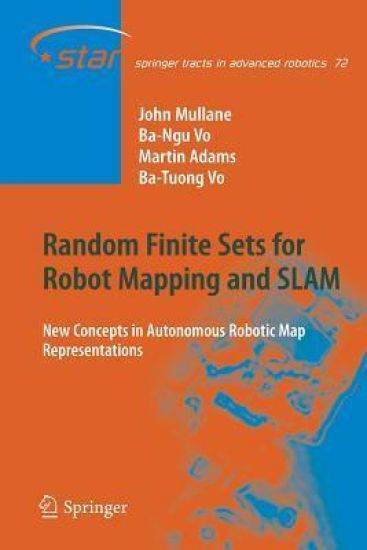
Random Finite Sets for Robot Mapping & SLAM

Random Finite Sets for Robot Mapping & SLAM

John Stephen Mullane; Ba-Ngu Vo; Martin David Adams; Ba-Tuong Vo

Springer-Verlag Berlin and Heidelberg GmbH Co. K
2011
sidottu
The monograph written by John Mullane, Ba-Ngu Vo, Martin Adams and Ba-Tuong Vo is devoted to the field of autonomous robot systems, which have been receiving a great deal of attention by the research community in the latest few years. The contents are focused on the problem of representing the environment and its uncertainty in terms of feature based maps. Random Finite Sets are adopted as the fundamental tool to represent a map, and a general framework is proposed for feature management, data association and state estimation. The approaches are tested in a number of experiments on both ground based and marine based facilities.
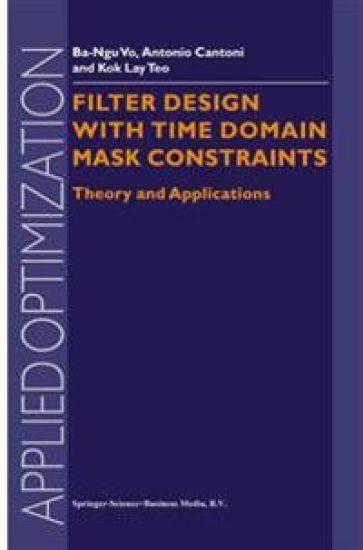
Filter Design With Time Domain Mask Constraints: Theory and Applications

Filter Design With Time Domain Mask Constraints: Theory and Applications

Ba-Ngu Vo; Antonio Cantoni

Springer-Verlag New York Inc.
2010
nidottu
Optimum envelope-constrained filter design is concerned with time-domain synthesis of a filter such that its response to a specific input signal stays within prescribed upper and lower bounds, while minimizing the impact of input noise on the filter output or the impact of the shaped signal on other systems depending on the application. In many practical applications, such as in TV channel equalization, digital transmission, and pulse compression applied to radar, sonar and detection, the soft least square approach, which attempts to match the output waveform with a specific desired pulse, is not the most suitable one. Instead, it becomes necessary to ensure that the response stays within the hard envelope constraints defined by a set of continuous inequality constraints. The main advantage of using the hard envelope-constrained filter formulation is that it admits a whole set of allowable outputs. From this set one can then choose the one which results in the minimization of a cost function appropriate to the application at hand. The signal shaping problems so formulated are semi-infinite optimization problems. This monograph presents in a unified manner results that have been generated over the past several years and are scattered in the research literature. The material covered in the monograph includes problem formulation, numerical optimization algorithms, filter robustness issues and practical examples of the application of envelope constrained filter design. Audience: Postgraduate students, researchers in optimization and telecommunications engineering, and applied mathematicians.
Filter Design With Time Domain Mask Constraints: Theory and Applications
Optimum envelope-constrained filter design is concerned with time-domain synthesis of a filter such that its response to a specific input signal stays within prescribed upper and lower bounds, while minimizing the impact of input noise on the filter output or the impact of the shaped signal on other systems depending on the application. In many practical applications, such as in TV channel equalization, digital transmission, and pulse compression applied to radar, sonar and detection, the soft least square approach, which attempts to match the output waveform with a specific desired pulse, is not the most suitable one. Instead, it becomes necessary to ensure that the response stays within the hard envelope constraints defined by a set of continuous inequality constraints. The main advantage of using the hard envelope-constrained filter formulation is that it admits a whole set of allowable outputs. From this set one can then choose the one which results in the minimization of a cost function appropriate to the application at hand. The signal shaping problems so formulated are semi-infinite optimization problems. This monograph presents in a unified manner results that have been generated over the past several years and are scattered in the research literature. The material covered in the monograph includes problem formulation, numerical optimization algorithms, filter robustness issues and practical examples of the application of envelope constrained filter design. Audience: Postgraduate students, researchers in optimization and telecommunications engineering, and applied mathematicians.