Kirjojen hintavertailu. Mukana 12 530 820 kirjaa ja 12 kauppaa.

Kirjailija

Barbara B.H. Partee

Kirjat ja teokset yhdessä paikassa: 5 kirjaa, julkaisuja vuosilta 1978-2010, suosituimpien joukossa Mathematical Methods in Linguistics. Vertaile teosten hintoja ja tarkista saatavuus suomalaisista kirjakaupoista.

5 kirjaa

Kirjojen julkaisuhaarukka 1978-2010.

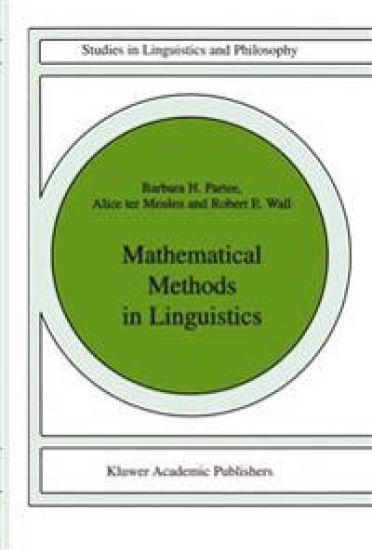
Mathematical Methods in Linguistics

Mathematical Methods in Linguistics

Barbara B.H. Partee; A.G. ter Meulen; R. Wall

Kluwer Academic Publishers
1990
nidottu
Elementary set theory accustoms the students to mathematical abstraction, includes the standard constructions of relations, functions, and orderings, and leads to a discussion of the various orders of infinity. The material on logic covers not only the standard statement logic and first-order predicate logic but includes an introduction to formal systems, axiomatization, and model theory. The section on algebra is presented with an emphasis on lattices as well as Boolean and Heyting algebras. Background for recent research in natural language semantics includes sections on lambda-abstraction and generalized quantifiers. Chapters on automata theory and formal languages contain a discussion of languages between context-free and context-sensitive and form the background for much current work in syntactic theory and computational linguistics. The many exercises not only reinforce basic skills but offer an entry to linguistic applications of mathematical concepts. Forupper-level undergraduate students and graduate students in theoretical linguistics, computer-science students with interests in computational linguistics, logic programming and artificial intelligence, mathematicians and logicians with interests in linguistics and the semantics of natural language.
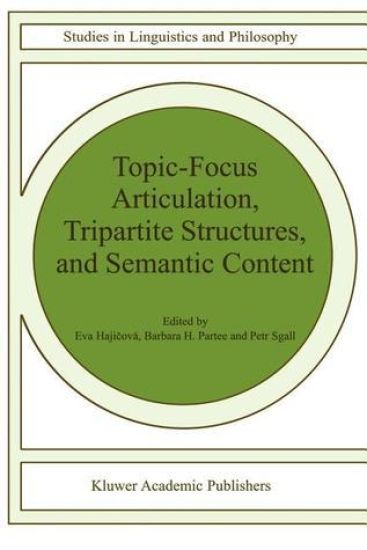
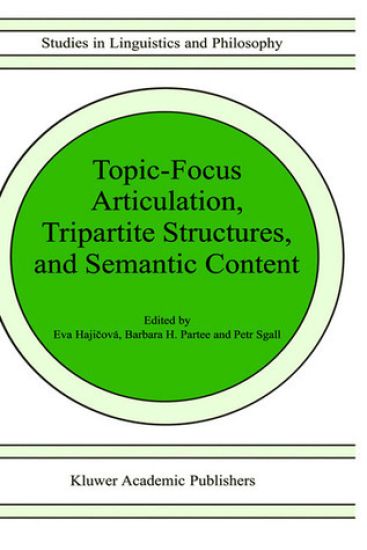
Topic-Focus Articulation, Tripartite Structures, and Semantic Content

Topic-Focus Articulation, Tripartite Structures, and Semantic Content

Eva Hajicová; Barbara B.H. Partee; P. Sgall

Springer
2010
nidottu
1. 1 OBJECTIVES The main objective of this joint work is to bring together some ideas that have played central roles in two disparate theoretical traditions in order to con­ tribute to a better understanding of the relationship between focus and the syn­ tactic and semantic structure of sentences. Within the Prague School tradition and the branch of its contemporary development represented by Hajicova and Sgall (HS in the sequel), topic-focus articulation has long been a central object of study, and it has long been a tenet of Prague school linguistics that topic-focus structure has systematic relevance to meaning. Within the formal semantics tradition represented by Partee (BHP in the sequel), focus has much more recently become an area of concerted investigation, but a number of the semantic phenomena to which focus is relevant have been extensively investi­ gated and given explicit compositional semantic-analyses. The emergence of 'tripartite structures' (see Chapter 2) in formal semantics and the partial simi­ larities that can be readily observed between some aspects of tripartite structures and some aspects of Praguian topic-focus articulation have led us to expect that a closer investigation of the similarities and differences in these different theoretical constructs would be a rewarding undertaking with mutual benefits for the further development of our respective theories and potential benefit for the study of semantic effects of focus in other theories as well.
Topic-Focus Articulation, Tripartite Structures, and Semantic Content

Topic-Focus Articulation, Tripartite Structures, and Semantic Content

Eva Hajicová; Barbara B.H. Partee; P. Sgall

Springer
1998
sidottu
1. 1 OBJECTIVES The main objective of this joint work is to bring together some ideas that have played central roles in two disparate theoretical traditions in order to con­ tribute to a better understanding of the relationship between focus and the syn­ tactic and semantic structure of sentences. Within the Prague School tradition and the branch of its contemporary development represented by Hajicova and Sgall (HS in the sequel), topic-focus articulation has long been a central object of study, and it has long been a tenet of Prague school linguistics that topic-focus structure has systematic relevance to meaning. Within the formal semantics tradition represented by Partee (BHP in the sequel), focus has much more recently become an area of concerted investigation, but a number of the semantic phenomena to which focus is relevant have been extensively investi­ gated and given explicit compositional semantic-analyses. The emergence of 'tripartite structures' (see Chapter 2) in formal semantics and the partial simi­ larities that can be readily observed between some aspects of tripartite structures and some aspects of Praguian topic-focus articulation have led us to expect that a closer investigation of the similarities and differences in these different theoretical constructs would be a rewarding undertaking with mutual benefits for the further development of our respective theories and potential benefit for the study of semantic effects of focus in other theories as well.
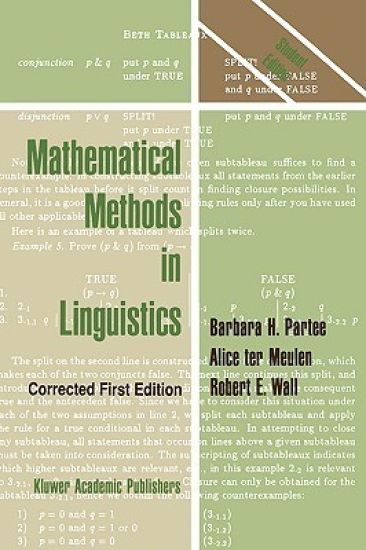
Mathematical Methods in Linguistics

Mathematical Methods in Linguistics

Barbara B.H. Partee; A.G. ter Meulen; R. Wall

Kluwer Academic Publishers
1990
sidottu
Elementary set theory accustoms the students to mathematical abstraction, includes the standard constructions of relations, functions, and orderings, and leads to a discussion of the various orders of infinity. The material on logic covers not only the standard statement logic and first-order predicate logic but includes an introduction to formal systems, axiomatization, and model theory. The section on algebra is presented with an emphasis on lattices as well as Boolean and Heyting algebras. Background for recent research in natural language semantics includes sections on lambda-abstraction and generalized quantifiers. Chapters on automata theory and formal languages contain a discussion of languages between context-free and context-sensitive and form the background for much current work in syntactic theory and computational linguistics. The many exercises not only reinforce basic skills but offer an entry to linguistic applications of mathematical concepts. Forupper-level undergraduate students and graduate students in theoretical linguistics, computer-science students with interests in computational linguistics, logic programming and artificial intelligence, mathematicians and logicians with interests in linguistics and the semantics of natural language.