Kirjojen hintavertailu. Mukana 12 595 353 kirjaa ja 12 kauppaa.

Kirjailija

Barbara E. Walvoord

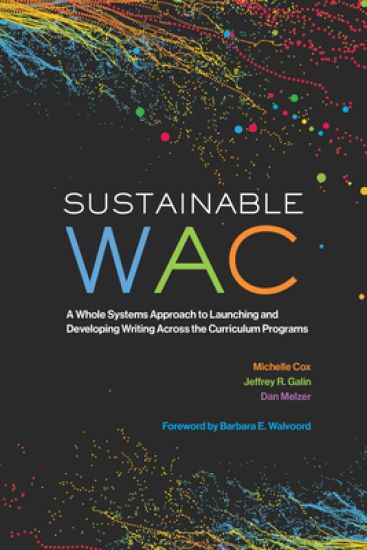
Kirjat ja teokset yhdessä paikassa: 6 kirjaa, julkaisuja vuosilta 2007-2018, suosituimpien joukossa Sustainable WAC. Vertaile teosten hintoja ja tarkista saatavuus suomalaisista kirjakaupoista.

6 kirjaa

Kirjojen julkaisuhaarukka 2007-2018.

Assessing and Improving Student Writing in College

Assessing and Improving Student Writing in College

Barbara E. Walvoord

John Wiley Sons Inc
2014
nidottu
Step-by-step guidance for shaping better writers while keeping faculty workloads manageable Effective communication is a critical skill for many academic disciplines and careers, and so colleges and universities and their faculty members are rightfully committed to improving student writing across the curriculum. Guiding and assessing student writing in classrooms, general education, and departments takes knowledge, planning, and persistence, but it can be done effectively and efficiently. Written in the concise, accessible style Barbara Walvoord is known for, Assessing and Improving Student Writing in College: A Guide for Institutions, General Education, Departments, and Classrooms offers administrators, program chairs, general education leaders, and classroom instructors the guidance they need. The book provides concrete suggestions for how to: Articulate goals for student writingMeasure student writingImprove student writingDocument that improvement The book begins by addressing four basic concepts: what we mean by writing, what we mean by "good" writing, how students learn to write, and the purposes of assessment. Next, Walvoord explains the various approaches and methods for assessing writing, urging a combination of them adapted to the institution's purposes and political context. After this introduction, successive chapters offer realistic, practical advice to institution-wide and general education leaders, department members, and classroom instructors. Walvoord addresses issues such as how to engage faculty, how to use rubrics, how to aggregate assessment information at the department and institutional levels, and how to report assessment information to accreditors. The chapter for classroom instructors offers practical suggestions: how to add more writing to a course without substantially increasing the grading load; how to construct writing assignments, how to make grading and responding more effective and time-efficient, how to address grammar and punctuation, and how to support students whose native language is not English. The book also includes four helpful appendices: a taxonomy of Writing Across the Curriculum (WAC) and Writing in the Disciplines (WID) programs; sample outlines for faculty development workshops; a student survey on teaching methods instructors can use to inform their choices in the classroom; and a student self-check cover sheet designed to help students take ownership of their own learning and responsibility for turning in complete, correct assignments. Practical, step-by-step guidance for each point in the assessment and improvement process creates a cohesive, institution-wide system that keeps students, faculty, and administrators on the same page.
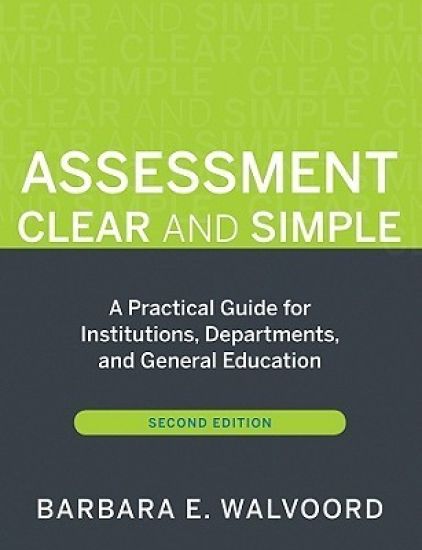
Assessment Clear and Simple

Assessment Clear and Simple

Barbara E. Walvoord; Trudy W. Banta

John Wiley Sons Inc
2010
nidottu
The first edition of Assessment Clear and Simple quickly became the essential go-to guide for anyone who participates in the assessment process in higher education. With the increased pressure to perform assessment to demonstrate accountability, Assessment Clear and Simple is needed more than ever. This second edition of the classic resource offers a concise, step-by-step guide that helps make assessment simple, cost-efficient, and useful to an institution. It contains effective strategies for meeting the requirements of accreditation agencies, legislatures, review boards, and others, while emphasizing and showing how to move from data to actions that improve student learning. This thoroughly revised and updated edition includes many new or expanded features, including: Illustrative examples drawn from the author's experience consulting with more than 350 institutions A basic, no-frills assessment plan for departments and for general education Tips on how to integrate portfolios and e-portfolios into the assessment process Suggestions for using rubrics and alternatives to rubrics, including doing assessment for multidisciplinary work Clear instructions on how to construct a coherent institution-wide assessment system and explain it to accreditors Ideas for assigning responsibility for general education assessment Strategies for gathering information about departmental assessment while keeping the departmental workload manageable Information on how to manage assessment in times of budgetary cutbacks Praise for the Second Edition of Assessment Clear and Simple "Walvoord's approach to assessment is wonderfully straightforward; it is also effective in facilitating faculty engagement in assessment. We've applied a number of her methods to our campus assessment efforts with success. This book makes assessment both manageable and useful in improving and enhancing student learning."?Martha L. A. Stassen, director of assessment, University of Massachusetts, Amherst, and president, New England Educational Assessment Network (NEEAN) "Walvoord's work clearly presents the basics for getting started in assessment of student learning while honestly addressing the complexities of assessment when driven by faculty passion for student learning. This book is a valuable resource for the novice as well as the developing experts who are leading their institutions in academic assessment."?Bobbi Allen, faculty assessment director, Delta College
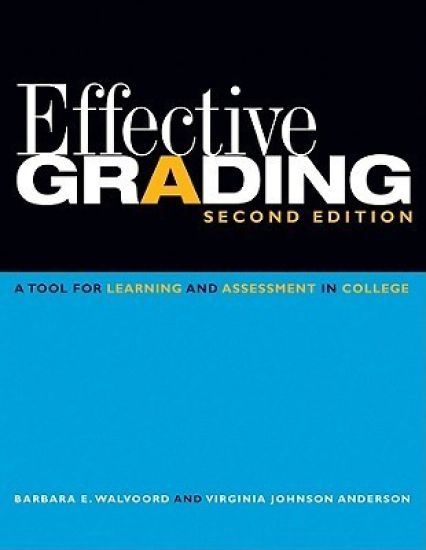
Effective Grading

Effective Grading

Barbara E. Walvoord; Virginia Johnson Anderson

John Wiley Sons Inc
2009
nidottu
The second edition of Effective Grading—the book that has become a classic in the field—provides a proven hands-on guide for evaluating student work and offers an in-depth examination of the link between teaching and grading. Authors Barbara E. Walvoord and Virginia Johnson Anderson explain that grades are not isolated artifacts but part of a process that, when integrated with course objectives, provides rich information about student learning, as well as being a tool for learning itself. The authors show how the grading process can be used for broader assessment objectives, such as curriculum and institutional assessment. This thoroughly revised and updated edition includes a wealth of new material including: Expanded integration of the use of technology and online teaching A sample syllabus with goals, outcomes, and criteria for student work New developments in assessment for grant-funded projects Additional information on grading group work, portfolios, and service-learning experiences New strategies for aligning tests and assignments with learning goals Current thought on assessment in departments and general education, using classroom work for program assessments, and using assessment data systematically to "close the loop" Material on using the best of classroom assessment to foster institutional assessment New case examples from colleges and universities, including community colleges "When the first edition of Effective Grading came out, it quickly became the go-to book on evaluating student learning. This second edition, especially with its extension into evaluating the learning goals of departments and general education programs, will make it even more valuable for everyone working to improve teaching and learning in higher education." —L. Dee Fink, author, Creating Significant Learning Experiences "Informed by encounters with hundreds of faculty in their workshops, these two accomplished teachers, assessors, and faculty developers have created another essential text. Current faculty, as well as graduate students who aspire to teach in college, will carry this edition in a briefcase for quick reference to scores of examples of classroom teaching and assessment techniques and ways to use students' classroom work in demonstrating departmental and institutional effectiveness." —Trudy W. Banta, author, Designing Effective Assessment
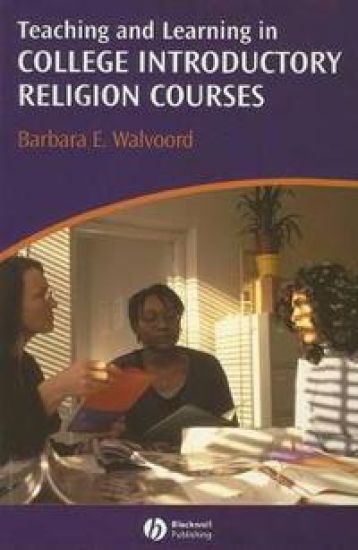
Teaching and Learning in College Introductory Religion Courses

Teaching and Learning in College Introductory Religion Courses

Barbara E. Walvoord

Wiley-Blackwell (an imprint of John Wiley Sons Ltd)
2007
nidottu
From public to private, non-sectarian to faith-based institutions, this book describes the best ways to teach introductory courses in theology and religion. The author's research data from 533 introductory courses yields concrete, useful information about student goals, student learning, and effective pedagogical methods. Offers practical, realistic, research-based guidance for faculty and graduate students, incorporating the practices of highly-effective teachersLooks at key topics, such as how to establish and communicate with students about learning goals, what kinds of student development to expect, how to construct effective assignments, how to manage the paper load, and how to ensure that students are prepared for classIncludes case studies of theology and religious studies courses at various institutions both public and private, including large and small classes, in subjects as diverse as World Religions, Introduction to Religion, Bible, and Theology.
Teaching and Learning in College Introductory Religion Courses

Teaching and Learning in College Introductory Religion Courses

Barbara E. Walvoord

Wiley-Blackwell (an imprint of John Wiley Sons Ltd)
2007
sidottu
From public to private, non-sectarian to faith-based institutions, this book describes the best ways to teach introductory courses in theology and religion. The author's research data from 533 introductory courses yields concrete, useful information about student goals, student learning, and effective pedagogical methods. Offers practical, realistic, research-based guidance for faculty and graduate students, incorporating the practices of highly-effective teachersLooks at key topics, such as how to establish and communicate with students about learning goals, what kinds of student development to expect, how to construct effective assignments, how to manage the paper load, and how to ensure that students are prepared for classIncludes case studies of theology and religious studies courses at various institutions both public and private, including large and small classes, in subjects as diverse as World Religions, Introduction to Religion, Bible, and Theology.