Kirjojen hintavertailu. Mukana 12 390 323 kirjaa ja 12 kauppaa.

Kirjailija

Barbara J. Thayer-Bacon

Kirjat ja teokset yhdessä paikassa: 4 kirjaa, julkaisuja vuosilta 2000-2013, suosituimpien joukossa Transforming Critical Thinking. Vertaile teosten hintoja ja tarkista saatavuus suomalaisista kirjakaupoista.

Mukana myös kirjoitusasut: Barbara J.Thayer- Bacon

4 kirjaa

Kirjojen julkaisuhaarukka 2000-2013.

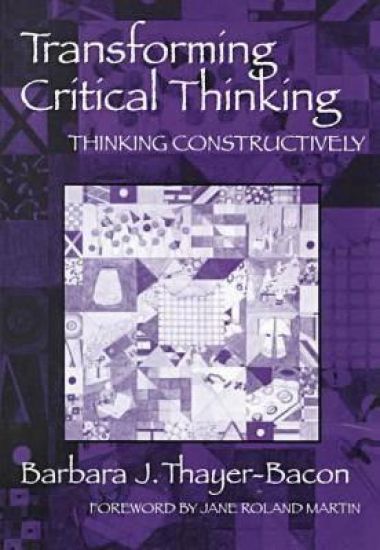
Transforming Critical Thinking

Transforming Critical Thinking

Barbara J.Thayer- Bacon

Teachers' College Press
2000
nidottu
Barbara J. Thayer-Bacon presents a groundbreaking reconceptualization of critical thinking theory. Drawing on pragmatic, feminist, and postmodern philosophies, this richly detailed volume presents an overview of the history of critical thinking and identifies its major theorists. Thayer-Bacon critiques how critical thinking is conceptualized and applied in classrooms and offers a newly delineated platform for how women and feminist theorists, as well as men, can engage in what she calls "constructive thinking." Her proposals are not only timely, they are also original. This book is a vital addition to the discourse and debates about critical thinking theory.
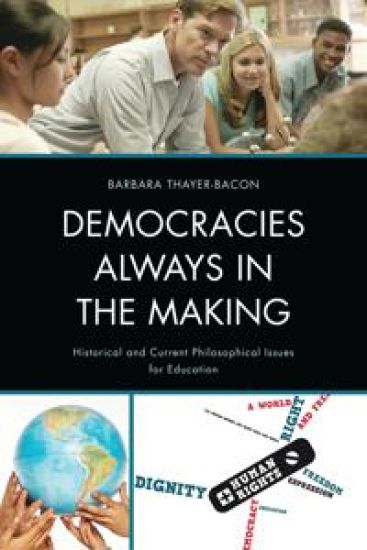
Democracies Always in the Making

Democracies Always in the Making

Barbara J. Thayer-Bacon

Rowman Littlefield Education
2013
sidottu
Democracies Always in the Making develops Barbara Thayer-Bacon’s relational and pluralistic democratic theory, as well as translates that socio-political philosophical theory into educational theory and recommendations for school reform in American public schools. John Dewey warned us long ago that a nation cannot hope to be a democracy someday without paying attention to how it educates its young future citizens. Democracy is a goal, an ideal which we must continually strive for that can guide us in our decision-making, as we continue to live in a world that is unpredictable, flawed, and limited in terms of its resources. There are key political philosophers of education who we can turn to for help. They offer us important ideas that will help us re-check our assumptions and critique our daily practice. Existing school models also offer us important examples of how to structure schools as well as various methodologies and curriculum that we can elect to use to help us move closer to the ideal of a democracy.
Democracies Always in the Making

Democracies Always in the Making

Barbara J. Thayer-Bacon

Rowman Littlefield Education
2013
nidottu
Democracies Always in the Making develops Barbara Thayer-Bacon’s relational and pluralistic democratic theory, as well as translates that socio-political philosophical theory into educational theory and recommendations for school reform in American public schools. John Dewey warned us long ago that a nation cannot hope to be a democracy someday without paying attention to how it educates its young future citizens. Democracy is a goal, an ideal which we must continually strive for that can guide us in our decision-making, as we continue to live in a world that is unpredictable, flawed, and limited in terms of its resources. There are key political philosophers of education who we can turn to for help. They offer us important ideas that will help us re-check our assumptions and critique our daily practice. Existing school models also offer us important examples of how to structure schools as well as various methodologies and curriculum that we can elect to use to help us move closer to the ideal of a democracy.
Relational "(e)Pistemologies"

Relational "(e)Pistemologies"

Barbara J. Thayer-Bacon

Peter Lang Publishing Inc
2003
nidottu
Relational (e)pistemologies redefines epistemology in a non-transcendent manner and reclaims the traditional epistemological concerns of standards and criteria for warranting arguments and determining truth and falsity. These concerns must be reclaimed in order to make them visible and accountable as well as pragmatically useful on socially constructed grounds - not transcendental grounds. Thayer-Bacon's book offers analysis and critique as well as redescription. She presents a pragmatist social feminist view, a relational perspective of knowing embedded within a discussion of many other relational views - personal, social and holistic, ecological, and scientific - which emphasize connections. Thayer-Bacon describes each of these forms of relationality, and she points to key scholars whose work highlights a certain relational form. She concludes with a discussion of the educational implications relational (e)pistemological theories have for education.