Kirjojen hintavertailu. Mukana 12 497 225 kirjaa ja 12 kauppaa.

Kirjailija

Barbara Kamler

Kirjat ja teokset yhdessä paikassa: 8 kirjaa, julkaisuja vuosilta 2012-2024, suosituimpien joukossa Sophie. Vertaile teosten hintoja ja tarkista saatavuus suomalaisista kirjakaupoista.

8 kirjaa

Kirjojen julkaisuhaarukka 2012-2024.

Sophie

Sophie

Barbara Kamler

Ginninderra Press
2024
pokkari
At fourteen Sophie Kamler crossed the Atlantic alone, from Poland to America. At sixteen she paid for her siblings and mother to follow. At eighteen, a penniless wife, then a mother of three, she defied New York gangsters.At fifty six, a widow, she married again only to be widowed a second time. Matriarch to a sprawling but tightly held family of descendants, hers is a story of ambition - of love given, withheld, slighted, sustained and disappointed.Told here by her granddaughter, Barbara Kamler, in riveting vignettes, photographs and poetic reflections, this tale will resonate with the experience of so many remarkable women, minimising the complexity and vibrancy of their lives.
Love, Regardless

Love, Regardless

Barbara Kamler

HYBRID PUBLISHERS
2022
nidottu
Love, regardless - the second collection from Melbourne-based Barbara Kamler - is an enthralling gallery of poetic portraits celebrating love that endures. It features a unique, dialogic mode of storytelling, whereby interviews with fourteen couples are poetically crafted into rhythmic, syllabic verse. Each poem explores the intimacy of first connecting and the various complications negotiated along the way - crushing pressures of sexual or racial norms, the challenge of chronic illness or disparate histories, and the demands of extended family or geographic distance. Yet these are sanguine stories that transcend the trials of the everyday, making real the possibility of mutual love and joy over a lifetime. Love, regardless is a beautiful and provocative collection that sings with the vitality of the spoken word, as couples thread the past to the present - recounting the passion and pathos of long love - and the ways they move forward, together, regardless.
Detox Your Writing

Detox Your Writing

Pat Thomson; Barbara Kamler

Routledge
2016
sidottu
There are a number of books which aim to help doctoral researchers write the PhD. This book offers something different - the scholarly detox. This is not a faddish alternative, it’s not extreme. It’s a moderate approach intended to gently interrupt old ways of doing things and establish new habits and orientations to writing the PhD.The book addresses the problems that most doctoral researchers experience at some time during their candidature – being unclear about their contribution, feeling lost in the literature, feeling like an imposter, not knowing how to write with authority, wanting to edit rather than revise. Each chapter addresses a problem, suggests an alternative framing, and then offers strategies designed to address the real issue. Detox Your Writing is intended to be a companionable work book – something doctoral researchers can use throughout their doctorate to ask questions about taken-for-granted ways of writing and reading, and to develop new and effective approaches. The authors’ distinctive approach to doctoral writing mobilises the rich traditions of linguistic scholarship, as well as the literatures on scholarly identity formation. Building on years of expertise they place their emphasis both on tools and techniques as well as the discursive practices of becoming a scholar. The authors provide a wide repertoire of strategies that doctoral researchers can select from, rather than a linear lock step progression through a set of exercises. The book is a toolkit but a far from prescriptive one. It shows that there are many routes to developing a personal academic voice and identity and a well-crafted text. With points for reflection alongside examples from a broad range of disciplines, the book offers thinking tools, writing tools, linguistic tools, and reading tools which are relevant to all stages of doctoral research.This practical text can be used in all university doctoral training and composition and writing courses. However, it is not a dry how-to-do–it manual that ignores debates or focuses solely on the mechanical at the expense of the lived experience of doctoral research. It provides a practical, theorised, real-world, guide to postgraduate writing.
Detox Your Writing

Detox Your Writing

Pat Thomson; Barbara Kamler

Routledge
2016
nidottu
There are a number of books which aim to help doctoral researchers write the PhD. This book offers something different - the scholarly detox. This is not a faddish alternative, it’s not extreme. It’s a moderate approach intended to gently interrupt old ways of doing things and establish new habits and orientations to writing the PhD.The book addresses the problems that most doctoral researchers experience at some time during their candidature – being unclear about their contribution, feeling lost in the literature, feeling like an imposter, not knowing how to write with authority, wanting to edit rather than revise. Each chapter addresses a problem, suggests an alternative framing, and then offers strategies designed to address the real issue. Detox Your Writing is intended to be a companionable work book – something doctoral researchers can use throughout their doctorate to ask questions about taken-for-granted ways of writing and reading, and to develop new and effective approaches. The authors’ distinctive approach to doctoral writing mobilises the rich traditions of linguistic scholarship, as well as the literatures on scholarly identity formation. Building on years of expertise they place their emphasis both on tools and techniques as well as the discursive practices of becoming a scholar. The authors provide a wide repertoire of strategies that doctoral researchers can select from, rather than a linear lock step progression through a set of exercises. The book is a toolkit but a far from prescriptive one. It shows that there are many routes to developing a personal academic voice and identity and a well-crafted text. With points for reflection alongside examples from a broad range of disciplines, the book offers thinking tools, writing tools, linguistic tools, and reading tools which are relevant to all stages of doctoral research.This practical text can be used in all university doctoral training and composition and writing courses. However, it is not a dry how-to-do–it manual that ignores debates or focuses solely on the mechanical at the expense of the lived experience of doctoral research. It provides a practical, theorised, real-world, guide to postgraduate writing.
Helping Doctoral Students Write

Helping Doctoral Students Write

Barbara Kamler; Pat Thomson

Routledge
2014
sidottu
Helping Doctoral Students Write offers a proven approach to effective doctoral writing. By treating research as writing and writing as research, the authors offer pedagogical strategies for doctoral supervisors that will assist the production of well-argued and lively dissertations. It is clear that many doctoral candidates find research writing complicated and difficult, but the advice they receive often glosses over the complexities of writing and/or locates the problem in the writer. Kamler and Thomson provide a highly effective framework for scholarly work that is located in personal, institutional and cultural contexts. The pedagogical approach developed in the book is based on the notion of writing as a social practice. This approach allows supervisors to think of doctoral writers as novices who need to learn new ways with words as they enter the discursive practices of scholarly communities. This involves learning sophisticated writing practices with specific sets of conventions and textual characteristics. The authors offer supervisors practical advice on helping with commonly encountered writing tasks such as the proposal, the journal abstract, the literature review and constructing the dissertation argument.The first edition of this book has helped many academics and thousands of research students produce better written material. Now fully updated the second edition includes: Examples from a broader range of academic disciplines A new chapter on writing from the thesis for peer reviewed journals More advice on reading and note taking, performance and conferences, Further information on developing a personal academic writing style, and Advice on the use of social media (blogs, tweets and wikis) to create trans-disciplinary and trans-national networks and conversations.Their discussion of the complexities of forming a scholarly identity is illustrated throughout by stories and writings of actual doctoral students.In conclusion, they present a persuasive and proven argument that universities must move away from simply auditing supervision to supporting the development of scholarly research communities. Any supervisor keen to help their students develop as academics will find the ideas and practical solutions presented in this book fascinating and insightful reading.
Helping Doctoral Students Write

Helping Doctoral Students Write

Barbara Kamler; Pat Thomson

Routledge
2014
nidottu
Helping Doctoral Students Write offers a proven approach to effective doctoral writing. By treating research as writing and writing as research, the authors offer pedagogical strategies for doctoral supervisors that will assist the production of well-argued and lively dissertations. It is clear that many doctoral candidates find research writing complicated and difficult, but the advice they receive often glosses over the complexities of writing and/or locates the problem in the writer. Kamler and Thomson provide a highly effective framework for scholarly work that is located in personal, institutional and cultural contexts. The pedagogical approach developed in the book is based on the notion of writing as a social practice. This approach allows supervisors to think of doctoral writers as novices who need to learn new ways with words as they enter the discursive practices of scholarly communities. This involves learning sophisticated writing practices with specific sets of conventions and textual characteristics. The authors offer supervisors practical advice on helping with commonly encountered writing tasks such as the proposal, the journal abstract, the literature review and constructing the dissertation argument.The first edition of this book has helped many academics and thousands of research students produce better written material. Now fully updated the second edition includes: Examples from a broader range of academic disciplines A new chapter on writing from the thesis for peer reviewed journals More advice on reading and note taking, performance and conferences, Further information on developing a personal academic writing style, and Advice on the use of social media (blogs, tweets and wikis) to create trans-disciplinary and trans-national networks and conversations.Their discussion of the complexities of forming a scholarly identity is illustrated throughout by stories and writings of actual doctoral students.In conclusion, they present a persuasive and proven argument that universities must move away from simply auditing supervision to supporting the development of scholarly research communities. Any supervisor keen to help their students develop as academics will find the ideas and practical solutions presented in this book fascinating and insightful reading.
Writing for Peer Reviewed Journals

Writing for Peer Reviewed Journals

Pat Thomson; Barbara Kamler

Routledge
2012
nidottu
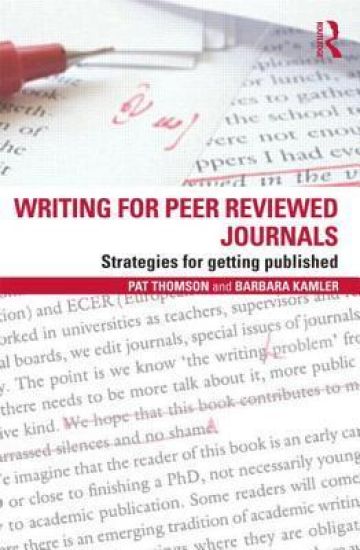
It’s not easy getting published, but everyone has to do it. Writing for Peer Reviewed Journals presents an insider’s perspective on the secret business of academic publishing, making explicit many of the dilemmas and struggles faced by all writers, but rarely discussed. Its unique approach is theorised and practical. It offers a set of moves for writing a journal article that is structured and doable but also attends to the identity issues that manifest on the page and in the politics of academic life.The book comprehensively assists anyone concerned about getting published; whether they are early in their career or moving from a practice base into higher education, or more experienced but still feeling in need of further information. Avoiding a ‘tips and tricks’ approach, which tends to oversimplify what is at stake in getting published, the authors emphasise the production, nurture and sustainability of scholarship through writing – a focus on both the scholar and the text or what they call text work/identity work. The chapters are ordered to develop a systematic approach to the process, including such topics as: The writer The reader What’s the contribution? Beginning work Refining the argument Engaging with reviewers and editors Writing for Peer Reviewed Journals uses a wide range of multi-disciplinary examples from the writing workshops the authors have run in universities around the world: including the UK, Canada, Australia, New Zealand, Ireland, South Africa, Norway, Sweden, Denmark and the United States. This international approach coupled with theoretically grounded strategies to guide the authoring process ensure that people at all stages of their career are addressed. This lively book uses a combination of personal stories, student texts, published journal abstracts and excerpts from interviews with journal editors and publishers. Written in an accessible style, one which does not use the patronising ‘you’ of advice books, it offers a collegial approach to a task which is difficult for most scholars, regardless of their years of experience.
Writing for Peer Reviewed Journals

Writing for Peer Reviewed Journals

Pat Thomson; Barbara Kamler

Routledge
2012
sidottu
It’s not easy getting published, but everyone has to do it. Writing for Peer Reviewed Journals presents an insider’s perspective on the secret business of academic publishing, making explicit many of the dilemmas and struggles faced by all writers, but rarely discussed. Its unique approach is theorised and practical. It offers a set of moves for writing a journal article that is structured and doable but also attends to the identity issues that manifest on the page and in the politics of academic life.The book comprehensively assists anyone concerned about getting published; whether they are early in their career or moving from a practice base into higher education, or more experienced but still feeling in need of further information. Avoiding a ‘tips and tricks’ approach, which tends to oversimplify what is at stake in getting published, the authors emphasise the production, nurture and sustainability of scholarship through writing – a focus on both the scholar and the text or what they call text work/identity work. The chapters are ordered to develop a systematic approach to the process, including such topics as: The writer The reader What’s the contribution? Beginning work Refining the argument Engaging with reviewers and editors Writing for Peer Reviewed Journals uses a wide range of multi-disciplinary examples from the writing workshops the authors have run in universities around the world: including the UK, Canada, Australia, New Zealand, Ireland, South Africa, Norway, Sweden, Denmark and the United States. This international approach coupled with theoretically grounded strategies to guide the authoring process ensure that people at all stages of their career are addressed. This lively book uses a combination of personal stories, student texts, published journal abstracts and excerpts from interviews with journal editors and publishers. Written in an accessible style, one which does not use the patronising ‘you’ of advice books, it offers a collegial approach to a task which is difficult for most scholars, regardless of their years of experience.