Kirjojen hintavertailu. Mukana 12 390 323 kirjaa ja 12 kauppaa.
Kirjailija
Barry C. Arnold
Kirjat ja teokset yhdessä paikassa: 14 kirjaa, julkaisuja vuosilta 1987-2020, suosituimpien joukossa Pareto Distributions. Vertaile teosten hintoja ja tarkista saatavuus suomalaisista kirjakaupoista.
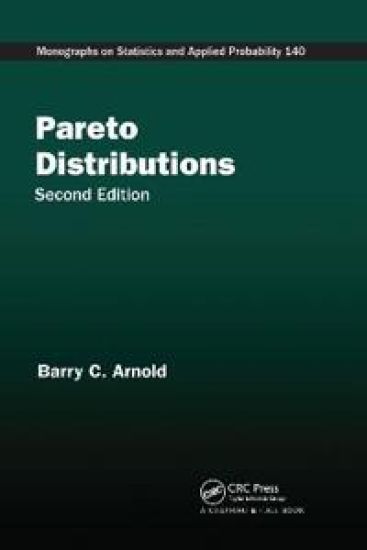
Since the publication of the first edition over 30 years ago, the literature related to Pareto distributions has flourished to encompass computer-based inference methods. Pareto Distributions, Second Edition provides broad, up-to-date coverage of the Pareto model and its extensions. This edition expands several chapters to accommodate recent results and reflect the increased use of more computer-intensive inference procedures.New to the Second Edition New material on multivariate inequality Recent ways of handling the problems of inference for Pareto models and their generalizations and extensionsNew discussions of bivariate and multivariate income and survival models This book continues to provide researchers with a useful resource for understanding the statistical aspects of Pareto and Pareto-like distributions. It covers income models and properties of Pareto distributions, measures of inequality for studying income distributions, inference procedures for Pareto distributions, and various multivariate Pareto distributions existing in the literature.
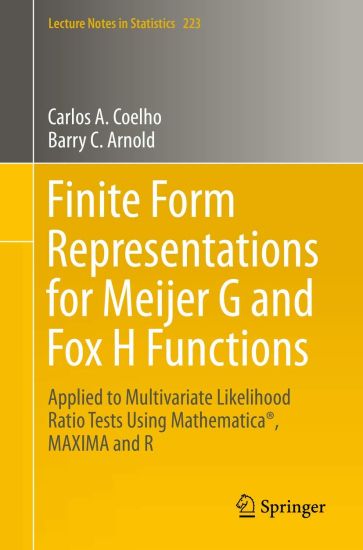
This book depicts a wide range of situations in which there exist finite form representations for the Meijer G and the Fox H functions. Accordingly, it will be of interest to researchers and graduate students who, when implementing likelihood ratio tests in multivariate analysis, would like to know if there exists an explicit manageable finite form for the distribution of the test statistics. In these cases, both the exact quantiles and the exact p-values of the likelihood ratio tests can be computed quickly and efficiently.The test statistics in question range from common ones, such as those used to test e.g. the equality of means or the independence of blocks of variables in real or complex normally distributed random vectors; to far more elaborate tests on the structure of covariance matrices and equality of mean vectors. The book also provides computational modules in Mathematica®, MAXIMA and R, which allow readers to easily implement, plot and compute the distributions of any of these statistics, or any other statistics that fit into the general paradigm described here.
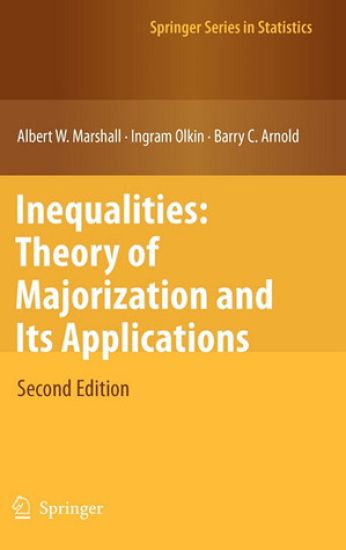
This book was written to serve as a graduate-level textbook for special topics classes in mathematics, statistics, and economics, to introduce these topics to other researchers, and for use in short courses. It is an introduction to the theory of majorization and related notions, and contains detailed material on economic applications of majorization and the Lorenz order, investigating the theoretical aspects of these two interrelated orderings. Revising and expanding on an earlier monograph, Majorization and the Lorenz Order: A Brief Introduction, the authors provide a straightforward development and explanation of majorization concepts, addressing historical development of the topics, and providing up-to-date coverage of families of Lorenz curves. The exposition of multivariate Lorenz orderings sets it apart from existing treatments of these topics.Mathematicians, theoretical statisticians, economists, and other social scientists who already recognize the utility of the Lorenz order in income inequality contexts and arenas will find the book useful for its sound development of relevant concepts rigorously linked to both the majorization literature and the even more extensive body of research on economic applications. Barry C. Arnold, PhD, is Distinguished Professor in the Statistics Department at the University of California, Riverside. He is a Fellow of the American Statistical Society, the American Association for the Advancement of Science, and the Institute of Mathematical Statistics, and is an elected member of the International Statistical Institute. He is the author of more than two hundred publications and eight books.José María Sarabia, PhD, is Professor of Statistics and Quantitative Methods in Business and Economics in the Department of Economics at the University of Cantabria, Spain. He is author of more than one hundred and fifty publications and ten books and is an associate editor of several journals including TEST, Communications in Statistics, and Journal of Statistical Distributions and Applications.
This book was written to serve as a graduate-level textbook for special topics classes in mathematics, statistics, and economics, to introduce these topics to other researchers, and for use in short courses. It is an introduction to the theory of majorization and related notions, and contains detailed material on economic applications of majorization and the Lorenz order, investigating the theoretical aspects of these two interrelated orderings. Revising and expanding on an earlier monograph, Majorization and the Lorenz Order: A Brief Introduction, the authors provide a straightforward development and explanation of majorization concepts, addressing historical development of the topics, and providing up-to-date coverage of families of Lorenz curves. The exposition of multivariate Lorenz orderings sets it apart from existing treatments of these topics.Mathematicians, theoretical statisticians, economists, and other social scientists who already recognize the utility of the Lorenz order in income inequality contexts and arenas will find the book useful for its sound development of relevant concepts rigorously linked to both the majorization literature and the even more extensive body of research on economic applications. Barry C. Arnold, PhD, is Distinguished Professor in the Statistics Department at the University of California, Riverside. He is a Fellow of the American Statistical Society, the American Association for the Advancement of Science, and the Institute of Mathematical Statistics, and is an elected member of the International Statistical Institute. He is the author of more than two hundred publications and eight books.José María Sarabia, PhD, is Professor of Statistics and Quantitative Methods in Business and Economics in the Department of Economics at the University of Cantabria, Spain. He is author of more than one hundred and fifty publications and ten books and is an associate editor of several journals including TEST, Communications in Statistics, and Journal of Statistical Distributions and Applications.
This book’s first edition has been widely cited by researchers in diverse fields. The following are excerpts from reviews. “Inequalities: Theory of Majorization and its Applications” merits strong praise. It is innovative, coherent, well written and, most importantly, a pleasure to read. … This work is a valuable resource!” (Mathematical Reviews). “The authors … present an extremely rich collection of inequalities in a remarkably coherent and unified approach. The book is a major work on inequalities, rich in content and original in organization.” (Siam Review). “The appearance of … Inequalities in 1979 had a great impact on the mathematical sciences. By showing how a single concept unified a staggering amount of material from widely diverse disciplines–probability, geometry, statistics, operations research, etc.–this work was a revelation to those of us who had been trying to make sense of his own corner of this material.” (Linear Algebra and its Applications). This greatly expanded new edition includes recent research on stochastic, multivariate and group majorization, Lorenz order, and applications in physics and chemistry, in economics and political science, in matrix inequalities, and in probability and statistics. The reference list has almost doubled.
Since the publication of the first edition over 30 years ago, the literature related to Pareto distributions has flourished to encompass computer-based inference methods. Pareto Distributions, Second Edition provides broad, up-to-date coverage of the Pareto model and its extensions. This edition expands several chapters to accommodate recent results and reflect the increased use of more computer-intensive inference procedures.New to the Second Edition New material on multivariate inequality Recent ways of handling the problems of inference for Pareto models and their generalizations and extensionsNew discussions of bivariate and multivariate income and survival modelsThis book continues to provide researchers with a useful resource for understanding the statistical aspects of Pareto and Pareto-like distributions. It covers income models and properties of Pareto distributions, measures of inequality for studying income distributions, inference procedures for Pareto distributions, and various multivariate Pareto distributions existing in the literature.
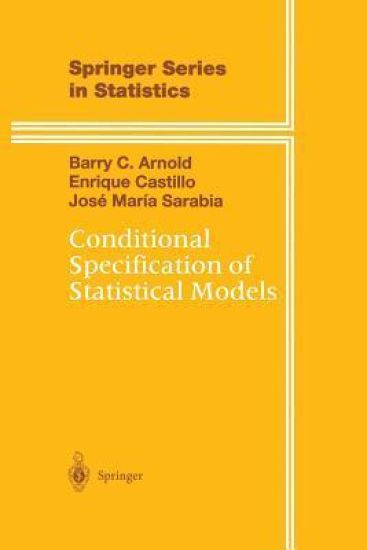
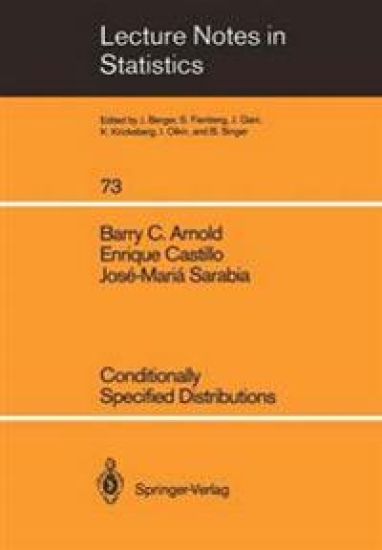
Efforts to visualize multivariate densities necessarily involve the use of cross-sections, or, equivalently, conditional densities. This book focuses on distributions that are completely specified in terms of conditional densities. They are appropriately used in any modeling situation where conditional information is completely or partially available. All statistical researchers seeking more flexible models than those provided by classical models will find conditionally specified distributions of interest.
This book’s first edition has been widely cited by researchers in diverse fields. The following are excerpts from reviews. “Inequalities: Theory of Majorization and its Applications” merits strong praise. It is innovative, coherent, well written and, most importantly, a pleasure to read. … This work is a valuable resource!” (Mathematical Reviews). “The authors … present an extremely rich collection of inequalities in a remarkably coherent and unified approach. The book is a major work on inequalities, rich in content and original in organization.” (Siam Review). “The appearance of … Inequalities in 1979 had a great impact on the mathematical sciences. By showing how a single concept unified a staggering amount of material from widely diverse disciplines–probability, geometry, statistics, operations research, etc.–this work was a revelation to those of us who had been trying to make sense of his own corner of this material.” (Linear Algebra and its Applications). This greatly expanded new edition includes recent research on stochastic, multivariate and group majorization, Lorenz order, and applications in physics and chemistry, in economics and political science, in matrix inequalities, and in probability and statistics. The reference list has almost doubled.
Written in a simple style that requires no advanced mathematical or statistical background, A First Course in Order Statistics introduces the general theory of order statistics and their applications. The book covers topics such as distribution theory for order statistics from continuous and discrete populations, moment relations, bounds and approximations, order statistics in statistical inference and characterization results, and basic asymptotic theory. This classic text will aid readers in understanding much of the current literature on order statistics, a burgeoning field of study that is a requisite for any practicing statistician and an essential part of the training for students in statistics. The authors have updated the text with suggestions for further reading that readers may use for self-study.
Efforts to visualize multivariate densities necessarily involve the use of cross-sections, or, equivalently, conditional densities. This book focuses on distributions that are completely specified in terms of conditional densities. They are appropriately used in any modeling situation where conditional information is completely or partially available. All statistical researchers seeking more flexible models than those provided by classical models will find conditionally specified distributions of interest.
The first and only comprehensive guide to modern record theory andits applications Although it is often thought of as a special topic in orderstatistics, records form a unique area, independent of the study ofsample extremes. Interest in records has increased steadily overthe years since Chandler formulated the theory of records in 1952.Numerous applications of them have been developed in such far-flungfields as meteorology, sports analysis, hydrology, and stock marketanalysis, to name just a few. And the literature on the subjectcurrently comprises papers and journal articles numbering in thehundreds. Which is why it is so nice to have this book devotedexclusively to this lively area of statistics. Written by an exceptionally well-qualified author team, Recordspresents a comprehensive treatment of record theory and itsapplications in a variety of disciplines. With the help of amultitude of fascinating examples, Professors Arnold, Balakrishnan,and Nagaraja help readers quickly master basic and advanced recordvalue concepts and procedures, from the classical record valuemodel to random and multivariate record models. The book follows arational textbook format, featuring witty and insightful chapterintroductions that help smooth transitions from one topic toanother and challenging chapter-end exercises, which expand on thematerial covered. An extensive bibliography and numerous referencesthroughout the text specify sources for further readings onrelevant topics. Records is a valuable professional resource forprobabilists and statisticians, in addition to appliedstatisticians, meteorologists, hydrologists, market analysts, andsports analysts. It also makes an excellent primary text forcourses in record theory and a supplement to order statisticscourses.
The concept of conditional specification is not new. It is likely that earlier investigators in this area were deterred by computational difficulties encountered in the analysis of data following con ditionally specified models. Readily available computing power has swept away that roadblock. A broad spectrum of new flexible models may now be added to the researcher's tool box. This mono graph provides a preliminary guide to these models. Further development of inferential techniques, especially those involving concomitant variables, is clearly called for. We are grateful for invaluable assistance in the preparation of this monograph. In Riverside, Carole Arnold made needed changes in grammer and punctuation and Peggy Franklin miraculously transformed minute hieroglyphics into immaculate typescript. In Santander, Agustin Manrique ex pertly transformed rough sketches into clear diagrams. Finally, we thank the University of Cantabria for financial support which made possible Barry C. Arnold's enjoyable and productive visit to S- tander during the initial stages of the project. Barry C. Arnold Riverside, California USA Enrique Castillo Jose Maria Sarabia Santander, Cantabria Spain January, 1991 Contents 1 Conditional Specification 1 1.1 Why? ............. ........ . 1 1.2 How may one specify a bivariate distribution? 2 1.3 Early work on conditional specification 4 1.4 Organization of this monograph . . . . . . . . . . . . . . . . . . . . . . . . . . . .. 5 2 Basic Theorems 7 Compatible conditionals: The finite discrete case.
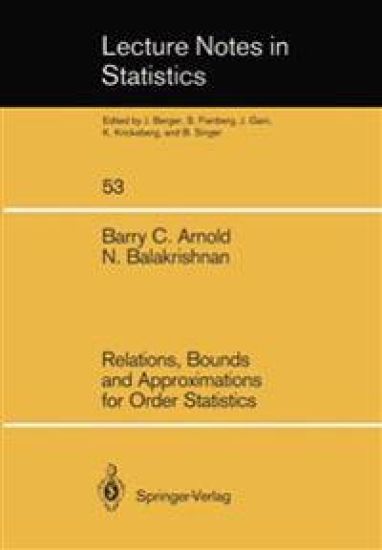
Bounds on moments of order statistics have been of interest since Sir Francis Galton (1902) flrst addressed the problem of fairly dividing flrst and second prize money in a competition. The present compendium of results represents our effort to sort the plethora of results into some semblance of order. We have tried to assign priority for results appropriately. We will cheerfully accept corrections. Omissions of interesting results have inevitably occurred. On this too we await (cheerful) corrections. We are grateful to Peggy Franklin (University of California), Janet Leach, Domenica Calabria and Patsy Chan (McMaster University) who shared the responsibility of typing the manuscript. The flnal form of the manuscript owes much to their skill and patience. Barry C. Arnold Riverside, California U. S. A. N. Balakrishnan Hamilton, Ontario Canada November, 1988 Table of Contents Chapter 1: TIlE DISTRIBUTION OF ORDER STATISTICS Exercises 4 Chapter 2: RECURRENCE RELATIONS AND IDENTITIES FOR ORDER STATISTICS 2. 0. Introduction 5 2. 1. Relations for single moments 6 2. 2. Relations for product moments 9 2. 3. Relations for covariances 13 15 2. 4. Results for symmetric populations 2. 5. Results for normal population 17 20 2. 6. Results for two related populations 2. 7. Results for exchangeable variates 23 25 Exercises Chapter 3: BOUNDS ON EXPECTATIONS OF ORDER STATISTICS 3. 0. Introduction 38 3. 1. Universal bounds in the Li. d. case 38 3. 2. Variations on the Samuelson-Scott theme 43 3. 3.
My interest in majorization was first spurred by Ingram aIkin's proclivity for finding Schur convex functions lurking in the problem section of every issue of the American Mathematical Monthly. Later my interest in income inequality led me again to try and "really" understand Hardy, Littlewood and Polya' s contributions to the majori zation literature. I have found the income distribution context to be quite convenient for discussion of inequality orderings. The pre sent set of notes is designed for a one quarter course introducing majorization and the Lorenz order. The inequality principles of Dalton, especially the transfer or Robin Hood principle, are given appropriate prominence. Initial versions of these notes were used in graduate statistics classes taught at the Colegio de Postgraduados, Chapingo, Mexico and the University of California, Riverside. I am grateful to students in these classes for their constructive critical commentaries. My wife Carole made noble efforts to harness my free form writ ing and punctuation. Occasionally I was unmoved by her requests for clarification. Time will probably prove her right in these instances also. Peggy Franklin did an outstanding job of typing the manu script, and patiently endured requests for innumerable modifications.