Kirjojen hintavertailu. Mukana 12 218 318 kirjaa ja 12 kauppaa.

Kirjailija

Barry Cooper

Kirjat ja teokset yhdessä paikassa: 43 kirjaa, julkaisuja vuosilta 1979-2026, suosituimpien joukossa Australien berättar : drömtidens framtid - nitton noveller. Vertaile teosten hintoja ja tarkista saatavuus suomalaisista kirjakaupoista.

43 kirjaa

Kirjojen julkaisuhaarukka 1979-2026.

Alexander Kennedy Isbister

Alexander Kennedy Isbister

Barry Cooper

Carleton University Press,Canada
1988
nidottu
Born of mixed Scottish/Native Indian blood in what is now Saskatchewan, Isbister emigrated to Britain after he found his ambitions thwarted by Hudson's Bay Company policies regarding native-born employees. There he became a respected educator, but more important to this study, he also became the most persistent critic of the Company, and of British and Canadian policies dealing with the inhabitants of Rupert's Land and the Northwest Territories.
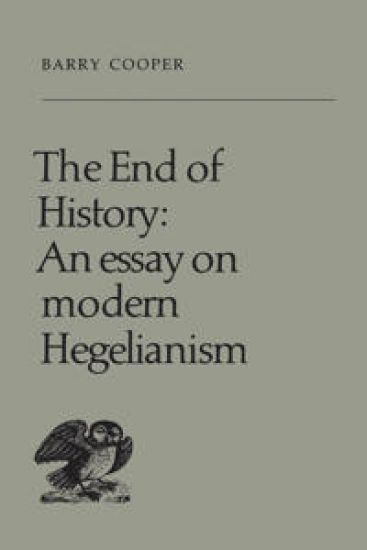
The End of History

The End of History

Barry Cooper

University of Toronto Press
1984
pokkari
History ended, according to Hegel according to Kojève, with the establishment and proliferation in Europe of states organized along Napoleonic lines: rational, bureaucratic, homogenous, atheist. This state lives in some tension with the popular slogan that helped give it birth: Liberty, Equality, Fraternity. But there is now also totalitarianism – the only new kind of regime, according to Arendt, created since the national state. Man is now in charge of nature, technology, and society; much of political life has become a gavotte elaborating the meaning of the Napoleonic model. This interpretation, however opposed it seems to common sense, has been influential, particularly in France where the course of existentialism is unintelligible without taking it into account. Professor Cooper argues that it is inherently plausible and examines the arguments of Hegel and Kojève to reveal its consistency and explanatory power. And he applies it to more contemporary events – the experience of the atomic bomb, the Gulag system of extermination, and the growth of multinational corporations. The work concludes by pulling together the presuppositions and theories of the totalitarian system, the Hegelian version of the Napoleonic state, and our contemporary technological society. Overall, the reader will find here a complete and challenging presentation of how the modern world understands its collective life.
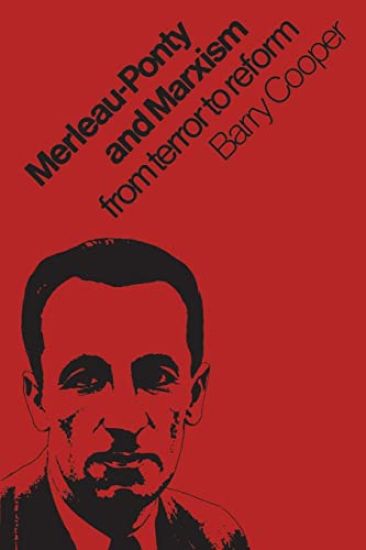
Merleau-Ponty and Marxism

Merleau-Ponty and Marxism

Barry Cooper

UNIVERSITY OF TORONTO PRESS
1979
pokkari
Influenced by Kojève's interpretation of Hegel as well as his direct political experience of the second world war, Maurice Merleau-Ponty abandoned the religious and philosophical position he had assumed in the 1930s and turned to Marxism. This is the first critical study of the French philosopher's political ideas and the context in which they evolved. In its origin and its development, Merleau-Ponty's political thought expressed a subtle dialectic between ongoing political events and the apparent truths of Marx's analysis. With the onset of the cold war, the discovery of the Soviet concentration camps, the repression of Eastern Europe, the Algerian crisis, and the founding of the Fifth Republic, Merleau-Ponty began to take a critical look at Marx's ideas of the genesis of humanism in the light of these disturbing political realities. His reconsideration of the basis of Marxism and his conclusion that it had lost contact with history led to a fundamental reorientation of his attitudes. No longer sympathetic to the use of violence to end violence, he criticized Sartre's external justification of communist violence as 'magical' and advocated instead a new liberalism combining parliamentary democracy with an awareness of the social problems of industrial capitalism. Barry Cooper's study of this important contemporary thinker gives context for an understanding of Merleau- Ponty's politics and, in so doing, brings together the complex issues and ideas that have shaped modern European political and philosophical thought.