Kirjojen hintavertailu. Mukana 12 595 353 kirjaa ja 12 kauppaa.

Kirjailija

Barry D. Smith

Kirjat ja teokset yhdessä paikassa: 9 kirjaa, julkaisuja vuosilta 2005-2018, suosituimpien joukossa The Indescribable God. Vertaile teosten hintoja ja tarkista saatavuus suomalaisista kirjakaupoista.

Mukana myös kirjoitusasut: Barry D Smith

9 kirjaa

Kirjojen julkaisuhaarukka 2005-2018.

The Meaning of Jesus' Death

The Meaning of Jesus' Death

Barry D. Smith

T. T.Clark Ltd
2018
nidottu
Barry D. Smith studies the salvation-historical meaning of Jesus’ death (commonly known as the atonement) in the New Testament. Smith works his way through the four theories of the doctrine of the atonement that have emerged in the history of Christian theology: moral influence, governmental, satisfaction and Christus victor theories. Smith works from the premise that, for a theory of the atonement to be successful, no biblical data may be omitted or distorted, and the generalized concepts used to comprehend the biblical data must be easily seen as implicit in the data. From this vantage point, Smith advances a formulation of the atonement that is best supported by the biblical text itself. The conclusion Smith reaches is that the biblical data supports both the penal-substitutionary version of the satisfaction theory and the Christus victor theory of the atonement, each of which should be viewed as two parts of a more inclusive theory of atonement present in the New Testament.
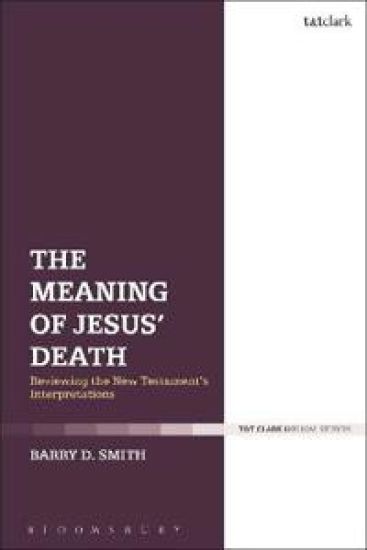
The Meaning of Jesus' Death

The Meaning of Jesus' Death

Barry D. Smith

T. T.Clark Ltd
2016
sidottu
Barry D. Smith studies the salvation-historical meaning of Jesus’ death (commonly known as the atonement) in the New Testament. Smith works his way through the four theories of the doctrine of the atonement that have emerged in the history of Christian theology: moral influence, governmental, satisfaction and Christus victor theories. Smith works from the premise that, for a theory of the atonement to be successful, no biblical data may be omitted or distorted, and the generalized concepts used to comprehend the biblical data must be easily seen as implicit in the data. From this vantage point, Smith advances a formulation of the atonement that is best supported by the biblical text itself. The conclusion Smith reaches is that the biblical data supports both the penal-substitutionary version of the satisfaction theory and the Christus victor theory of the atonement, each of which should be viewed as two parts of a more inclusive theory of atonement present in the New Testament.
The Tension Between God as Righteous Judge and as Merciful in Early Judaism
In recent years, the scholarly consensus has emerged that early Judaism should no longer be classified as a religion of legalistic works on righteousness, but rather defined primarily by God's covenant with Israel. In this work, it is argued, instead, that there is actually a tension in early Judaism between God as righteous judge and as merciful. As E. Sjöberg maintained in his Gott und Sünder im palästinischen Judentum, in the sources used for a reconstruction of early Judaism, there are two mutually exclusive ways in which God is said to relate to human beings. First, God as righteous judge deals with human beings as they deserve. They are assumed to be morally free and responsible, and God judges and recompenses them in history and eschatologically. Not only are the wicked punished for their sins, but the righteous are also rewarded for their obedience. And second, God as merciful does not deal with human beings as they deserve. Rather, he removes the guilt resulting from disobedience to the Law, sometimes on the simple condition of repentance. This means that a person can escape the consequences of disobedience. The understanding of God in the sources vacillates between God as righteous judge and God as merciful, without coming down definitively on one side to the exclusion of the other.