Kirjojen hintavertailu. Mukana 12 135 934 kirjaa ja 12 kauppaa.

Kirjailija

Barry Eichengreen

Kirjat ja teokset yhdessä paikassa: 28 kirjaa, julkaisuja vuosilta 1989-2026, suosituimpien joukossa Golden Fetters: The Gold Standard and the Great Depression, 1919-1939. Vertaile teosten hintoja ja tarkista saatavuus suomalaisista kirjakaupoista.

28 kirjaa

Kirjojen julkaisuhaarukka 1989-2026.

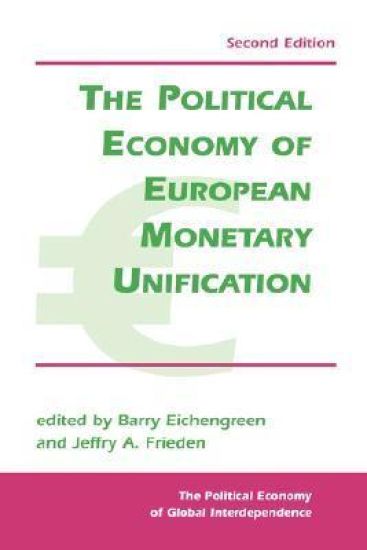
The Political Economy Of European Monetary Unification
The first edition of this book was published in 1994, as the future of monetary unification in Europe was very much in doubt. With Economic and Monetary Union now in place, it is appropriate to bring the scholarship on the topic up to date for the students of international political economics. To this effect, essayists Jeffry Frieden, Geoffrey Garrett, Lisa L. Martin, Benjamin J. Cohen revised four of the original chapters to reflect new conditions. Editors, Barry Eichengreen and Frieden completely rewrote the introductory essay. Three new chapters by Matthew Gabel, Charles Engel, and Paul De Grauwe et al cover public support for EMU, local currency pricing, and whether Europe is now better off? The updated volume's purpose remains that of bringing the latest in scholarship in Economics and Political Science to bear on the European monetary integration

Toward a New International Financial Architecture – A Practical Post–Asia Agenda

Toward a New International Financial Architecture – A Practical Post–Asia Agenda

Barry Eichengreen

The Peterson Institute for International Economics
1999
nidottu
The Asian financial crisis and the global economic turmoil that followed it have highlighted the need to avert financial crises and resolve them quickly if they do occur. This book addresses current concerns that existing institutional arrangements, including the Bretton Woods institutions, can no longer adequately cope with today's world of high capital mobility. It provides a critical assessment of competing proposals to better predict, forestall, and resolve international financial crises and outlines a practical and pragmatic agenda for reform. The recommendations are based on the belief that financial markets can malfunction, creating a compelling case for a financial safety net (and therefore a role for the IMF), but also creating problems of moral hazard that must be addressed.
European Monetary Unification

European Monetary Unification

Barry Eichengreen

MIT Press
1997
pokkari
The process of European monetary unification (EMU) is approaching a critical juncture. At the beginning of 1998 the member states of the European Union will decide whether or not to go ahead with their monetary union and determine which countries qualify as members. There is a high likelihood that Stage III of the Maastricht process-monetary union itself-will commence on January 1, 1999, and that a single currency, to be known as the Euro, will replace the national currencies of the founding member states at the beginning of 2002. Even if it is delayed, Stage III is likely to go forward soon thereafter. Whether EMU is feasible and desirable is contested among economists and politicians alike. This book sheds light on the controversy by considering seven major aspects: (1) what the theory of optimum currency areas reveals about the EMU project, (2) how Europe compares with existing monetary unions such as the United States, (3) the crisis in the European monetary system and the feasibility of stabilizing exchange rates in the absence of monetary unification, (4) fiscal policy and EMU, (5) labor markets and EMU, (6) the connections between monetary and political union, and (7) EMU and the rest of the world.The author views EMU as neither a grand achievement nor a terrible blunder, but as a process. He argues that the effects of monetary unification will depend on how it is structured and governed, and how quickly Europe's markets adapt to a single currency. The process of monetary unification will not end in 1999 or 2002; rather, the structure and operation of Europe's monetary union will continue to evolve for years to come.
Gold Standard In Theory & History

Gold Standard In Theory & History

Barry Eichengreen; Marc Flandreau

Routledge
1997
nidottu
Since the successful first edition of The Gold Standard in Theory and History was published in 1985, much new research has been completed. This updated version contains five new essays including:* post 1990 literature on exchange rate target zones* a discussion of the light shed by the gold standard on the European Monetary Union debate* a new introduction by Eichengreen with Marc FlandreauThis will be an invaluable resource for students of macroeconomics, international economics and economic history at all levels.
Gold Standard In Theory & History

Gold Standard In Theory & History

Barry Eichengreen; Marc Flandreau

Routledge
1997
sidottu
Since the successful first edition of The Gold Standard in Theory and History was published in 1985, much new research has been completed. This updated version contains five new essays including:* post 1990 literature on exchange rate target zones* a discussion of the light shed by the gold standard on the European Monetary Union debate* a new introduction by Eichengreen with Marc FlandreauThis will be an invaluable resource for students of macroeconomics, international economics and economic history at all levels.
Golden Fetters

Golden Fetters

Barry Eichengreen

Oxford University Press Inc
1996
nidottu
This book is a reassessment of the international monetary crises of the post-World War I period that led to the Great Depression of the 1930s. It also analyses the responses of the world economic powers to the Depression and how new monetary policies set the stage for the watershed post-World War II system established at Bretton Woods. It offers new theories of what effect the Great Depression had on the collapse of the world monetary system, and what effect the collapse had on deepening and prolonging the Depression, by exploring the link between global economic crisis and the the gold standard (the framework for international monetary affairs until 1931). The events described had a profound effect upon twentieth-century history: the Depression abetted the rise of Hitler and the demise of the gold standard is a historical cause of inflation.
Elusive Stability

Elusive Stability

Barry Eichengreen

Cambridge University Press
1993
pokkari
This volume provides a new interpretation of the operation and macroeconomic repercussions of the international monetary system during the interwar years. Each of the eleven essays is explicitly concerned with the role of exchange rates in macroeconomic fluctuations from the American and European perspective. The final essay examines the interwar experience from a long-term perspective.
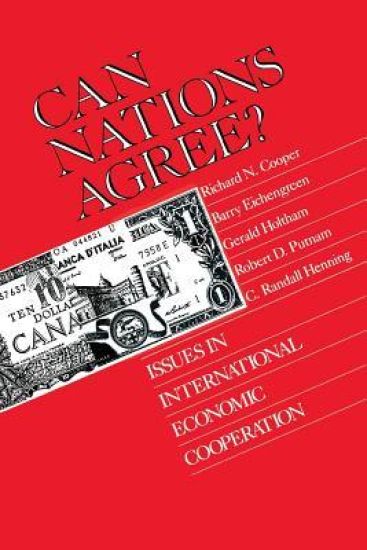
Can Nations Agree?

Can Nations Agree?

Richard N. Cooper; Barry Eichengreen; Gerald Holtham; Robert D. Putnam; C. Randall Henning

Brookings Institution
1989
nidottu
In the age of Three Mile Island and Chernobyl, a new international trade in industrial and human waste, the depletion of the ozone layer, and the greenhouse effect, the importance of international cooperation is supremely evident. In the economic arena, such problems include speculative instability in financial and primary commodities markets, competition in tax regimes, and the greatly enhanced scope for tax evasion. Can Nations Agree? examines the crucial issues surrounding international cooperation-conditions that foster cooperation toward common goals; ways to handle the friction arising from conflicting goals; and the structures that best promote cooperation. Although nations recognize the value of cooperation in an independent world, a variety of conditions inhibit the process. In recent decades the number of independent nations has risen rapidly, and so has the variety of decisionmakers and national interests to be reconciled. At the same time, the economic power of the United States has declined in relation to other successful capitalist countries. In the chapters on the 1978 Bonn economic summit, German macroeconomic policy, international cooperation on public health issues, and hegemony and stability, the scholars contributing to this volume analyze the history and process of international cooperation to offer fresh insight for future efforts.