Kirjojen hintavertailu. Mukana 12 390 323 kirjaa ja 12 kauppaa.

Kirjailija

Barry G. Rabe

Kirjat ja teokset yhdessä paikassa: 4 kirjaa, julkaisuja vuosilta 1986-2020, suosituimpien joukossa Trump, the Administrative Presidency, and Federalism. Vertaile teosten hintoja ja tarkista saatavuus suomalaisista kirjakaupoista.

4 kirjaa

Kirjojen julkaisuhaarukka 1986-2020.

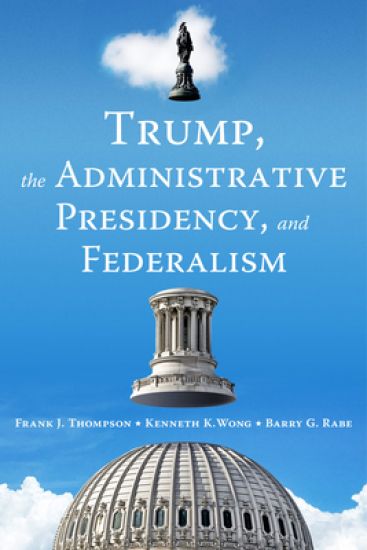
Trump, the Administrative Presidency, and Federalism

Trump, the Administrative Presidency, and Federalism

Frank J. Thompson; Kenneth K. Wong; Barry G. Rabe

Brookings Institution
2020
nidottu
How Trump has used the federal government to promote conservative policiesThe presidency of Donald Trump has been unique in many respects—most obviously his flamboyant personal style and disregard for conventional niceties and factual information. But one area hasn't received as much attention as it deserves: Trump's use of the “administrative presidency,” including executive orders and regulatory changes, to reverse the policies of his predecessor and advance positions that lack widespread support in Congress.This book analyzes the dynamics and unique qualities of Trump's administrative presidency in the important policy areas of health care, education, and climate change. In each of these spheres, the arrival of the Trump administration represented a hostile takeover in which White House policy goals departed sharply from the more “liberal” ideologies and objectives of key agencies, which had been embraced by the Obama administration.Three expert authors show how Trump has continued, and even expanded, the rise of executive branch power since the Reagan years. The authors intertwine this focus with an in-depth examination of how the Trump administration's hostile takeover has drastically changed key federal policies—and reshaped who gets what from government—in the areas of health care, education, and climate change.Readers interested in the institutions of American democracy and the nation's progress (or lack thereof) in dealing with pressing policy problems will find deep insights in this book. Of particular interest is the book's examination of how the Trump administration's actions have long-term implications for American democracy.
Can We Price Carbon?

Can We Price Carbon?

Barry G. Rabe

MIT Press
2018
pokkari
A political science analysis of the feasibility and sustainability of carbon pricing, drawing from North American, European, and Asian case studies.Climate change, economists generally agree, is best addressed by putting a price on the carbon content of fossil fuels-by taxing carbon, by cap-and-trade systems, or other methods. But what about the politics of carbon pricing? Do political realities render carbon pricing impracticable? In this book, Barry Rabe offers the first major political science analysis of the feasibility and sustainability of carbon pricing, drawing upon a series of real-world attempts to price carbon over the last two decades in North America, Europe, and Asia.Rabe asks whether these policies have proven politically viable and, if adopted, whether they survive political shifts and managerial challenges over time. The entire policy life cycle is examined, from adoption through advanced implementation, on a range of pricing policies including not only carbon taxes and cap-and-trade but also such alternative methods as taxing fossil fuel extraction. These case studies, Rabe argues, show that despite the considerable political difficulties, carbon pricing can be both feasible and durable.
Statehouse and Greenhouse

Statehouse and Greenhouse

Barry G. Rabe

Brookings Institution
2004
nidottu
"No environmental issue triggers such feelings of hopelessness as global climate change. Many areas of the world, including regions of the United States, have experienced a wide range of unusually dramatic weather events recently. Much climate change analysis forecasts horrors of biblical proportions, such as massive floods, habitat loss, species loss, and epidemics related to warmer weather. Such accounts of impending disaster have helped trigger extreme reactions, wherein some observers simply dismiss global climate change as, at the very worst, a minor inconvenience requiring modest adaptation. It is perhaps no surprise, therefore, that an American federal government known for institutional gridlock has accomplished virtually nothing in this area in the last decade. Policy inertia is not the story of this book, however. Statehouse and Greenhouse examines the surprising evolution of state-level government policies on global climate change. Environmental policy analyst Barry Rabe details a diverse set of innovative cases, offering detailed analysis of state-level policies designed to combat global warming. The book explains why state innovation in global climate change has been relatively vigorous and why it has drawn so little attention thus far. Rabe draws larger potential lessons from this recent flurry of American experience. Statehouse and Greenhouse helps to move debate over global climate change from bombast to the realm of what is politically and technically feasible. "
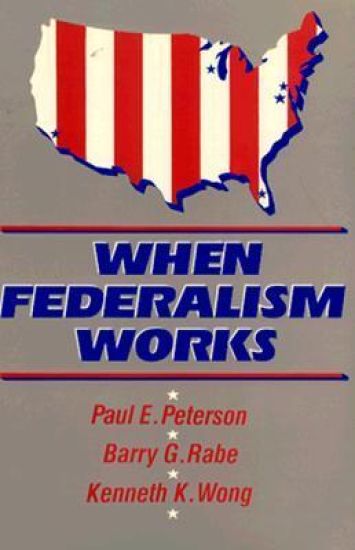
When Federalism Works

When Federalism Works

Paul E. Peterson; Barry G. Rabe; Kenneth K. Wong

Brookings Institution
1986
nidottu
"Twenty years ago cooperative federalism, in the form of federal grant-in-aid programs administered by state and local governments, was applauded almost without reservation as the best means of helping the handicapped, the educationally disadvantaged, the poor, and other groups with special needs. More recently these same programs have been criticized for excessive regulations and red tape, bureaucratic ineptitude, and high cost. The criticisms have been used to justify efforts to curb federal domestic spending and terminate many grants-in-aid.In When Federalism Works, Paul E. Peterson, Barry G. Rabe, and Kenneth K. Wong examine the new conventional wisdom about federal grants. Through documentary research and hundreds of interviews with local, state, and federal administrators and elected officials, they consider the implementation and operation of federal programs for education, health care, and housing in four urban areas to learn which programs worked, when, and why. Why did rent subsidy programs encounter seemingly endless difficulties, while special education was a notable success? Why did compensatory education fare better in Milwaukee than in Baltimore? Among the factors the authors find significant are the extent to which a program is directed toward groups in need, the political and economic circumstances of the area in which it is implemented, and the degree of professionalism among those who administer it at all levels of government. When Federalism Works provides a solid introduction to the most important grant-in-aid programs of the past twenty years and a thoughtful assessment of where they might be going."