Kirjojen hintavertailu. Mukana 12 595 353 kirjaa ja 12 kauppaa.

Kirjailija

Barry Kernfeld

Kirjat ja teokset yhdessä paikassa: 4 kirjaa, julkaisuja vuosilta 1997-2011, suosituimpien joukossa What to Listen For in Jazz. Vertaile teosten hintoja ja tarkista saatavuus suomalaisista kirjakaupoista.

4 kirjaa

Kirjojen julkaisuhaarukka 1997-2011.

Pop Song Piracy

Pop Song Piracy

Barry Kernfeld

University of Chicago Press
2011
sidottu
The music industry's ongoing battle against digital piracy is just the latest skirmish in a long conflict over who has the right to distribute music. Starting with music publishers' efforts to stamp out bootleg compilations of lyric sheets in 1929, Barry Kernfeld's "Pop Song Piracy" details nearly a century of disobedient music distribution, from song sheets to MP3s. In the 1940s and '50s, Kernfeld reveals, song sheets were succeeded by fake books, unofficial volumes of melodies and lyrics for popular songs that were a key tool for musicians. Music publishers attempted to wipe out fake books, but after their efforts proved unsuccessful they published their own. "Pop Song Piracy" shows that this pattern of disobedience, prohibition, and assimilation recurred in each conflict over unauthorized music distribution, from European pirate radio stations to bootlegged live shows. Beneath this pattern, Kernfeld argues, there exists a complex give and take between distribution methods that merely copy existing songs (such as counterfeit CDs) and ones that transform songs into new products (such as file sharing). Ultimately, he contends, it was the music industry's persistent lagging behind in creating innovative products that led to the very piracy it sought to eliminate.

Pop Song Piracy

Pop Song Piracy

Barry Kernfeld

University of Chicago Press
2011
nidottu
The music industry's ongoing battle against digital piracy is just the latest skirmish in a long conflict over who has the right to distribute music. Starting with music publishers' efforts to stamp out bootleg compilations of lyric sheets in 1929, Barry Kernfeld's "Pop Song Piracy" details nearly a century of disobedient music distribution, from song sheets to MP3s. In the 1940s and '50s, Kernfeld reveals, song sheets were succeeded by fake books, unofficial volumes of melodies and lyrics for popular songs that were a key tool for musicians. Music publishers attempted to wipe out fake books, but after their efforts proved unsuccessful they published their own. "Pop Song Piracy" shows that this pattern of disobedience, prohibition, and assimilation recurred in each conflict over unauthorized music distribution, from European pirate radio stations to bootlegged live shows. Beneath this pattern, Kernfeld argues, there exists a complex give and take between distribution methods that merely copy existing songs (such as counterfeit CDs) and ones that transform songs into new products (such as file sharing). Ultimately, he contends, it was the music industry's persistent lagging behind in creating innovative products that led to the very piracy it sought to eliminate.

The Story of Fake Books

The Story of Fake Books

Barry Kernfeld

Scarecrow Press
2006
nidottu
Fake books—anthologies of songs notated in a musical shorthand—have been used by countless pop and jazz musicians in both professional and amateur settings for more than half a century. The Story of Fake Books: Bootlegging Songs to Musicians traces the entertaining and previously unknown account of the origins of pop song fake books, which evolved through the bootlegging of a now obscure musical subscription service, the Tune-Dex. The book follows the history of fake books through their increased popularity among musicians to their prosecution by the government and the music industry, resulting in America's first full-blown federal trial for criminal copyright infringement. Through accounts given by jazz musicians Steve Swallow and Pat Metheny, The Story of Fake Books also reveals the definitive history of the most popular fake book, one that has acquired a legendary status among jazz musicians: an anthology of jazz tunes called The Real Book. Drawing from information in FBI files, entertainment trade papers, and federal court records, author Barry Kernfeld presents pioneering research, which brings together aspects of pop music history and copyright law to disclose this predecessor of current-day battles over pop song piracy.
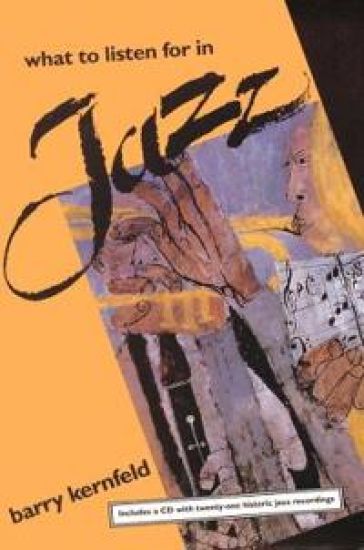
What to Listen For in Jazz

What to Listen For in Jazz

Barry Kernfeld

Yale University Press
1997
pokkari
Exhilarating and exciting, subtle and profound—jazz requires knowledge and understanding to be truly appreciated. Barry Kernfeld here provides a thorough, learned, and accessible introduction to jazz, discussing its musical concepts, procedures, and styles and providing the background necessary to fully enjoy this musical art. The book is organized around twenty-one historical jazz recordings—from the New Orleans Rhythm Kings' Tin Roof Blues (1923) to Ornette Coleman's Honeymooners (1987)—that are analyzed in the text and included in a compact disc that accompanies the book. Barry Kernfeld draws from these musical works to illustrate jazz rhythm, forms, arrangement, composition, improvisation, style, and sound (recording fidelity, tuning systems, instrumentation, and timbre). Included in the book are eighty-five notated music examples keyed to the compact disc and a biographical dictionary of musicians who figure prominently on the disc. By laying out musical ideas that unify the genre, rather than by splintering it along stylistic lines, this authoritative book offers a new method for enhancing enjoyment and understanding of jazz. It will be a valued resource for students and general listeners who wish to know more about this unique musical form.