Kirjojen hintavertailu. Mukana 12 595 353 kirjaa ja 12 kauppaa.

Kirjailija

Barry R. Weingast

Kirjat ja teokset yhdessä paikassa: 6 kirjaa, julkaisuja vuosilta 1997-2013, suosituimpien joukossa The Oxford Handbook of Political Economy. Vertaile teosten hintoja ja tarkista saatavuus suomalaisista kirjakaupoista.

6 kirjaa

Kirjojen julkaisuhaarukka 1997-2013.

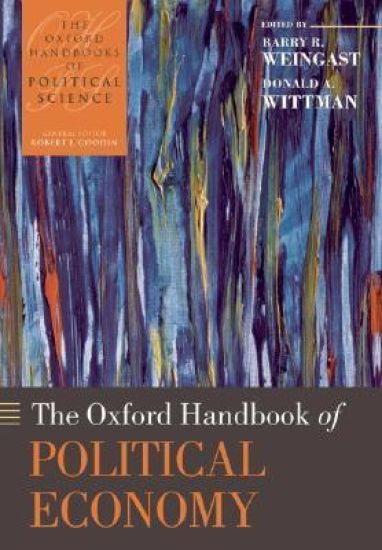
The Oxford Handbook of Political Economy

The Oxford Handbook of Political Economy

Barry R. Weingast; Donald Wittman

Oxford University Press
2008
nidottu
Over its long lifetime, "political economy" has had many different meanings: the science of managing the resources of a nation so as to provide wealth to its inhabitants for Adam Smith; the study of how the ownership of the means of production influenced historical processes for Marx; the study of the inter-relationship between economics and politics for some twentieth-century commentators; and for others, a methodology emphasizing individual rationality (the economic or "public choice" approach) or institutional adaptation (the sociological version). This Handbook views political economy as a grand (if imperfect) synthesis of these various strands, treating political economy as the methodology of economics applied to the analysis of political behavior and institutions. This Handbook surveys the field of political economy, with 58 chapters ranging from micro to macro, national to international, institutional to behavioral, methodological to substantive. Chapters on social choice, constitutional theory, and public economics are set alongside ones on voters, parties and pressure groups, macroeconomics and politics, capitalism and democracy, and international political economy and international conflict.
Korean Political and Economic Development

Korean Political and Economic Development

Jongryn Mo; Barry R. Weingast

Harvard University, Asia Center
2013
sidottu
How do poor nations become rich, industrialized, and democratic? And what role does democracy play in this transition? To address these questions, Jongryn Mo and Barry R. Weingast study South Korea’s remarkable transformation since 1960. The authors concentrate on three critical turning points: Park Chung Hee’s creation of the development state beginning in the early 1960s, democratization in 1987, and the genesis of and reaction to the 1997 economic crisis. At each turning point, Korea took a significant step toward creating an open access social order.The dynamics of this transition hinge on the inclusion of a wide array of citizens, rather than just a narrow elite, in economic and political activities and organizations. The political economy systems that followed each of the first two turning points lacked balance in the degree of political and economic openness and did not last. The Korean experience, therefore, suggests that a society lacking balance cannot sustain development. Korean Political and Economic Development offers a new view of how Korea was able to maintain a pro-development state with sustained growth by resolving repeated crises in favor of rebalancing and greater political and economic openness.
Gewalt und Gesellschaftsordnungen

Gewalt und Gesellschaftsordnungen

Douglass C North; John J. Wallis; Barry R. Weingast

Mohr Siebeck
2013
nidottu
Alle Gesellschaften müssen sich mit der Möglichkeit wie der Realität von Gewalt auseinandersetzen; sie tun das auf unterschiedliche Art. Douglass C. North, John Joseph Wallis und Barry R. Weingast stellen das Problem der Gewalt in einen größeren sozialwissenschaftlichen und historischen Zusammenhang und zeigen, wie eng wirtschaftliches und politisches Verhalten verbunden sind. Die meisten aus der Geschichte bekannten Gesellschaften, von den Autoren als natürliche Staaten bezeichnet, begrenzen Gewaltanwendung vorbeugend, indem sie durch politische Einflussnahme auf die Wirtschaftstätigkeit privilegierte Interessen schaffen. Diese Privilegien reduzieren den Einsatz von Gewalt von Seiten mächtiger Einzelner; es wird auf diese Weise jedoch die wirtschaftliche ebenso wie die politische Entwicklung solcher Staaten behindert. Denn für die große Mehrheit der Nicht-Privilegierten ist der Zugang zu Politik und Wirtschaft dadurch beschränkt.Im Unterschied hierzu schaffen moderne Gesellschaften Zugangsfreiheit zu wirtschaftlichen und politischen Organisationen (Unternehmen, Märkten, Parlamenten, hoheitlichen Einrichtungen) und fördern damit den politischen wie den wirtschaftlichen Wettbewerb und somit die gesellschaftliche Entwicklung. Das Buch bietet ein gedankliches Gerüst zum Verständnis der zwei Typen von Gesellschaftsordnungen, die es an historischen Beispielen von der römischen Antike bis ins 19. Jahrhundert veranschaulicht. Anhand dieses Konzepts wird erklärt, wieso Gesellschaften mit Zugangsfreiheit sowohl politisch wie wirtschaftlich höher entwickelt sind und auf welche Weise seit dem 19. Jahrhundert rund 25 Länder den Übergang vom einen Typus zum anderen geschafft haben.
Violence and Social Orders

Violence and Social Orders

Douglass C. North; John Joseph Wallis; Barry R. Weingast

Cambridge University Press
2009
sidottu
All societies must deal with the possibility of violence, and they do so in different ways. This book integrates the problem of violence into a larger social science and historical framework, showing how economic and political behavior are closely linked. Most societies, which we call natural states, limit violence by political manipulation of the economy to create privileged interests. These privileges limit the use of violence by powerful individuals, but doing so hinders both economic and political development. In contrast, modern societies create open access to economic and political organizations, fostering political and economic competition. The book provides a framework for understanding the two types of social orders, why open access societies are both politically and economically more developed, and how some 25 countries have made the transition between the two types.
Analytic Narratives

Analytic Narratives

Robert H. Bates; Avner Greif; Margaret Levi; Jean-Laurent Rosenthal; Barry R. Weingast

Princeton University Press
1998
pokkari
Students of comparative politics have long faced a vexing dilemma: how can social scientists draw broad, applicable principles of political order from specific historical examples? In Analytic Narratives, five senior scholars offer a new and ambitious methodological response to this important question. By employing rational-choice and game theory, the authors propose a way of extracting empirically testable, general hypotheses from particular cases. The result is both a methodological manifesto and an applied handbook that political scientists, economic historians, sociologists, and students of political economy will find essential. In their jointly written introduction, the authors frame their approach to the origins and evolution of political institutions. The individual essays that follow demonstrate the concept of the analytic narrative--a rational-choice approach to explain political outcomes--in case studies. Avner Greif traces the institutional foundations of commercial expansion in twelfth-century Genoa. Jean-Laurent Rosenthal analyzes how divergent fiscal policies affected absolutist European governments, while Margaret Levi examines the transformation of nineteenth-century conscription laws in France, the United States, and Prussia. Robert Bates explores the emergence of a regulatory organization in the international coffee market. Finally, Barry Weingast studies the institutional foundations of democracy in the antebellum United States and its breakdown in the Civil War. In the process, these studies highlight the economic role of political organizations, the rise and deterioration of political communities, and the role of coercion, especially warfare, in political life. The results are both empirically relevant and theoretically sophisticated. Analytic Narratives is an innovative and provocative work that bridges the gap between the game-theoretic and empirically driven approaches in political economy. Political historians will find the use of rational-choice models novel; theorists will discover arguments more robust and nuanced than those derived from abstract models. The book improves on earlier studies by advocating--and applying--a cross-disciplinary approach to explain strategic decision making in history.
The New Federalism

The New Federalism

John A. Ferejohn; Barry R. Weingast

Hoover Institution Press,U.S.
1997
nidottu
In recent years, the growth of the federal government and its failure to resolve many major problems have ignited a serious new debate. Some scholars and policymakers suggest that reinvigorating American federalism—returing a variety of regulatory and police powers back to the states—may better solve many of these problems. Others claim that it will gut policies or cripple national regulation. This book confronts these issues as it investigates the central question of the new American federalism: Will it yield better government, in doing so it poses the provocative question, Can the states be trusted? Proponents of greater federalism argue that it creates competition and fosters the "laboratory of the states." Opponents claim that decentralizing power to the states will lead to a "race to the bottom." The contributors to the volume examine the current state of knowledge and evidence about both sides of the argument and offer •A historical and constitutional perspective that raises important questions for the contemporary debate •The main lessons of modern economics applicable to the new federalism •Evidence on interstate competition in three important policy domains: welfare, the environment, and corporate law •An outline of the relative merits of a statutory versus a constitutional basis for the new federalism The authors of the The New Federalism: Can the State be Trusted? conclude that the answer is a qualified yes. The studies in this volume find little evidence for a race to the bottom in three major policy domains. his book should be an invaluable resource to federal and state policymakers alike.