

Kirjailija
Bayard Rustin
Kirjat ja teokset yhdessä paikassa: 3 kirjaa, julkaisuja vuosilta 2014-2026, suosituimpien joukossa From Protest to Politics. Vertaile teosten hintoja ja tarkista saatavuus suomalaisista kirjakaupoista.
3 kirjaa
Kirjojen julkaisuhaarukka 2014-2026.
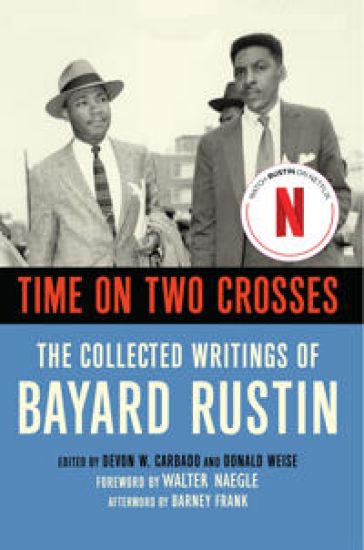
In 1956 Bayard Rustin taught Martin Luther King Jr. strategies of nonviolence during the Montgomery Bus Boycott, thereby launching the civil rights movement. Widely acclaimed as a founding father of modern black protest, Rustin reached international notoriety in 1963 as the openly gay organizer of the March on Washington. Long before the March on Washington, Rustin's leadership placed him at the vanguard of social protest. His gay identity, however, became a point of contention with the movement, with the controversy embroiling even King himself. Time on Two Crosses offers an insider's view of many of the defining political moments of our time. From Gandhi's impact on African Americans, white supremacists in Congress, and the assassination of Malcolm X to Rustin's never-before-published essays on Louis Farrakhan, affirmative action, and the call for gay rights, Time on Two Crosses chronicles five decades of Rustin's commitment to justice and equality.

Voices of Christ: Reflections on Applied Christianity
Leo Tolstoy; Bayard Rustin; Hugh Hollowell
Enfranchised Mind
2014
nidottu
Among all the noise, strife, debates, and politics of the last two millennia, the message of Christ has persisted through those who live it. This message is not a doctrine or a secret teaching, but a loving, engaged way of being which Jesus taught plainly and directly. Within this anthology, five authors describe what it means to them to be living this message in their life and time. The authors are: Leo Tolstoy, the famed late 19th century nihilist who converted late in his life; J.C. Kumarappa, who struggled for Indian independence with Gandhi, and was known as "Gandhi's economist"; Bayard Rustin, who brought nonviolence and Martin Luther King, Jr., into the American Civil Rights Movement; Hugh Hollowell, who founded a parish for the impoverished in Raleigh, North Carolina; and Magdelene Harrison, a prominent young Quaker scholar who rediscovered the Quaker symbol of "going naked as a signe".