Kirjojen hintavertailu. Mukana 12 116 401 kirjaa ja 12 kauppaa.
Kirjailija
Behrouz Zolfaghari
Kirjat ja teokset yhdessä paikassa: 15 kirjaa, julkaisuja vuosilta 2019-2024, suosituimpien joukossa A Flexible Framework for the Design of Programmable Parallel LFSRs. Vertaile teosten hintoja ja tarkista saatavuus suomalaisista kirjakaupoista.
Real-time and Embedded Systems: Life Cycle, Ecosystem and Scheduling Trends establishes life cycles and ecosystems for real-time and embedded systems, highlighting design, implementation and test objectives challenges, approaches, and trends. The book outlines applications and supporting computing platforms, as well as enabling sciences and technologies. It examines the latest studies in real-time and embedded scheduling and presents a roadmap for future research on these topics. Technologies for managing real-time and embedded systems play a key role in areas such as aviation and industrial engineering, where missing a safety-critical real-time system deadline can lead to a human catastrophe. A real-time system is a system in which the notions of correctness and performance are joined together and defined as timeliness, which is described in terms of well-defined real time constraints. An embedded system is a computer system with limited processing power, memory and I/O resources that appears as a fabricated part of another system that can be mechanical, electrical, etc. Real-time and embedded systems serve to a variety of technological, medical and scientific applications. Task scheduling plays a significant role in meeting time constraints in real-time systems as well as resource constraints in embedded systems.
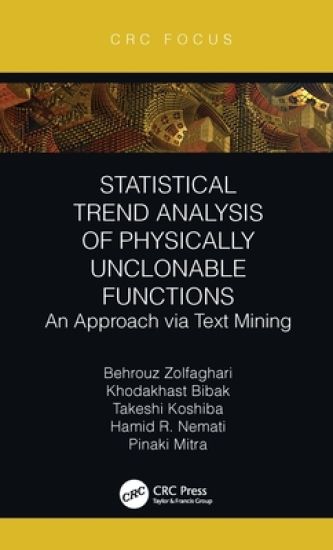
Physically Unclonable Functions (PUFs) translate unavoidable variations in certain parameters of materials, waves, or devices into random and unique signals. They have found many applications in the Internet of Things (IoT), authentication systems, FPGA industry, several other areas in communications and related technologies, and many commercial products. Statistical Trend Analysis of Physically Unclonable Functions first presents a review on cryptographic hardware and hardware-assisted cryptography. The review highlights PUF as a mega trend in research on cryptographic hardware design. Afterwards, the authors present a combined survey and research work on PUFs using a systematic approach. As part of the survey aspect, a state-of-the-art analysis is presented as well as a taxonomy on PUFs, a life cycle, and an established ecosystem for the technology. In another part of the survey, the evolutionary history of PUFs is examined, and strategies for further research in this area are suggested. In the research side, this book presents a novel approach for trend analysis that can be applied to any technology or research area. In this method, a text mining tool is used which extracts 1020 keywords from the titles of the sample papers. Then, a classifying tool classifies the keywords into 295 meaningful research topics. The popularity of each topic is then numerically measured and analyzed over the course of time through a statistical analysis on the number of research papers related to the topic as well as the number of their citations. The authors identify the most popular topics in four different domains; over the history of PUFs, during the recent years, in top conferences, and in top journals. The results are used to present an evolution study as well as a trend analysis and develop a roadmap for future research in this area. This method gives an automatic popularity-based statistical trend analysis which eliminates the need for passing personal judgments about the direction of trends, and provides concrete evidence to the future direction of research on PUFs. Another advantage of this method is the possibility of studying a whole lot of existing research works (more than 700 in this book).This book will appeal to researchers in text mining, cryptography, hardware security, and IoT.
Perfectly-secure cryptography is a branch of information-theoretic cryptography. A perfectly-secure cryptosystem guarantees that the malicious third party cannot guess anything regarding the plain text or the key, even in the case of full access to the cipher text. Despite this advantage, there are only a few real-world implementations of perfect secrecy due to some well-known limitations. Any simple, straightforward modeling can pave the way for further advancements in the implementation, especially in environments with time and resource constraints such as IoT. This book takes one step towards this goal via presenting a hybrid combinatorial-Boolean model for perfectly-secure cryptography in IoT. In this book, we first present an introduction to information-theoretic cryptography as well as perfect secrecy and its real-world implementations. Then we take a systematic approach to highlight information-theoretic cryptography as a convergence point for existing trends in research on cryptography in IoT. Then we investigate combinatorial and Boolean cryptography and show how they are seen almost everywhere in the ecosystem and the life cycle of information-theoretic IoT cryptography. We finally model perfect secrecy in IoT using Boolean functions, and map the Boolean functions to simple, well-studied combinatorial designs like Latin squares. This book is organized in two parts. The first part studie s information-theoretic cryptography and the promise it holds for cryptography in IoT. The second part separately discusses combinatorial and Boolean cryptography, and then presents the hybrid combinatorial-Boolean model for perfect secrecy in IoT.
This book studies the intersection between cryptography and AI, highlighting the significant cross-impact and potential between the two technologies. The authors first study the individual ecosystems of cryptography and AI to show the omnipresence of each technology in the ecosystem of the other one. Next, they show how these technologies have come together in collaborative or adversarial ways. In the next section, the authors highlight the coevolution being formed between cryptography and AI. Throughout the book, the authors use evidence from state-of-the-art research to look ahead at the future of the crypto-AI dichotomy. The authors explain how they anticipate that quantum computing will join the dichotomy in near future, augmenting it to a trichotomy. They verify this through two case studies highlighting another scenario wherein crypto, AI and quantum converge. The authors study current trends in chaotic image encryption as well as information-theoretic cryptography and show how these trends lean towards quantum-inspired artificial intelligence (QiAI). After concluding the discussions, the authors suggest future research for interested researchers.
Perfectly-secure cryptography is a branch of information-theoretic cryptography. A perfectly-secure cryptosystem guarantees that the malicious third party cannot guess anything regarding the plain text or the key, even in the case of full access to the cipher text. Despite this advantage, there are only a few real-world implementations of perfect secrecy due to some well-known limitations. Any simple, straightforward modeling can pave the way for further advancements in the implementation, especially in environments with time and resource constraints such as IoT. This book takes one step towards this goal via presenting a hybrid combinatorial-Boolean model for perfectly-secure cryptography in IoT. In this book, we first present an introduction to information-theoretic cryptography as well as perfect secrecy and its real-world implementations. Then we take a systematic approach to highlight information-theoretic cryptography as a convergence point for existing trends in research on cryptography in IoT. Then we investigate combinatorial and Boolean cryptography and show how they are seen almost everywhere in the ecosystem and the life cycle of information-theoretic IoT cryptography. We finally model perfect secrecy in IoT using Boolean functions, and map the Boolean functions to simple, well-studied combinatorial designs like Latin squares. This book is organized in two parts. The first part studie s information-theoretic cryptography and the promise it holds for cryptography in IoT. The second part separately discusses combinatorial and Boolean cryptography, and then presents the hybrid combinatorial-Boolean model for perfect secrecy in IoT.
Physically Unclonable Functions (PUFs) translate unavoidable variations in certain parameters of materials, waves, or devices into random and unique signals. They have found many applications in the Internet of Things (IoT), authentication systems, FPGA industry, several other areas in communications and related technologies, and many commercial products. Statistical Trend Analysis of Physically Unclonable Functions first presents a review on cryptographic hardware and hardware-assisted cryptography. The review highlights PUF as a mega trend in research on cryptographic hardware design. Afterwards, the authors present a combined survey and research work on PUFs using a systematic approach. As part of the survey aspect, a state-of-the-art analysis is presented as well as a taxonomy on PUFs, a life cycle, and an established ecosystem for the technology. In another part of the survey, the evolutionary history of PUFs is examined, and strategies for further research in this area are suggested. In the research side, this book presents a novel approach for trend analysis that can be applied to any technology or research area. In this method, a text mining tool is used which extracts 1020 keywords from the titles of the sample papers. Then, a classifying tool classifies the keywords into 295 meaningful research topics. The popularity of each topic is then numerically measured and analyzed over the course of time through a statistical analysis on the number of research papers related to the topic as well as the number of their citations. The authors identify the most popular topics in four different domains; over the history of PUFs, during the recent years, in top conferences, and in top journals. The results are used to present an evolution study as well as a trend analysis and develop a roadmap for future research in this area. This method gives an automatic popularity-based statistical trend analysis which eliminates the need for passing personal judgments about the direction of trends, and provides concrete evidence to the future direction of research on PUFs. Another advantage of this method is the possibility of studying a whole lot of existing research works (more than 700 in this book).This book will appeal to researchers in text mining, cryptography, hardware security, and IoT.