Kirjojen hintavertailu. Mukana 12 595 353 kirjaa ja 12 kauppaa.

Kirjailija

Béla Paláncz

Kirjat ja teokset yhdessä paikassa: 8 kirjaa, julkaisuja vuosilta 2014-2025, suosituimpien joukossa Hybrid Imaging and Visualization. Vertaile teosten hintoja ja tarkista saatavuus suomalaisista kirjakaupoista.

8 kirjaa

Kirjojen julkaisuhaarukka 2014-2025.

Hybrid Imaging and Visualization

Hybrid Imaging and Visualization

Joseph Awange; Béla Paláncz; Lajos Völgyesi

Springer International Publishing AG
2025
sidottu
This second edition of the book that targets those in computer algebra and artificial intelligence introduces Black Hole algorithm that is essential for optimizing hyperparameters, an important task in machine learning where mostly, stochastic global methods are used as well as ChatGPT, a novel and in the last few years, very popular Generative AI technology. In addition, fisher discriminant, a linear discriminant that can provide an optimal separation of objects, and the conversion of time series into images thereby making it possible to employ convolution neural network to classify time series effectively are presented.
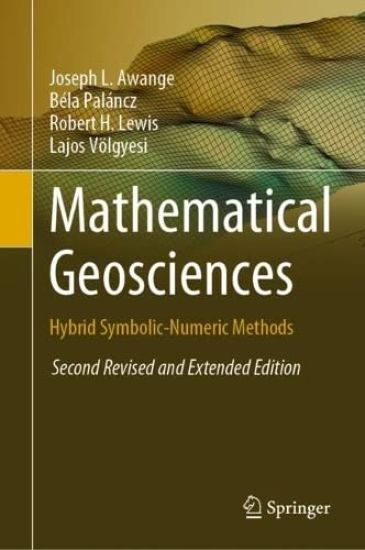
Mathematical Geosciences

Mathematical Geosciences

Joseph L. Awange; Béla Paláncz; Robert H. Lewis; Lajos Völgyesi

Springer Nature Switzerland AG
2024
nidottu
This second edition of Mathematical Geosciences book adds five new topics: Solution equations with uncertainty, which proposes two novel methods for solving nonlinear geodetic equations as stochastic variables when the parameters of these equations have uncertainty characterized by probability distribution. The first method, an algebraic technique, partly employs symbolic computations and is applicable to polynomial systems having different uncertainty distributions of the parameters. The second method, a numerical technique, uses stochastic differential equation in Ito form; Nature Inspired Global Optimization where Meta-heuristic algorithms are based on natural phenomenon such as Particle Swarm Optimization. This approach simulates, e.g., schools of fish or flocks of birds, and is extended through discussion of geodetic applications. Black Hole Algorithm, which is based on the black hole phenomena is added and a new variant of the algorithm code is introduced and illustrated based on examples; The application of the Gröbner Basis to integer programming based on numeric symbolic computation is introduced and illustrated by solving some standard problems; An extension of the applications of integer programming solving phase ambiguity in Global Navigation Satellite Systems (GNSSs) is considered as a global quadratic mixed integer programming task, which can be transformed into a pure integer problem with a given digit of accuracy. Three alternative algorithms are suggested, two of which are based on local and global linearization via McCormic Envelopes; and Machine learning techniques (MLT) that offer effective tools for stochastic process modelling. The Stochastic Modelling section is extended by the stochastic modelling via MLT and their effectiveness is compared with that of the modelling via stochastic differential equations (SDE). Mixing MLT with SDE also known as frequently Neural Differential Equations is also introduced and illustratedby an image classification via a regression problem.
Mathematical Geosciences

Mathematical Geosciences

Joseph L. Awange; Béla Paláncz; Robert H. Lewis; Lajos Völgyesi

Springer Nature Switzerland AG
2023
sidottu
This second edition of Mathematical Geosciences book adds five new topics: Solution equations with uncertainty, which proposes two novel methods for solving nonlinear geodetic equations as stochastic variables when the parameters of these equations have uncertainty characterized by probability distribution. The first method, an algebraic technique, partly employs symbolic computations and is applicable to polynomial systems having different uncertainty distributions of the parameters. The second method, a numerical technique, uses stochastic differential equation in Ito form; Nature Inspired Global Optimization where Meta-heuristic algorithms are based on natural phenomenon such as Particle Swarm Optimization. This approach simulates, e.g., schools of fish or flocks of birds, and is extended through discussion of geodetic applications. Black Hole Algorithm, which is based on the black hole phenomena is added and a new variant of the algorithm code is introduced and illustrated based on examples; The application of the Gröbner Basis to integer programming based on numeric symbolic computation is introduced and illustrated by solving some standard problems; An extension of the applications of integer programming solving phase ambiguity in Global Navigation Satellite Systems (GNSSs) is considered as a global quadratic mixed integer programming task, which can be transformed into a pure integer problem with a given digit of accuracy. Three alternative algorithms are suggested, two of which are based on local and global linearization via McCormic Envelopes; and Machine learning techniques (MLT) that offer effective tools for stochastic process modelling. The Stochastic Modelling section is extended by the stochastic modelling via MLT and their effectiveness is compared with that of the modelling via stochastic differential equations (SDE). Mixing MLT with SDE also known as frequently Neural Differential Equations is also introduced and illustratedby an image classification via a regression problem.
Hybrid Imaging and Visualization

Hybrid Imaging and Visualization

Joseph Awange; Béla Paláncz; Lajos Völgyesi

Springer Nature Switzerland AG
2020
nidottu
The book introduces the latest methods and algorithms developed in machine and deep learning (hybrid symbolic-numeric computations, robust statistical techniques for clustering and eliminating data as well as convolutional neural networks) dealing not only with images and the use of computers, but also their applications to visualization tasks generalized by up-to-date points of view. Associated algorithms are deposited on iCloud.
Mathematical Geosciences

Mathematical Geosciences

Joseph L. Awange; Béla Paláncz; Robert H. Lewis; Lajos Völgyesi

Springer International Publishing AG
2019
nidottu
This book showcases powerful new hybrid methods that combine numerical and symbolic algorithms. Hybrid algorithm research is currently one of the most promising directions in the context of geosciences mathematics and computer mathematics in general. One important topic addressed here with a broad range of applications is the solution of multivariate polynomial systems by means of resultants and Groebner bases. But that’s barely the beginning, as the authors proceed to discuss genetic algorithms, integer programming, symbolic regression, parallel computing, and many other topics.The book is strictly goal-oriented, focusing on the solution of fundamental problems in the geosciences, such as positioning and point cloud problems. As such, at no point does it discuss purely theoretical mathematics. "The book delivers hybrid symbolic-numeric solutions, which are a large and growing area at the boundary of mathematics and computer science." Dr. Daniel Lichtbau
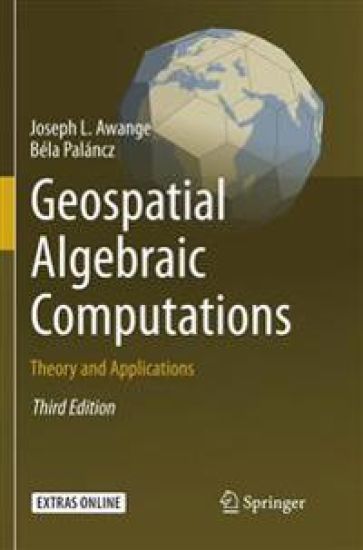
Geospatial Algebraic Computations

Geospatial Algebraic Computations

Joseph Awange; Béla Paláncz

Springer International Publishing AG
2018
nidottu
Improved geospatial instrumentation and technology such as in laser scanning has now resulted in millions of data being collected, e.g., point clouds. It is in realization that such huge amount of data requires efficient and robust mathematical solutions that this third edition of the book extends the second edition by introducing three new chapters: Robust parameter estimation, Multiobjective optimization and Symbolic regression. Furthermore, the linear homotopy chapter is expanded to include nonlinear homotopy. These disciplines are discussed first in the theoretical part of the book before illustrating their geospatial applications in the applications chapters where numerous numerical examples are presented. The renewed electronic supplement contains these new theoretical and practical topics, with the corresponding Mathematica statements and functions supporting their computations introduced and applied. This third edition is renamed in light of these technological advancements.
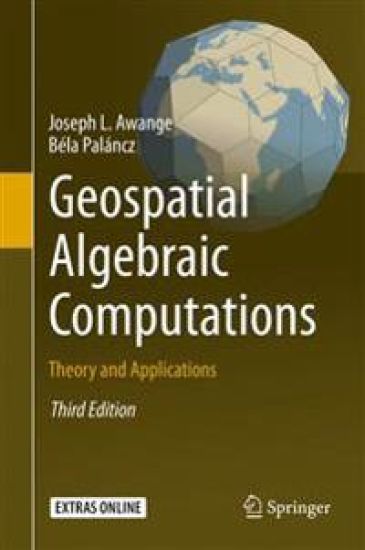
Geospatial Algebraic Computations

Geospatial Algebraic Computations

Joseph Awange; Béla Paláncz

Springer International Publishing AG
2016
sidottu
Improved geospatial instrumentation and technology such as in laser scanning has now resulted in millions of data being collected, e.g., point clouds. It is in realization that such huge amount of data requires efficient and robust mathematical solutions that this third edition of the book extends the second edition by introducing three new chapters: Robust parameter estimation, Multiobjective optimization and Symbolic regression. Furthermore, the linear homotopy chapter is expanded to include nonlinear homotopy. These disciplines are discussed first in the theoretical part of the book before illustrating their geospatial applications in the applications chapters where numerous numerical examples are presented. The renewed electronic supplement contains these new theoretical and practical topics, with the corresponding Mathematica statements and functions supporting their computations introduced and applied. This third edition is renamed in light of these technological advancements.
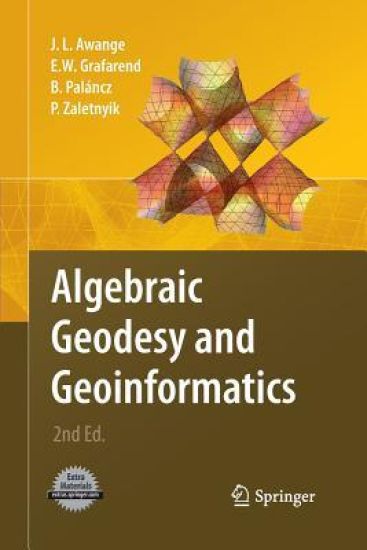
Algebraic Geodesy and Geoinformatics

Algebraic Geodesy and Geoinformatics

Joseph L. Awange; Erik W. Grafarend; Béla Paláncz; Piroska Zaletnyik

Springer-Verlag Berlin and Heidelberg GmbH Co. K
2014
nidottu
While preparing and teaching ‘Introduction to Geodesy I and II’ to undergraduate students at Stuttgart University, we noticed a gap which motivated the writing of the present book: Almost every topic that we taught required some skills in algebra, and in particular, computer algebra! From positioning to transformation problems inherent in geodesy and geoinformatics, knowledge of algebra and application of computer algebra software were required. In preparing this book therefore, we have attempted to put together basic concepts of abstract algebra which underpin the techniques for solving algebraic problems. Algebraic computational algorithms useful for solving problems which require exact solutions to nonlinear systems of equations are presented and tested on various problems. Though the present book focuses mainly on the two ?elds, the concepts and techniques presented herein are nonetheless applicable to other ?elds where algebraic computational problems might be encountered. In Engineering for example, network densi?cation and robotics apply resection and intersection techniques which require algebraic solutions. Solution of nonlinear systems of equations is an indispensable task in almost all geosciences such as geodesy, geoinformatics, geophysics (just to mention but a few) as well as robotics. These equations which require exact solutions underpin the operations of ranging, resection, intersection and other techniques that are normally used. Examples of problems that require exact solutions include; • three-dimensional resection problem for determining positions and orientation of sensors, e. g. , camera, theodolites, robots, scanners etc.