Kirjojen hintavertailu. Mukana 12 595 353 kirjaa ja 12 kauppaa.

Kirjailija

Ben Wisner

Kirjat ja teokset yhdessä paikassa: 7 kirjaa, julkaisuja vuosilta 2003-2026, suosituimpien joukossa At Risk. Vertaile teosten hintoja ja tarkista saatavuus suomalaisista kirjakaupoista.

7 kirjaa

Kirjojen julkaisuhaarukka 2003-2026.

At Risk

At Risk

Piers Blaikie; Terry Cannon; Ian Davis; Ben Wisner

Routledge
2003
nidottu
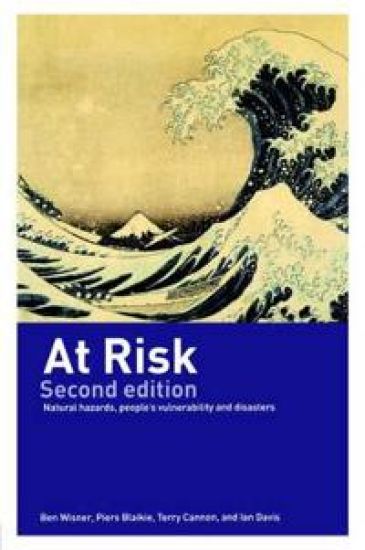
The term 'natural disaster' is often used to refer to natural events such as earthquakes, hurricanes or floods. However, the phrase 'natural disaster' suggests an uncritical acceptance of a deeply engrained ideological and cultural myth. At Risk questions this myth and argues that extreme natural events are not disasters until a vulnerable group of people is exposed.The updated new edition confronts a further ten years of ever more expensive and deadly disasters and discusses disaster not as an aberration, but as a signal failure of mainstream 'development'. Two analytical models are provided as tools for understanding vulnerability. One links remote and distant 'root causes' to 'unsafe conditions' in a 'progression of vulnerability'. The other uses the concepts of 'access' and 'livelihood' to understand why some households are more vulnerable than others. Examining key natural events and incorporating strategies to create a safer world, this revised edition is an important resource for those involved in the fields of environment and development studies.
At Risk

At Risk

Piers Blaikie; Terry Cannon; Ian Davis; Ben Wisner

Routledge
2003
sidottu
The term 'natural disaster' is often used to refer to natural events such as earthquakes, hurricanes or floods. However, the phrase 'natural disaster' suggests an uncritical acceptance of a deeply engrained ideological and cultural myth. At Risk questions this myth and argues that extreme natural events are not disasters until a vulnerable group of people is exposed.The updated new edition confronts a further ten years of ever more expensive and deadly disasters and discusses disaster not as an aberration, but as a signal failure of mainstream 'development'. Two analytical models are provided as tools for understanding vulnerability. One links remote and distant 'root causes' to 'unsafe conditions' in a 'progression of vulnerability'. The other uses the concepts of 'access' and 'livelihood' to understand why some households are more vulnerable than others. Examining key natural events and incorporating strategies to create a safer world, this revised edition is an important resource for those involved in the fields of environment and development studies.
Power and Need in Africa

Power and Need in Africa

Ben Wisner

TAYLOR FRANCIS LTD
2026
sidottu
Power and Need in Africa (1988) examines the mechanisms for giving the poor of Africa the means to develop their own future – a renaissance which has as its constituent elements environmental sustainability, women’s emancipation and social justice.
Understanding and Addressing Disaster Risk

Understanding and Addressing Disaster Risk

Ben Wisner; Irasema Alcántara-Ayala; JC Gaillard; Ilan Kelman; Victor Marchezini

TAYLOR FRANCIS LTD
2025
nidottu
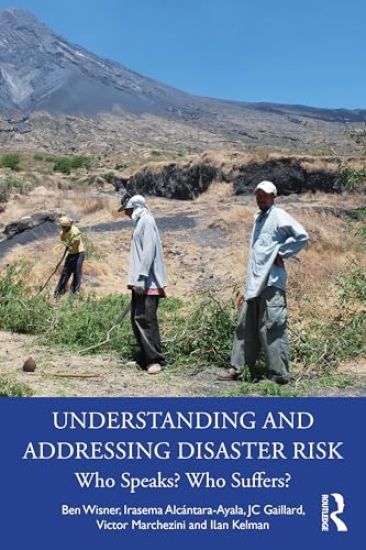
In Understanding and Addressing Disaster Risk, the authors explain how people modify the environment and exert power over each other in ways that make nature potentially harmful and put people in harm’s way. Opportunities and challenges faced by those engaging with disaster risk are explored.Across 11 chapters, the authors show that disasters are not natural, are not events, and do not happen quickly. Instead, they are the result of chronic societal processes emerging from the creation and perpetuation of vulnerabilities and limitations on people’s abilities to respond to hazards. The book also explores the environmental component of disaster risk through the lens of different natural elements and phenomena, including biological-ecological and water-weather-climate processes as well as geological and outer space dynamics. The authors explain the mutual influence of the different components of disasters in creating disaster risk across diverse regions of the world. They critique attempts to reduce disaster risk through top-down, siloed assumptions, attitudes, and values. The value of people’s knowledge of hazards – often ignored or dismissed by authorities – is a central theme. This book is original because of how it re-interprets and advances understanding of the disaster process through the study of such societal processes of vulnerability, risk creation, and power imbalances. It is also unique in diving further into “root causes” of disaster in order to place them within local histories and colonial legacies as well as contemporary, typically misdirected, agendas while upending previous “solutions” which have been shown to do more harm than good.Understanding and Addressing Disaster Risk is useful for and useable by decision-makers, policy makers, researchers, and students to shatter the vicious cycle of repeating known mistakes which compound detrimental outcomes.The Open Access version of this book, available at www.taylorfrancis.com, has been made available under a Creative Commons Attribution-Non Commercial-No Derivatives (CC-BY-NC-ND) 4.0 International license.
Understanding and Addressing Disaster Risk

Understanding and Addressing Disaster Risk

Ben Wisner; Irasema Alcántara-Ayala; JC Gaillard; Ilan Kelman; Victor Marchezini

TAYLOR FRANCIS LTD
2025
sidottu
In Understanding and Addressing Disaster Risk, the authors explain how people modify the environment and exert power over each other in ways that make nature potentially harmful and put people in harm’s way. Opportunities and challenges faced by those engaging with disaster risk are explored.Across 11 chapters, the authors show that disasters are not natural, are not events, and do not happen quickly. Instead, they are the result of chronic societal processes emerging from the creation and perpetuation of vulnerabilities and limitations on people’s abilities to respond to hazards. The book also explores the environmental component of disaster risk through the lens of different natural elements and phenomena, including biological-ecological and water-weather-climate processes as well as geological and outer space dynamics. The authors explain the mutual influence of the different components of disasters in creating disaster risk across diverse regions of the world. They critique attempts to reduce disaster risk through top-down, siloed assumptions, attitudes, and values. The value of people’s knowledge of hazards – often ignored or dismissed by authorities – is a central theme. This book is original because of how it re-interprets and advances understanding of the disaster process through the study of such societal processes of vulnerability, risk creation, and power imbalances. It is also unique in diving further into “root causes” of disaster in order to place them within local histories and colonial legacies as well as contemporary, typically misdirected, agendas while upending previous “solutions” which have been shown to do more harm than good.Understanding and Addressing Disaster Risk is useful for and useable by decision-makers, policy makers, researchers, and students to shatter the vicious cycle of repeating known mistakes which compound detrimental outcomes.The Open Access version of this book, available at www.taylorfrancis.com, has been made available under a Creative Commons Attribution-Non Commercial-No Derivatives (CC-BY-NC-ND) 4.0 International license.
Disaster Risk Reduction

Disaster Risk Reduction

Mark Pelling; Ben Wisner

Routledge
2014
nidottu
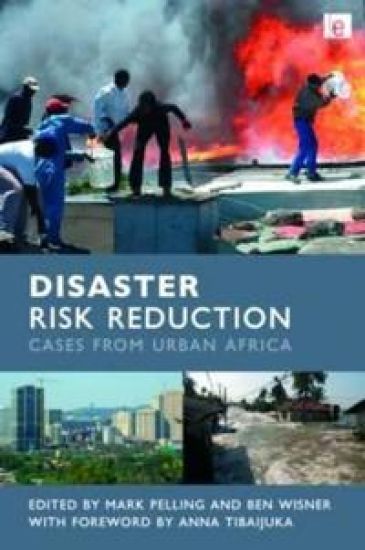
Published with ProVention Consortium, UNDP and UN-Habitat 'This excellent book is essential reading for those concerned with urban risk and its reduction in Africa, the most rapidly urbanizing region of the world.' Professor Jo Beall, Development Studies Institute, London School of Economics 'At last a book that recognizes the impacts of disasters on Africa's 350 million urban dwellers, including the many disasters that get overlooked and go unrecorded. But also a book that, through careful case studies, shows what creates disaster risk and what local measures can be taken to address it.' David Satterthwaite, International Institute for Environment and Development (IIED). 'This innovative volume combines the latest conceptualisations of urban disaster risk and vulnerability with case studies from across the African continent on how existing and innovative information can inform efforts to address the problems. Coverage ranges from the major catastrophes of news headlines to small, everyday disasters with which poor urban residents have to cope in their survival strategies. Written by international authorities and local specialists, this extremely useful book should find a place in the hands of academics and practitioners alike.' Professor David Simon, Department of Geography, Royal Holloway, University of London This is a one-of-a-kind book packed with original research and offering an innovative way of thinking about the reduction of risk in rapidly urbanizing cities across the globe. It is a must-have for professionals, researchers and policy makers. The book addresses four inter-related themes critical for urban risk reduction: environment; livehood; urban governance and the generation of urban risks. Its focus is on Africa, the most rapidly urbanizing world region, but it illustrates global processes. Part one reviews development, urbanization and disaster risk in Africa as a whole, identifies state-of-the-art practices and policies for building urban resilience and provides a tool kit for urban risk reduction. It also presents a powerful conceptual framework to analyse and compare disaster risk and resilience in different cities and communities. Part two presents detailed case studies from Algeria, Ghana, Senegal, Kenya, Tanzania and South Africa illustrating vulnerability to hazards ranging from earthquake to shack fire, environmental health hazards, traffic hazards and flooding. Part three looks to the future and outlines a vision for a safer urban Africa based on achieving gains in human security through inclusive governance and investment in the creative capacities of Africa's urban dwellers. With foreword by Anna Tibaijuka, Executive Director, UN-HABITAT
Disaster Risk Reduction

Disaster Risk Reduction

Mark Pelling; Ben Wisner

Earthscan Ltd
2008
sidottu
Published with ProVention Consortium, UNDP and UN-Habitat 'This excellent book is essential reading for those concerned with urban risk and its reduction in Africa, the most rapidly urbanizing region of the world.' Professor Jo Beall, Development Studies Institute, London School of Economics 'At last a book that recognizes the impacts of disasters on Africa's 350 million urban dwellers, including the many disasters that get overlooked and go unrecorded. But also a book that, through careful case studies, shows what creates disaster risk and what local measures can be taken to address it.' David Satterthwaite, International Institute for Environment and Development (IIED). 'This innovative volume combines the latest conceptualisations of urban disaster risk and vulnerability with case studies from across the African continent on how existing and innovative information can inform efforts to address the problems. Coverage ranges from the major catastrophes of news headlines to small, everyday disasters with which poor urban residents have to cope in their survival strategies. Written by international authorities and local specialists, this extremely useful book should find a place in the hands of academics and practitioners alike.' Professor David Simon, Department of Geography, Royal Holloway, University of London This is a one-of-a-kind book packed with original research and offering an innovative way of thinking about the reduction of risk in rapidly urbanizing cities across the globe. It is a must-have for professionals, researchers and policy makers. The book addresses four inter-related themes critical for urban risk reduction: environment; livehood; urban governance and the generation of urban risks. Its focus is on Africa, the most rapidly urbanizing world region, but it illustrates global processes. Part one reviews development, urbanization and disaster risk in Africa as a whole, identifies state-of-the-art practices and policies for building urban resilience and provides a tool kit for urban risk reduction. It also presents a powerful conceptual framework to analyse and compare disaster risk and resilience in different cities and communities. Part two presents detailed case studies from Algeria, Ghana, Senegal, Kenya, Tanzania and South Africa illustrating vulnerability to hazards ranging from earthquake to shack fire, environmental health hazards, traffic hazards and flooding. Part three looks to the future and outlines a vision for a safer urban Africa based on achieving gains in human security through inclusive governance and investment in the creative capacities of Africa's urban dwellers. With foreword by Anna Tibaijuka, Executive Director, UN-HABITAT