Kirjojen hintavertailu. Mukana 12 595 353 kirjaa ja 12 kauppaa.

Kirjailija

Benjamin Carter Hett

Kirjat ja teokset yhdessä paikassa: 7 kirjaa, julkaisuja vuosilta 2004-2021, suosituimpien joukossa Death of Democracy. Vertaile teosten hintoja ja tarkista saatavuus suomalaisista kirjakaupoista.

7 kirjaa

Kirjojen julkaisuhaarukka 2004-2021.

The Nazi Menace

The Nazi Menace

Benjamin Carter Hett

St Martin's Press
2021
nidottu
A panoramic narrative of the years leading up to the Second World War--a tale of democratic crisis, racial conflict, and a belated recognition of evil, with profound resonance for our own time. Berlin, November 1937. Adolf Hitler meets with his military commanders to impress upon them the urgent necessity for a war of aggression in eastern Europe. Some generals are unnerved by the F hrer's grandiose plan, but these dissenters are silenced one by one, setting in motion events that will culminate in the most calamitous war in history. Benjamin Carter Hett takes us behind the scenes in Berlin, London, Moscow, and Washington, revealing the unsettled politics within each country in the wake of the German dictator's growing provocations. He reveals the fitful path by which anti-Nazi forces inside and outside Germany came to understand Hitler's true menace to European civilization and learned to oppose him, painting a sweeping portrait of governments under siege, as larger-than-life figures struggled to turn events to their advantage. As in The Death of Democracy, his acclaimed history of the fall of the Weimar Republic, Hett draws on original sources and newly released documents to show how these long-ago conflicts have unexpected resonances in our own time. To read The Nazi Menace is to see past and present in a new and unnerving light.
The Nazi Menace

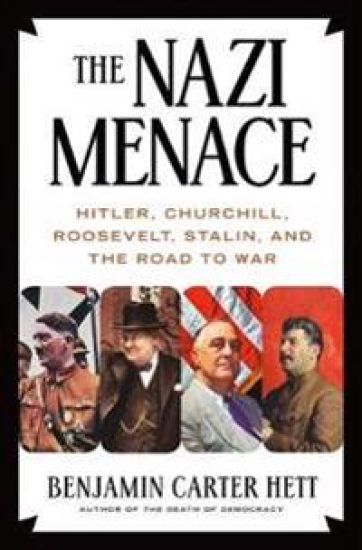
The Nazi Menace

Benjamin Carter Hett

Henry Holt Company Inc
2020
sidottu
Berlin, November 1937. In a secret meeting with his top advisors, Adolf Hitler proclaims the urgent necessity for a war of aggression in Europe. Some conservatives are unnerved by this grandiose plan, but they are soon silenced, setting in motion events that will lead to the most calamitous war in history. Benjamin Carter Hett, the author of The Death of Democracy, his acclaimed history of the fall of the Weimar Republic, takes us from Berlin to London, Moscow, and Washington to show how anti-Nazi forces inside and outside Germany came to understand Hitler’s true menace to European civilisation and learned to oppose him. Drawing on original sources in German, English, French, and Russian, including newly released intelligence documents, he paints a sweeping portrait of governments under siege, populated by larger-than-life figures like Winston Churchill, Joseph Stalin, Neville Chamberlain, Franklin Roosevelt, Joachim von Ribbentrop, and Vyacheslav Molotov. The Nazi Menace evokes a time when the verities of life were subverted, a time marked by fake news, cultural unrest over refugees, and the challenges of national security in a consumerist democracy. To read Hett's book is to see the 1930s - and our world today - in a new and unnerving light.
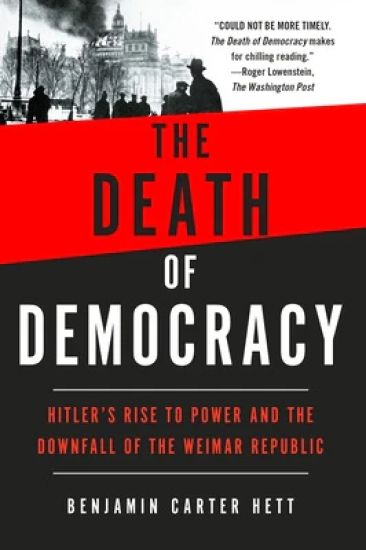
The Death of Democracy: Hitler's Rise to Power and the Downfall of the Weimar Republic
A riveting account of how the Nazi Party came to power and how the failures of the Weimar Republic and the shortsightedness of German politicians allowed it to happen. Why did democracy fall apart so quickly and completely in Germany in the 1930s? How did a democratic government allow Adolf Hitler to seize power? In The Death of Democracy, Benjamin Carter Hett answers these questions, and the story he tells has disturbing resonances for our own time. To say that Hitler was elected is too simple. He would never have come to power if Germany's leading politicians had not responded to a spate of populist insurgencies by trying to co-opt him, a strategy that backed them into a corner from which the only way out was to bring the Nazis in. Hett lays bare the misguided confidence of conservative politicians who believed that Hitler and his followers would willingly support them, not recognizing that their efforts to use the Nazis actually played into Hitler's hands. They had willingly given him the tools to turn Germany into a vicious dictatorship. Benjamin Carter Hett is a leading scholar of twentieth-century Germany and a gifted storyteller whose portraits of these feckless politicians show how fragile democracy can be when those in power do not respect it. He offers a powerful lesson for today, when democracy once again finds itself embattled and the siren song of strongmen sounds ever louder.
Death of Democracy

Death of Democracy

Benjamin Carter Hett

Random House UK
2019
pokkari
The Death of Democracy explores one of the great questions in all of human history: what caused the fall of one of the most progressive governments in twentieth-century Europe, and the rise of the most terrifying? Drawing on extraordinary individual stories to illustrate its broader arguments, this revelatory new account presents a panoramic portrait of Germany at a turning point, focusing on the global dimension of the Nazi phenomenon as part of a widespread reaction against a world order of triumphant, cosmopolitan liberal democracy and capitalism after the First World War. This was a world situation that pushed its opponents to embrace authoritarianism, nationalism and economic self-sufficiency, kick-starting a revolution reliant upon the innovative exploitation of new media technologies, and the formidable political and self-promotional skills of its leader. Based on award-winning research and recently discovered archival material, The Death of Democracy is an authoritative and panoramic new survey of one of the most pivotal periods in modern history, and a book with a clear and important message for the world today.
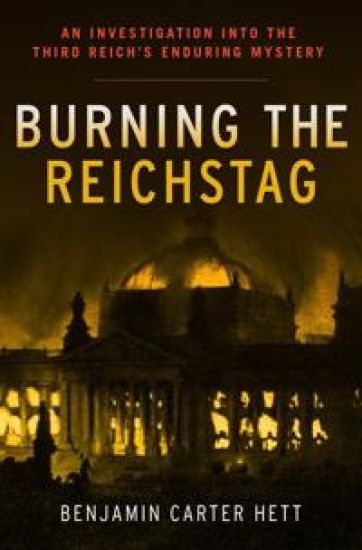
Burning the Reichstag

Burning the Reichstag

Benjamin Carter Hett

Oxford University Press Inc
2014
sidottu
In February 1933, Adolf Hitler had only a tenuous grasp on power. Chancellor of Germany for merely four weeks, he led a fragile coalition government. The Nazis had lost seats in the Reichstag in the recent election, and claimed only three of thirteen cabinet posts. Then on February 27th, arson sent the Reichstag, the home and symbol of German democracy, up in flames. Immediately blaming the Communists, Hitler's new government approved a decree that tore the heart out of the democratic constitution of the Weimar Republic and cancelled the rule of law. Five thousand people were immediately arrested. The Reichstag fire marked the true beginning of the Third Reich, which ruled for 12 more years. The controversy surrounding the fire's origins has endured for 80. In Burning the Reichstag, Benjamin Hett offers a gripping account of Hitler's rise to dictatorship-one that challenges orthodoxy and recovers the true significance of the part the fire played. At the scene the police arrested 23-year-old Marinus van der Lubbe, a Dutch Communist stonemason. Though he was initially dismissed abroad as a Nazi tool, post-war historians since the 1950s have largely judged him solely guilty-a lone arsonist exploited by Hitler. Hett's book reopens the case, providing vivid portraits of key figures, including Rudolf Diels, Hermann Goering, Joseph Goebbels, and the historian Fritz Tobias, whose account of the fire has, until now, been the standard. Making use of a number of new sources and archives, Hett sets the Reichstag fire in a wider context, revealing how and why it has remained one of the last mysteries of the Nazi period, and one of the most controversial and contested events in the 20th century. Burning the Reichstag will stand as the landmark work on this subject.
Death in the Tiergarten

Death in the Tiergarten

Benjamin Carter Hett

Harvard University Press
2004
sidottu
From Alexanderplatz, the bustling Berlin square ringed by bleak slums, to Moabit, site of the city's most feared prison, Death in the Tiergarten illuminates the culture of criminal justice in late imperial Germany. In vivid prose, Benjamin Hett examines daily movement through the Berlin criminal courts and the lawyers, judges, jurors, thieves, pimps, and murderers who inhabited this world.Drawing on previously untapped sources, including court records, pamphlet literature, and pulp novels, Hett examines how the law reflected the broader urban culture and politics of a rapidly changing city. In this book, German criminal law looks very different from conventional narratives of a rigid, static system with authoritarian continuities traceable from Bismarck to Hitler. From the murder trial of Anna and Hermann Heinze in 1891 to the surprising treatment of the notorious Captain of Koepenick in 1906, Hett illuminates a transformation in the criminal justice system that unleashed a culture war fought over issues of permissiveness versus discipline, the boundaries of public discussion of crime and sexuality, and the role of gender in the courts. Trained in both the law and history, Hett offers a uniquely valuable perspective on the dynamic intersections of law and society, and presents an impressive new view of early twentieth-century German history.