Kirjojen hintavertailu. Mukana 12 390 323 kirjaa ja 12 kauppaa.
Kirjailija
Benjamin H. Bratton
Kirjat ja teokset yhdessä paikassa: 6 kirjaa, julkaisuja vuosilta 2012-2026, suosituimpien joukossa Machine Decision Is Not Final. Vertaile teosten hintoja ja tarkista saatavuus suomalaisista kirjakaupoista.
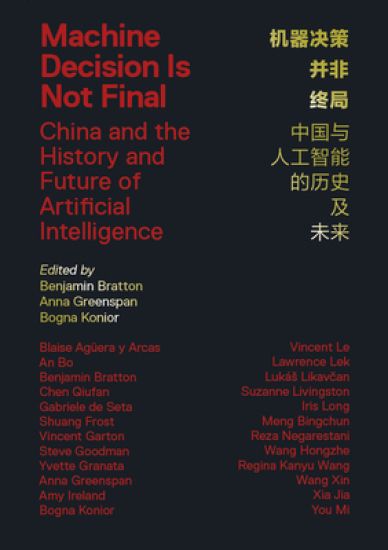
An interdisciplinary, cross-cultural collection that decenters familiar narratives to provide a fresh perspective on what artificial intelligence is today, and what it might become. Historians, media theorists, science-fiction writers, philosophers, and artists from China and elsewhere reexamine the nation's intense engagement with AI, moving beyond the clich s that still dominate contemporary debate. Today, visions of the contested future of AI veer between common planetary goals and a new Cold War, as culturally-specific models of intelligence, speculative traditions, and thought experiments come up against the emergence of novel forms of cognition that cannot be reduced to any historical cultural tradition. This uniquely positioned volume provides expert insight into this tension, using China as a touchstone for rethinking artificiality and intelligence as sites of difference in a way that is already present in the difficulty of precisely translating the Chinese term 人工智能. Tracking the history of Chinese AI from the pre-Cultural Revolution to the post-Deng Xiaoping eras right up to contemporary debates surrounding facial recognition, the writers in this collection draw on a mixture of speculative thought experiments and cutting-edge use cases to offer singular views on topics including AI and Chinese philosophy, AI ethics and policymaking, the development of computational models in early Chinese cybernetics, and the aesthetics of Sinofuturism. Spanning borders between different worlds, histories, futures, and foundational models, Machine Decision is Not Final is not only a timely reappraisal of the stakes of AI development, but a tool for constructing more global imaginaries for the future of AI. ContributorsBlaise Aguera y Arcas, Bo An, Benjamin Bratton, Shuang Frost, Vince Garton, Steve Goodman, Yvette Granata, Anna Greenspan, Amy Ireland, Xia Jia, Bogna Konior, Vincent Le, Lawrence Lek, Lukas Likavcan, Suzanne Livingston, Iris Long, Bingchun Meng, Reza Negarestani, Chen Quifan, Gabriele de Seta, Hongzhe Wang, Wang Xin, Mi You
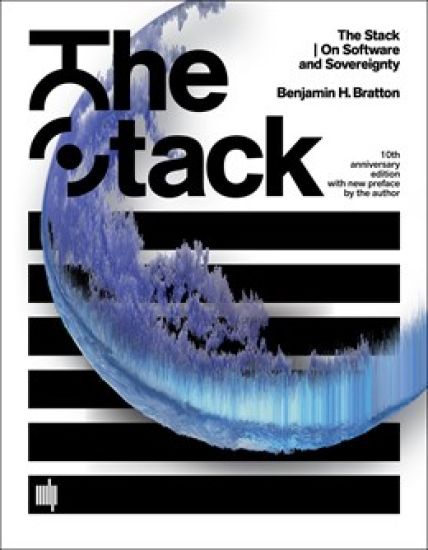
A comprehensive political and design theory of planetary-scale computation proposing that The Stack-an accidental megastructure-is both a technological apparatus and a model for a new geopolitical architecture.What has planetary-scale computation done to our geopolitical realities? It takes different forms at different scales-from energy and mineral sourcing and subterranean cloud infrastructure to urban software and massive universal addressing systems; from interfaces drawn by the augmentation of the hand and eye to users identified by self-quantification and the arrival of legions of sensors, algorithms, and robots. Together, how do these distort and deform modern political geographies and produce new territories in their own image?In The Stack, Benjamin Bratton proposes that these different genres of computation-smart grids, cloud platforms, mobile apps, smart cities, the Internet of Things, automation-can be seen not as so many species evolving on their own, but as forming a coherent whole: an accidental megastructure called The Stack that is both a computational apparatus and a new governing architecture. We are inside The Stack and it is inside of us. In an account that is both theoretical and technical, drawing on political philosophy, architectural theory, and software studies, Bratton explores six layers of The Stack: Earth, Cloud, City, Address, Interface, User. Each is mapped on its own terms and understood as a component within the larger whole built from hard and soft systems intermingling-not only computational forms but also social, human, and physical forces. This model, informed by the logic of the multilayered structure of protocol "stacks," in which network technologies operate within a modular and vertical order, offers a comprehensive image of our emerging infrastructure and a platform for its ongoing reinvention. The Stack is an interdisciplinary design brief for a new geopolitics that works with and for planetary-scale computation. Interweaving the continental, urban, and perceptual scales, it shows how we can better build, dwell within, communicate with, and govern our worlds.thestack.org
Essays, articles, artworks, and documents taken from and inspired by the symposium on Reza Negarestani's Cyclonopedia: Complicity with Anonymous Materials, which took place in March 2011 at The New School. Hailed by novelists, philosophers, artists, cinematographers, and designers, Cyclonopedia is a key work in the emerging domains of speculative realism and theory-fiction. The text has attracted a wide-ranging and interdisciplinary audience, provoking vital debate around the relationship between philosophy, geopolitics, geophysics, and art. At once a work of speculative theology, a political samizdat, and a philosophic grimoire, Cyclonopedia is a Deleuzo-Lovecraftian middle-eastern Odyssey populated by archeologists, jihadis, oil smugglers, Delta Force officers, heresiarchs, and the corpses of ancient gods. Playing out the book's own theory of creativity - "a confusion in which no straight line can be traced or drawn between creator and created - original inauthenticity" - this multidimensional collection both faithfully interprets the text and realizes it as a loving, perforated host of fresh heresies. The volume includes an incisive contribution from the author explicating a key figure of the novel: the cyclone.CONTENTS: Robin Mackay, "A Brief History of Geotrauma" - McKenzie Wark, "An Inhuman Fiction of Forces" - Benjamin H. Bratton, "Root the Earth: On Peak Oil Apophenia" - Alisa Andrasek, "Dustism" - Zach Blas, "Queerness, Openness" - Melanie Doherty, "Non-Oedipal Networks and the Inorganic Unconscious" - Anthony Sciscione, "Symptomatic Horror: Lovecraft's 'The Colour Out of Space'" - Kate Marshall, "Cyclonopedia as Novel (a meditation on complicity as inauthenticity)" - Alexander R. Galloway, "What is a Hermeneutic Light?" - Eugene Thacker, "Black Infinity; or, Oil Discovers Humans" - Nicola Masciandaro, "Gourmandized in the Abattoir of Openness" - Dan Mellamphy & Nandita Biswas Mellamphy, "Phileas Fogg, or the Cyclonic Passepartout: On the Alchemical Elements of War" - Ben Woodard, "The Untimely (and Unshapely) Decomposition of Onto-Epistemological Solidity: Negarestani's Cyclonopedia as Metaphysics" - Ed Keller, ". . .Or, Speaking with the Alien, a Refrain. . ." - Lionel Maunz, "Receipt of Malice" - yk Tekten, "Symposium Photographs" - Reza Negarestani, "Notes on the Figure of the Cyclone"