

Kirjailija
Benjamin H. D. Buchloh
Kirjat ja teokset yhdessä paikassa: 7 kirjaa, julkaisuja vuosilta 2009-2024, suosituimpien joukossa Gerhard Richter. Vertaile teosten hintoja ja tarkista saatavuus suomalaisista kirjakaupoista.
7 kirjaa
Kirjojen julkaisuhaarukka 2009-2024.
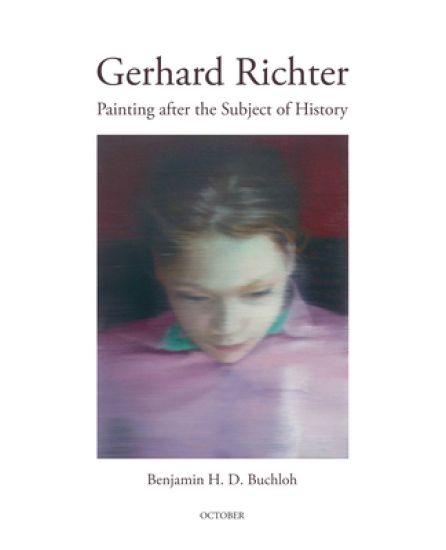

A lavishly illustrated monograph that spans the entire career of Gerhard Richter, one of the most celebrated contemporary artists "Spans the contemporary German artist's six-decade career. . . . [A] stirring exhibition in [its] own right."—New York Times"[A] weighty catalogue... illuminat[es] some less-visited corners of Richter's oeuvre."—New York Review of Books Over the course of his acclaimed 60-year career, Gerhard Richter (b. 1932) has employed both representation and abstraction as a means of reckoning with the legacy, collective memory, and national sensibility of post–Second World War Germany, in both broad and very personal terms. This handsomely designed book features approximately 100 of his key canvases, from photo paintings created in the early 1960s to portraits and later large-scale abstract series, as well as select works in glass. New essays by eminent scholars address a variety of themes: Sheena Wagstaff evaluates the conceptual import of the artist’s technique; Benjamin H. D. Buchloh discusses the poignant Birkenau paintings (2014); Peter Geimer explores the artist’s enduring interest in photographic imagery; Briony Fer looks at Richter’s family pictures against traditional painting genres and conventions; Brinda Kumar investigates the artist’s engagement with landscape as a site of memory; André Rottmann considers the impact of randomization and chance on Richter’s abstract works; and Hal Foster examines the glass and mirror works. As this book demonstrates, Richter’s rich and varied oeuvre is a testament to the continued relevance of painting in contemporary art.Published by The Metropolitan Museum of Art/Distributed by Yale University PressExhibition Schedule:The Met Breuer, New York (March 4–July 5, 2020)Museum of Contemporary Art, Los Angeles (August 14, 2020–January 19, 2021)
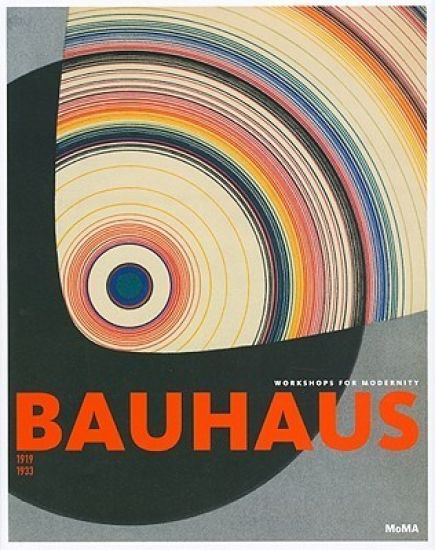
The Bauhaus, the school of art and design founded in Germany in 1919 and shut down by the Nazis in 1933, brought together artists, architects and designers in an extraordinary conversation about modern art. "Bauhaus 1919-1933", published to accompany a major multimedia exhibition at MoMA, is the first comprehensive treatment of the subject by MoMA since 1938 and offers a new generational perspective on the 20th century's most influential experiment in artistic education. It brings together works in a broad range of mediums, including industrial design, furniture, architecture, graphics, photography, textiles, ceramics, theatre and costume design, and painting and sculpture many of which have rarely if ever been seen outside of Germany. Featuring about 400 colour plates and a rich range of documentary images, this publication includes two overarching images by the exhibitions curators, Leah Dickerman and Barry Bergdoll, concise interpretive essays on key objects by over twenty leading scholars, and an illustrated, narrative chronology.
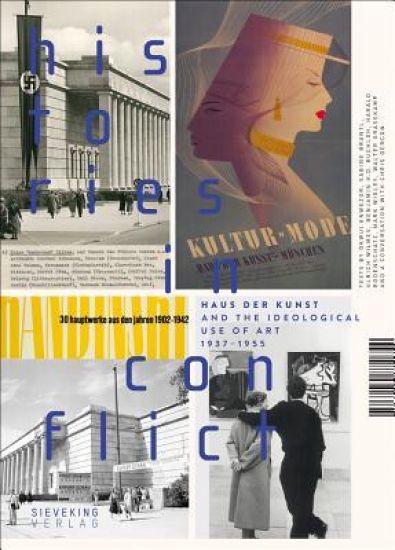
Histories in Conflict: The Haus der Kunst and the Ideological Uses of Art, 1937-1955
Sabine Branti; Harald Bodenschatz; Benjamin H. D. Buchloh; Chris Dercon; Okwui Enwezor; Walter Grasskamp; Mark Wigley; Ulrich Wilmes
Sieveking Verlag
2017
nidottu
For the Haus der Kunst in Munich, the question of how to deal with its own past arose directly after the end of the Second World War, when the building once again served as an exhibition space . This richly illustrated volume spans the key historical dates during which a social and political development took place, at whose beginning stood the ideology of the National Socialists and whose end marked the start of Germany's transformation into a democratic state. In this time period, it was not only the orientation of the Haus der Kunst's content that changed; as a result of the cultural-historical upheavals of this time, the basis for the building's development as an international exhibition venue was also laid. Today the Haus der Kunst plays a formative role in the discussion of relevant positions in contemporary art. It documents the historical developments within the context of political and cultural transformations, as well as their international parallels and references. Large exhibitions that were influential for the topography of the art of the twentieth century such as the World Exposition in Paris in 1937, the biennials in Venice, and the first documenta in 1955 provide the coordinates for the international dimension of the Haus der Kunst's story.
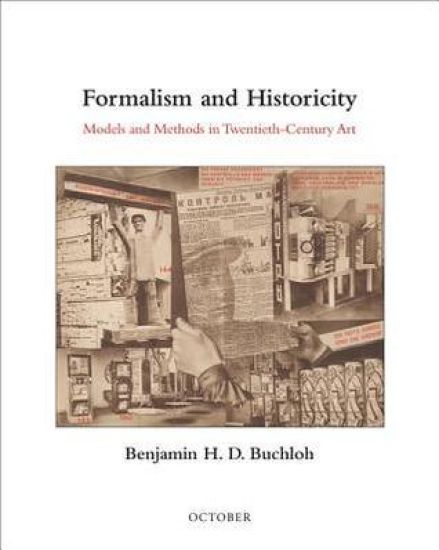
Essays spanning three decades by one of the most rigorous art thinkers of our time grapple with formal and historical paradigms in twentieth century art.These influential essays by the noted critic and art historian Benjamin Buchloh have had a significant impact on the theory and practice of art history. Written over the course of three decades and now collected in one volume, they trace a history of crucial artistic transitions, iterations, and paradigmatic shifts in the twentieth century, considering both the evolution and emergence of artistic forms and the specific historical moment in which they occurred. Buchloh's subject matter ranges through various moments in the history of twentieth-century American and European art, from the moment of the retour a l'ordre of 1915 to developments in the Soviet Union in the 1920s to the beginnings of Conceptual art in the late 1960s to the appropriation artists of the 1980s. He discusses conflicts resulting from historical repetitions (such as the monochrome and collage/montage aesthetics in the 1910s, 1950s, and 1980s), the emergence of crucial neo-avantgarde typologies, and the resuscitation of obsolete genres (including the portrait and landscape, revived by 1980s photography). Although these essays are less monographic than those in Buchloh's earlier collection, Neo-Avantgarde and Culture Industry, two essays in this volume are devoted to Marcel Broodthaers, whose work remains central to Buchloh's theoretical concerns. Engaging with both formal and historical paradigms, Buchloh situates himself productively between the force fields of formal theory and historical narrative, embracing the discrepancies and contradictions between them and within individual artistic trajectories.ContentsFormalism and Historicity (1977) * Marcel Broodthaers: Allegories of the Avant-Garde (1980) * Figures of Authority, Ciphers of Regression: Notes on the Return of Representation in European Painting (1981) * Allegorical Procedures: Appropriations and Montage in Contemporary Art (1982) * The Museum Fictions of Marcel Broodthaers (1983) * From Faktura to Factography (1984) * Readymade, Objet Trouve, Idee Recue (1985) * The Primary Colors for the Second Time: A Paradigm Repetition of the Neo-Avantgarde (1986) * Cold War Constructivism (1986) * Conceptual Art 1962-1969: From the Aesthetics of Administration to the Critique of Institutions (1989) * Residual Resemblance: Three Notes on the Ends of Portraiture (1994) * Sculpture: Publicity and the Poverty of Experience (1996)
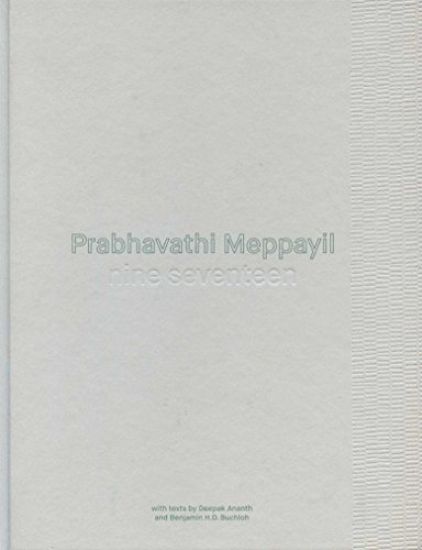
Prabhavathi Meppayil
Deepak Ananth; Benjamin H. D. Buchloh; Peter Benson Miller
Pace London
2014
sidottu