Kirjojen hintavertailu. Mukana 12 595 353 kirjaa ja 12 kauppaa.
Kirjailija
Benjamin P. Bowser
Kirjat ja teokset yhdessä paikassa: 8 kirjaa, julkaisuja vuosilta 1993-2016, suosituimpien joukossa Gangster Rap and Its Social Cost. Vertaile teosten hintoja ja tarkista saatavuus suomalaisista kirjakaupoista.
The debate about how higher education is failing to play a role in reducing inequality often centers on elite colleges, while ignoring the numerous public colleges and universities that educate the majority of our students. This book adds to the discussion by exploring an in-depth case study of the largest public higher educational system in the United States, The California State University, with implications for other state systems as well. Benjamin P. Bowser, experienced faculty member and author, discusses higher education reforms in response to increasing tuition, underprepared graduates, and declining academic standards. Focusing on the faculty perspective, this text examines how these reforms can threaten the mission of a public institution, only exacerbating the crisis of higher education and inequality.
Addressing drug use and abuse as a global phenomenon, this text draws on contemporary and international research findings to examine the causes of drug use in different countries and to explore different policy responses to its prevention and treatment. It is an invaluable resource for students, practitioners and anyone concerned with drug use.
Addressing drug use and abuse as a global phenomenon, this text draws on contemporary and international research findings to examine the causes of drug use in different countries and to explore different policy responses to its prevention and treatment. It is an invaluable resource for students, practitioners and anyone concerned with drug use.
Praise for the first edition . . . "A welcome addition to the growing sociological literature that looks beyond the circumstances of victims for the solutions to various social problems." --Contemporary Sociology "A clear articulation of a number of historical, spatial, and international perspectives on race relations. The new and novel focus provides fresh insights into a field that has found the development of a unified theory elusive." --International Social Science Review Challenging the popularly held view that racism is disappearing as a social phenomenon, the second edition of Impacts of Racism on White Americans reexamines the questions proposed by its first edition and notes that one decade later little has changed. This stimulating collection of original papers focuses on the new ways in which white Americans act out racism and weighs the advantages and disadvantages that whites experience from racism. Drawing on evidence from the social and behavioral sciences, this timely revision argues that racism is essentially a problem of European Americans and that most whites do not benefit from racism in the long term. In addition, this volume holds that racism cannot be eliminated until it is viewed as a white problem that seriously compromises the quality of life. The concluding chapter of the first edition, which summarized the major insights and findings of that edition, has been reprinted and in the final chapter of this new edition, editors Benjamin P. Bowser and Raymond G. Hunt expand on recommendations and clearly illustrate how far we've come, and most important, how far we have to go. Sure to follow the success of its first edition, Impacts of Racism on White Americans will make a major contribution to our understanding of the impacts of racism while providing students and professionals in race/ethnic studies, sociology, urban studies, and social psychology with thought-provoking, quality material.
A collection of papers presented on white racial attitudes, covering such topics as the political economy of white racism, and the potential problems of diversity
This book moves the controversy over multiculturalism in higher education from primarily an ideological debate to practical and concrete considerations. The first part outlines the demographic and historic realities that will make some form of multicultural education necessary in the coming century. The second part provides examples of how selective aspects of North American co-cultures (e.g., Native American and Puerto Rican) could be central to reforming curriculum and instruction. The final part provides practical and concrete suggestions and proposals for how to improve teaching, administration, and student outcomes in higher education by making them domestically and internationally multicultural. It becomes apparent that the need for greater multiculturalism is part of a long history of higher education in the United States as it has responded to cultural and social change, and that there is no inherent reason why the university community cannot include in its core organization and mission the wisdom of multiple cultures—European, African, Native American, and Asian.
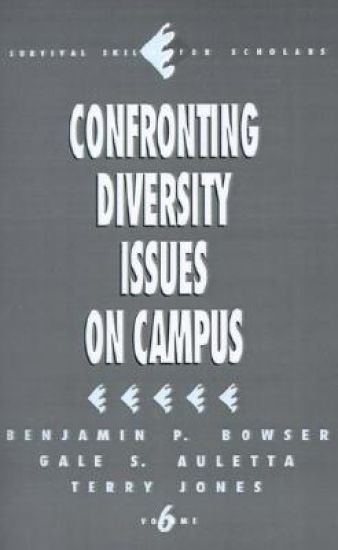
This book provides an analysis of racism and goes on to provide some suggestions as to what can be done to reduce it. The issue is explored from the standpoint of both students and faculty and, in my opinion, is well worth reading and studying. --The Academic Bookshelf No topic causes more concern at today's university than a discussion of diversity in education. Controversies about affirmative action hires, admission policies, intercultural relations in the classroom, the role of ethnic studies departments, and changes in the course curriculum all seem to swirl around the changing ethnic composition of the campus. How do we all get along? Tackling this question are authors Benjamin P. Bowser, Gale S. Auletta, and Terry Jones, who suggest some practical strategies for dealing with questions of racism, diversity, and intercultural communication. Their suggestions are addressed to both European-American faculty and faculty of color, and range from strategies to improve intercultural interpersonal skills to broad structural changes the university needs to undergo to fully embrace its diverse population.