Kirjojen hintavertailu. Mukana 12 595 353 kirjaa ja 12 kauppaa.

Kirjailija

Benjamin Wardhaugh

Kirjat ja teokset yhdessä paikassa: 24 kirjaa, julkaisuja vuosilta 2008-2025, suosituimpien joukossa Book of Wonders. Vertaile teosten hintoja ja tarkista saatavuus suomalaisista kirjakaupoista.

24 kirjaa

Kirjojen julkaisuhaarukka 2008-2025.

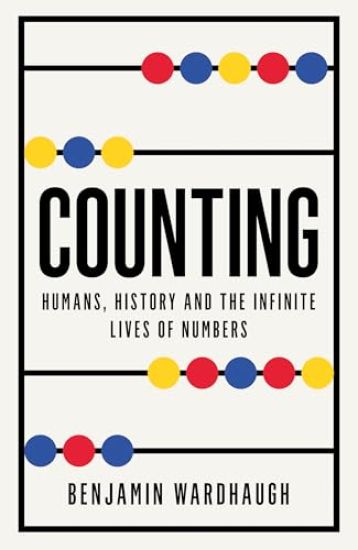
Counting

Counting

Benjamin Wardhaugh

HARPERCOLLINS PUBLISHERS
2025
nidottu
WHAT DOES IT MEAN TO COUNT? WHY ARE HUMANS THE ONLY SPECIES ON EARTH THAT CAN DO IT? WHERE DID COUNTING COME FROM? HOW HAS IT SHAPED SOCIETIES ALONG THE WAY? AND WHY DOES IT MATTER? Counting is an innovative, erudite, world-wrapping journey through humanity’s marvellous ability to impose numbers on things. Acclaimed historian and mathematician Benjamin Wardhaugh draws on stories from the Stone Age to cyberspace in pursuit of the elusive, fascinating, endlessly diverse history of human counting. Starting with the roots of counting in human brains, bodies and environments, Wardhaugh tours us around the world and through time while exploring the different flavours of counting that have developed over millennia. We meet the makers of bead necklaces in ancient South Africa, the inventors of writing in the world ’ s first metropolis, and the ‘counter culture’ of classical Athens. We see counting used – and changed – by Indian scholars, Chinese peasants and Papuan shopkeepers; we meet the distinctive numerate agendas of Mayan kings, US governments and Korean vloggers. Weaving these stories together, Wardhaugh shows how cultures have shaped counting, and how counting has shaped culture, in a rich tapestry spanning thousands of years. This is the vast story of human attempts to find some order in an unruly world; or, perhaps, to impose on a reluctant world the order that humans find within themselves. It is a history as wide, deep and tangled as that of humanity itself
Wie liest man historische mathematische Texte?

Wie liest man historische mathematische Texte?

Benjamin Wardhaugh

Springer Fachmedien Wiesbaden
2024
nidottu
Werke von früheren und wichtigen Mathematikern sind faszinierend. Sie weisen aber eine ganz andere Sprache und Notation auf, als wir sie heute kennen. In diesem Buch bietet Benjamin Wardhaugh einen Leitfaden für die Entschlüsselung solcher Texte, indem er die Fragen aufzeigt, die ihren Sinn und ihre Bedeutung erschließen: Wer hat den Text geschrieben? Für welches Publikum und mit welchem Ziel? Wie ist er zu seiner heutigen Form gelangt? Warum ist er heute noch relevant? Anhand zahlreicher konkreter Beispiele – von Fermat, Newton und Lagrange, um nur einige zu nennen – lehrt dieses Buch, historische Texte kritisch zu verstehen und zu analysieren. Es enthält Zusammenfassungen in Kästen, viele Literaturhinweise und ist ideal für Studierende und Lehrkräfte.
Thomas Salmon: Writings on Music

Thomas Salmon: Writings on Music

Benjamin Wardhaugh

TAYLOR FRANCIS LTD
2024
nidottu
Thomas Salmon (1647-1706) is remembered today for the fury with which Matthew Locke greeted his first foray into musical writing, the Essay to the Advancement of Musick (1672), and the near-farcical level to which the subsequent pamphlet dispute quickly descended. Salmon proposed a radical reform of musical notation, involving a new set of clefs which he claimed, and Locke denied, would make learning and performing music much easier. The incident has tended to be passed over rather briefly in the scholarly literature, but beneath the unedifying invective employed by Salmon, Locke and their supporters, serious and novel statements were being made about what constituted musical knowledge and what was the proper way to acquire it. This volume is the first published scholarly edition of Salmon's writings on notation, previously available only in microfilm and online facsimiles. A second volume to follow will present Salmon's writings on pitch - previously only available mostly in manuscript.
Thomas Salmon: Writings on Music

Thomas Salmon: Writings on Music

Benjamin Wardhaugh

TAYLOR FRANCIS LTD
2024
nidottu
This is the second volume in a two-part set on the writings of Thomas Salmon. Salmon (1647-1706) is remembered today for the fury with which Matthew Locke greeted his first foray into musical writing, the Essay to the Advancement of Musick (1672), and the near-farcical level to which the subsequent pamphlet dispute quickly descended. Salmon proposed a radical reform of musical notation, involving a new set of clefs which he claimed, and Locke denied, would make learning and performing music much easier (these writings are the subject of Volume I). Later in his life Salmon devoted his attention to an exploration of the possible reform of musical pitch. He made or renewed contact with instrument-makers and performers in London, with the mathematician John Wallis, with Isaac Newton and with the Royal Society of London through its Secretary Hans Sloane. A series of manuscript treatises and a published Proposal to Perform Musick, in Perfect and Mathematical Proportions (1688) paved the way for an appearance by Salmon at the Royal Society in 1705, when he provided a demonstration performance by professional musicians using instruments specially modified to his designs. This created an explicit overlap between the spaces of musical performance and of experimental performance, as well as raising questions about the meaning and the source of musical knowledge similar to those raised in his work on notation. Benjamin Wardhaugh presents the first published scholarly edition of Salmon's writings on pitch, previously only available mostly in manuscript.
Counting

Counting

Benjamin Wardhaugh

HARPERCOLLINS PUBLISHERS
2024
nidottu
WHAT DOES IT MEAN TO COUNT? WHY ARE HUMANS THE ONLY SPECIES ON EARTH THAT CAN DO IT? WHERE DID COUNTING COME FROM? HOW HAS IT SHAPED SOCIETIES ALONG THE WAY? AND WHY DOES IT MATTER?
Counting

Counting

Benjamin Wardhaugh

HARPERCOLLINS PUBLISHERS
2024
sidottu
WHAT DOES IT MEAN TO COUNT? WHY ARE HUMANS THE ONLY SPECIES ON EARTH THAT CAN DO IT? WHERE DID COUNTING COME FROM? HOW HAS IT SHAPED SOCIETIES ALONG THE WAY? AND WHY DOES IT MATTER? Counting is an innovative, erudite, world-wrapping journey through humanity’s marvellous ability to impose numbers on things. Acclaimed historian and mathematician Benjamin Wardhaugh draws on stories from the Stone Age to cyberspace in pursuit of the elusive, fascinating, endlessly diverse history of human counting. Starting with the roots of counting in human brains, bodies and environments, Wardhaugh tours us around the world and through time while exploring the different flavours of counting that have developed over millennia. We meet the makers of bead necklaces in ancient South Africa, the inventors of writing in the world ’ s first metropolis, and the ‘counter culture’ of classical Athens. We see counting used – and changed – by Indian scholars, Chinese peasants and Papuan shopkeepers; we meet the distinctive numerate agendas of Mayan kings, US governments and Korean vloggers. Weaving these stories together, Wardhaugh shows how cultures have shaped counting, and how counting has shaped culture, in a rich tapestry spanning thousands of years. This is the vast story of human attempts to find some order in an unruly world; or, perhaps, to impose on a reluctant world the order that humans find within themselves. It is a history as wide, deep and tangled as that of humanity itself
Encounters with Euclid

Encounters with Euclid

Benjamin Wardhaugh

HARPERCOLLINS PUBLISHERS
2021
pokkari
â??An astonishingly readable and informative history of the greatest mathematical bestseller of all time â?¦ The writing is vivid and the stories are gripping. Highly recommended â?? IAN STEWART, AUTHOR OF SIGNIFICANT FIGURES
Encounters with Euclid: How an Ancient Greek Geometry Text Shaped the World
A sweeping cultural history of one of the most influential mathematical books ever written Euclid's Elements of Geometry is one of the fountainheads of mathematics--and of culture. Written around 300 BCE, it has traveled widely across the centuries, generating countless new ideas and inspiring such figures as Isaac Newton, Bertrand Russell, Abraham Lincoln, and Albert Einstein. Encounters with Euclid tells the story of this incomparable mathematical masterpiece, taking readers from its origins in the ancient world to its continuing influence today. In this lively and informative book, Benjamin Wardhaugh explains how Euclid's text journeyed from antiquity to the Renaissance, introducing some of the many readers, copyists, and editors who left their mark on the Elements before handing it on. He shows how some read the book as a work of philosophy, while others viewed it as a practical guide to life. He examines the many different contexts in which Euclid's book and his geometry were put to use, from the Neoplatonic school at Athens and the artisans' studios of medieval Baghdad to the Jesuit mission in China and the workshops of Restoration London. Wardhaugh shows how the Elements inspired ideas in theology, art, and music, and how the book has acquired new relevance to the strange geometries of dark matter and curved space. Encounters with Euclid traces the life and afterlives of one of the most remarkable works of mathematics ever written, revealing its lasting role in the timeless search for order and reason in an unruly world.
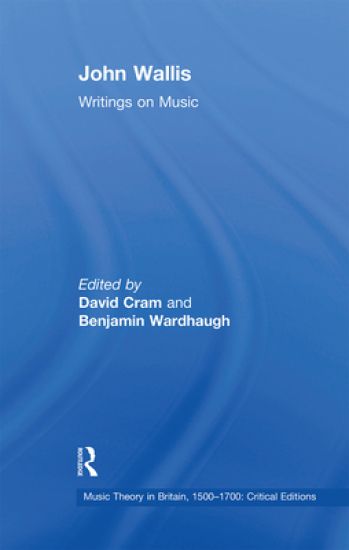
John Wallis: Writings on Music

John Wallis: Writings on Music

Benjamin Wardhaugh

Routledge
2020
nidottu
John Wallis (1616-1703), was one of the foremost British mathematicians of the seventeenth century, and is also remembered for his important writings on grammar and logic. An interest in music theory led him to produce translations into Latin of three ancient Greek texts - those of Ptolemy, Porphyry and Bryennius - and involved him in discussions with Henry Oldenburg, the Secretary of the Royal Society, Thomas Salmon and other individuals as his ideas developed. The texts presented in this volume cover the relationship of ancient and modern tuning theory, the building of organs, the phenomena of resonance, and other musical topics.
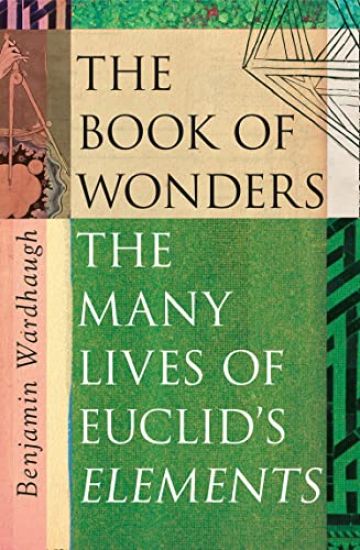
Book of Wonders

Book of Wonders

Benjamin Wardhaugh

HARPERCOLLINS PUBLISHERS
2020
nidottu
Euclid's Elements of Geometry was a book that changed the world. In a sweeping history, Benjamin Wardhaugh traces how an ancient Greek text on mathematics - often hailed as the world's first textbook - shaped two thousand years of art, philosophy and literature, as well as science and maths.
Book of Wonders

Book of Wonders

Benjamin Wardhaugh

HARPERCOLLINS PUBLISHERS
2020
sidottu
Euclidâ??s Elements of Geometry was a book that changed the world. In a sweeping history, Benjamin Wardhaugh traces how an ancient Greek text on mathematics â?? often hailed as the worldâ??s first textbook â?? shaped two thousand years of art, philosophy and literature, as well as science and maths.
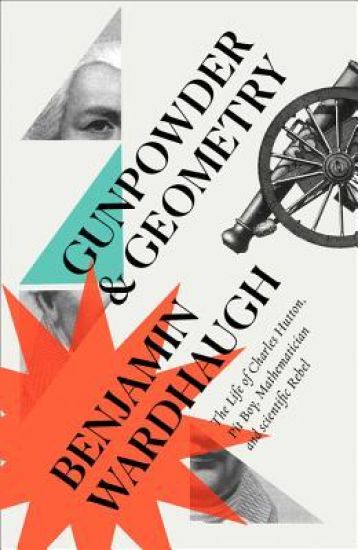
Gunpowder and Geometry

Gunpowder and Geometry

Benjamin Wardhaugh

William Collins
2020
nidottu
August, 1755. Newcastle, on the north bank of the Tyne. In the fields, men and women are getting the harvest in. Sunlight, or rain. Scudding clouds and backbreaking labour. Three hundred feet underground, young Charles Hutton is at the coalface. Cramped, dust-choked, wielding a five-pound pick by candlelight. Eighteen years old, he’s been down the pits on and off for more than a decade, and now it looks like a life sentence. No unusual story, although Charles is a clever lad – gifted at maths and languages – and for a time he hoped for a different life. Many hoped. Charles Hutton, astonishingly, would actually live the life he dreamed of. Twenty years later you’d have found him in Slaughter’s coffee house in London, eating a few oysters with the President of the Royal Society. By the time he died, in 1823, he was a fellow of scientific academies in four countries, while the Lord Chancellor of England counted himself fortunate to have known him. Hard work, talent, and no small share of luck would take Charles Hutton out of the pit to international fame, wealth, admiration and happiness. The pit-boy turned professor would become one of the most revered British scientists of his day. This book is his incredible story.
John Birchensha: Writings on Music

John Birchensha: Writings on Music

Christopher D.S. Field; Benjamin Wardhaugh

Routledge
2018
nidottu
John Birchensha (c.1605-?1681) is chiefly remembered for the impression that his theories about music made on the mathematicians, natural philosophers and virtuosi of the Royal Society in the 1660s and 1670s, and for inventing a system that he claimed would enable even those without practical experience of music to learn to compose in a short time by means of 'a few easy, certain, and perfect Rules'-his most famous composition pupil being Samuel Pepys in 1662. His great aim was to publish a treatise on music in its philosophical, mathematical and practical aspects (which would have included a definitive summary of his rules of composition), entitled Syntagma musicæ. Subscriptions for this book were invited in 1672-3, and it was due to be published by March 1675; but it never appeared, and no final manuscript of it survives. Consequently knowledge about his work has hitherto remained extremely sketchy. Recent research, however, has brought to light a number of manuscripts which allow us at last to form a more complete view of Birchensha's ideas. Almost none of this material has been previously published. The new items include an autograph treatise of c.1664 ('A Compendious Discourse of the Principles of the Practicall & Mathematicall Partes of Musick') which Birchensha presented to the natural philosopher Robert Boyle, and which covers concisely much of the ground that he intended to cover in Syntagma musicæ; a detailed synopsis for Syntagma musicæ which he prepared for a meeting of the Royal Society in February 1676; and an autograph notebook (now in Brussels) containing his six rules of composition with music examples, presumably written for a pupil. Bringing all this material together in a single volume will allow scholars to see how Birchensha's rules and theories developed over a period of fifteen years, and to gain at least a flavour of the lost Syntagma musicæ.
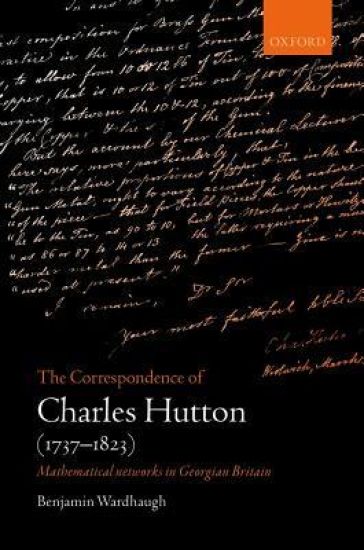
The Correspondence of Charles Hutton

The Correspondence of Charles Hutton

Benjamin Wardhaugh

Oxford University Press
2017
sidottu
This book contains all the letters that are known to survive from the correspondence of Charles Hutton (1737-1823). Hutton was one of the most prominent British mathematicians of his generation; he played roles at the Royal Society, the Royal Military Academy, the Board of Longitude, the 'philomath' network and elsewhere. He worked on the explosive force of gunpowder and the mean density of the earth, wining the Royal Society's Copley medal in 1778; he was also at the focus of a celebrated row at the Royal Society in 1784 over the place of mathematics there. He is of particular historical interest because of the variety of roles he played in British mathematics, the dexterity with which he navigated, exploited and shaped personal and professional networks in mathematics and science, and the length and visibility of his career. Hutton corresponded nationally and internationally, and his correspondence illustrates the overlapping, the intersection and interaction of the different networks in which Hutton moved. It therefore provides new information about how Georgian mathematics was structured socially, and how mathematical careers worked in that period. It provides a rare and valuable view of a mathematical culture that would substantially cease to exist when British mathematics embraced continental methods from the early ninetheenth century onwards. Over 130 letters survive, from 1770 to 1822, but they are widely scattered (in nearly thirty different archives) and have not been catalogued or edited before. This edition situates the correspondence with an introduction and explanatory notes.
John Wallis: Writings on Music

John Wallis: Writings on Music

Benjamin Wardhaugh

Ashgate Publishing Limited
2014
sidottu
John Wallis (1616-1703), was one of the foremost British mathematicians of the seventeenth century, and is also remembered for his important writings on grammar and logic. An interest in music theory led him to produce translations into Latin of three ancient Greek texts - those of Ptolemy, Porphyry and Bryennius - and involved him in discussions with Henry Oldenburg, the Secretary of the Royal Society, Thomas Salmon and other individuals as his ideas developed. The texts presented in this volume cover the relationship of ancient and modern tuning theory, the building of organs, the phenomena of resonance, and other musical topics.
Thomas Salmon: Writings on Music

Thomas Salmon: Writings on Music

Benjamin Wardhaugh

Ashgate Publishing Limited
2013
muu
Thomas Salmon (1647-1706) is remembered today for the fury with which Matthew Locke greeted his first foray into musical writing, the Essay to the Advancement of Musick (1672), and the near-farcical level to which the subsequent pamphlet dispute quickly descended. Salmon proposed a radical reform of musical notation, involving a new set of clefs which he claimed, and Locke denied, would make learning and performing music much easier (these writings are the subject of Volume I). The incident has tended to be passed over rather briefly in the scholarly literature, but beneath the unedifying invective employed by Salmon, Locke and their supporters, serious and novel statements were being made about what constituted musical knowledge and what was the proper way to acquire it. Later in his life Salmon devoted his attention to an exploration of the possible reform of musical pitch. He made or renewed contact with instrument-makers and performers in London, with the mathematician John Wallis, with Isaac Newton and with the Royal Society of London through its Secretary Hans Sloane. A series of manuscript treatises and a published Proposal to Perform Musick, in Perfect and Mathematical Proportions (1688) paved the way for an appearance by Salmon at the Royal Society in 1705, when he provided a demonstration performance by professional musicians using instruments specially modified to his designs (these writings are the subject of Volume II). This created an explicit overlap between the spaces of musical performance and of experimental performance, as well as raising questions about the meaning and the source of musical knowledge similar to those raised in his work on notation. In this two-volume set, Benjamin Wardhaugh presents the first published scholarly edition of Salmon's writings, previously available only in microfilm and online facsimiles.
Thomas Salmon: Writings on Music

Thomas Salmon: Writings on Music

Benjamin Wardhaugh

Ashgate Publishing Limited
2013
sidottu
Thomas Salmon (1647-1706) is remembered today for the fury with which Matthew Locke greeted his first foray into musical writing, the Essay to the Advancement of Musick (1672), and the near-farcical level to which the subsequent pamphlet dispute quickly descended. Salmon proposed a radical reform of musical notation, involving a new set of clefs which he claimed, and Locke denied, would make learning and performing music much easier. The incident has tended to be passed over rather briefly in the scholarly literature, but beneath the unedifying invective employed by Salmon, Locke and their supporters, serious and novel statements were being made about what constituted musical knowledge and what was the proper way to acquire it. This volume is the first published scholarly edition of Salmon's writings on notation, previously available only in microfilm and online facsimiles. A second volume to follow will present Salmon's writings on pitch - previously only available mostly in manuscript.