Kirjojen hintavertailu. Mukana 12 390 323 kirjaa ja 12 kauppaa.

Kirjailija

Benoît Leclercq

Kirjat ja teokset yhdessä paikassa: 8 kirjaa, julkaisuja vuosilta 2023-2026, suosituimpien joukossa Models of Modals. Vertaile teosten hintoja ja tarkista saatavuus suomalaisista kirjakaupoista.

8 kirjaa

Kirjojen julkaisuhaarukka 2023-2026.

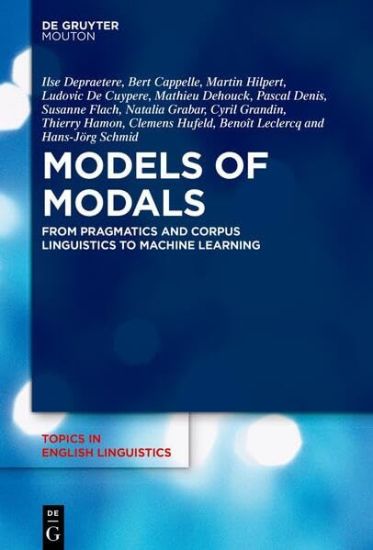
Models of Modals

Models of Modals

Ilse Depraetere; Bert Cappelle; Martin Hilpert; Ludovic De Cuypere; Mathieu Dehouck; Pascal Denis; Susanne Flach; Natalia Grabar; Cyril Grandin; Thierry Hamon; Clemens Hufeld; Benoît Leclercq; Hans-Jörg Schmid

De Gruyter
2024
isokokoinen pokkari
Modal verbs in English communicate delicate shades of meaning, there being a large range of verbs both on the necessity side (must, have to, should, ought to, need, need to) and the possibility side (can, may, could, might, be able to). They therefore constitute excellent test ground to apply and compare different methodologies that can lay bare the factors that drive the speaker’s choice of modal verb. This book is not merely concerned with a purely grammatical description of the use of modal verbs, but aims at advancing our understanding of lexical and grammatical units in general and of linguistic methodologies to explore these. It thus involves a genuine effort to compare, assess and combine a variety of approaches. It complements the leading descriptive qualitative work on modal verbs by testing a diverse range of quantitative methods, while not ignoring qualitative issues pertaining to the semantics-pragmatics interface. Starting from a critical assessment of what constitutes the meaning of modal verbs, different types of empirical studies (usage-based, data-driven and experimental), drawing considerably on the same data sets, shows how method triangulation can contribute to an enhanced understanding. Due attention is also given to individual variation as well as the degree to which modals can predict L2 proficiency level.
Linguistic Knowledge and Language Use

Linguistic Knowledge and Language Use

Benoît Leclercq

Cambridge University Press
2026
pokkari
One of the key challenges in linguistics is to account for the link between linguistic knowledge and our use of language in a way that is both descriptively accurate and cognitively plausible. This pioneering book addresses these challenges by combining insights from Construction Grammar and Relevance Theory, two influential approaches which until now have been considered incompatible. After a clear and detailed presentation of both theories, the author demonstrates that their integration is possible, and explains why this integration is necessary, in order to understand exactly how meaning comes about. A new theoretical model is offered that provides ground-breaking insights into the semantics-pragmatic interface, and addresses a variety of topics including the nature of lexical and grammatical concepts, procedural meaning, coercion and idiom processing. This title is part of the Flip it Open Programme and may also be available Open Access. Check our website Cambridge Core for details.
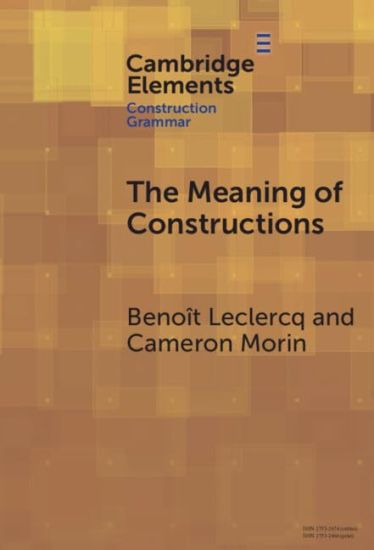
The Meaning of Constructions

The Meaning of Constructions

Benoît Leclercq; Cameron Morin

Cambridge University Press
2025
sidottu
This Element offers a primer for the study of meaning in a Construction Grammar approach. It reviews the main principles of meaning shared across constructionist frameworks, including its ubiquity in grammatical structure, its usage-based formation, and its nature as the output of cognitive representations. It also reviews the importance given to meaning in construction-based explanations of sentence composition, innovative language use, and language change. Paradoxically, the Element shows that there is no systematic framework delineating the rich structure of constructional meaning, which has led to theoretical disagreements and inconsistencies. It therefore proposes an operational model of meaning for practitioners of Construction Grammar. It details the characteristics of a complex interface of semantic, pragmatic, and social meaning, and shows how this framework sheds light on recent theoretical issues. The Element concludes by considering ways in which this framework can be used for future descriptive and theoretical research questions.
The Meaning of Constructions

The Meaning of Constructions

Benoît Leclercq; Cameron Morin

Cambridge University Press
2025
pokkari
This Element offers a primer for the study of meaning in a Construction Grammar approach. It reviews the main principles of meaning shared across constructionist frameworks, including its ubiquity in grammatical structure, its usage-based formation, and its nature as the output of cognitive representations. It also reviews the importance given to meaning in construction-based explanations of sentence composition, innovative language use, and language change. Paradoxically, the Element shows that there is no systematic framework delineating the rich structure of constructional meaning, which has led to theoretical disagreements and inconsistencies. It therefore proposes an operational model of meaning for practitioners of Construction Grammar. It details the characteristics of a complex interface of semantic, pragmatic, and social meaning, and shows how this framework sheds light on recent theoretical issues. The Element concludes by considering ways in which this framework can be used for future descriptive and theoretical research questions.
Linguistic Knowledge and Language Use

Linguistic Knowledge and Language Use

Benoît Leclercq

Cambridge University Press
2023
sidottu
One of the key challenges in linguistics is to account for the link between linguistic knowledge and our use of language in a way that is both descriptively accurate and cognitively plausible. This pioneering book addresses these challenges by combining insights from Construction Grammar and Relevance Theory, two influential approaches which until now have been considered incompatible. After a clear and detailed presentation of both theories, the author demonstrates that their integration is possible, and explains why this integration is necessary, in order to understand exactly how meaning comes about. A new theoretical model is offered that provides ground-breaking insights into the semantics-pragmatic interface, and addresses a variety of topics including the nature of lexical and grammatical concepts, procedural meaning, coercion and idiom processing. This title is part of the Flip it Open Programme and may also be available Open Access. Check our website Cambridge Core for details.
Models of Modals

Models of Modals

Ilse Depraetere; Bert Cappelle; Martin Hilpert; Ludovic De Cuypere; Mathieu Dehouck; Pascal Denis; Susanne Flach; Natalia Grabar; Cyril Grandin; Thierry Hamon; Clemens Hufeld; Benoît Leclercq; Hans-Jörg Schmid

De Gruyter
2023
sidottu
Modal verbs in English communicate delicate shades of meaning, there being a large range of verbs both on the necessity side (must, have to, should, ought to, need, need to) and the possibility side (can, may, could, might, be able to). They therefore constitute excellent test ground to apply and compare different methodologies that can lay bare the factors that drive the speaker’s choice of modal verb. This book is not merely concerned with a purely grammatical description of the use of modal verbs, but aims at advancing our understanding of lexical and grammatical units in general and of linguistic methodologies to explore these. It thus involves a genuine effort to compare, assess and combine a variety of approaches. It complements the leading descriptive qualitative work on modal verbs by testing a diverse range of quantitative methods, while not ignoring qualitative issues pertaining to the semantics-pragmatics interface. Starting from a critical assessment of what constitutes the meaning of modal verbs, different types of empirical studies (usage-based, data-driven and experimental), drawing considerably on the same data sets, shows how method triangulation can contribute to an enhanced understanding. Due attention is also given to individual variation as well as the degree to which modals can predict L2 proficiency level.