Kirjojen hintavertailu. Mukana 12 657 676 kirjaa ja 12 kauppaa.
Kirjailija
Bernard Grofman
Kirjat ja teokset yhdessä paikassa: 11 kirjaa, julkaisuja vuosilta 1992-2026, suosituimpien joukossa Introduction to the Laws of Statistical Sampling. Vertaile teosten hintoja ja tarkista saatavuus suomalaisista kirjakaupoista.
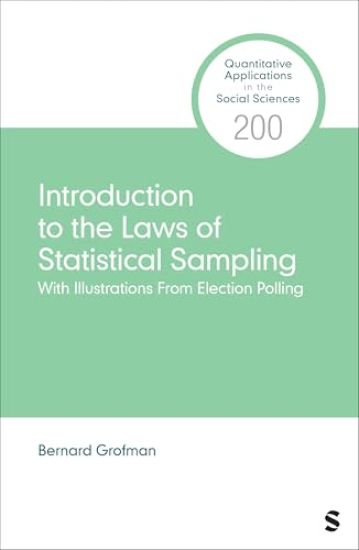
A concise, intuitive monograph that demystifies statistical sampling theory—especially as applied to elections and survey research—using real-world examples, simulations, and Excel-based tools. It’s designed to be accessible to readers with only high school algebra.
Extreme polarization in American politics--and especially in the U.S. Congress--is perhaps the most confounding political phenomenon of our time. This book binds together polarization in Congress and polarization in the electorate within an ever-expanding feedback loop. This loop is powered by the discipline exerted by the respective political parties on their Congressional members and district candidates and endorsed by the voters in each Congressional district who must choose between the alternatives offered. These alternatives are just as extreme in competitive as in lop-sided districts. Tight national party discipline produces party delegations in Congress that are widely separated from one another but each ideologically narrowly distributed. As district constituencies become more polarized and are egged on by activists, parties are further motivated to move past a threshold and appeal to their respective bases rather than to voters in the ideological center. America has indeed acquired parties with clear platforms--once thought to be a desirable goal--but these parties are now feuding camps. What resolution might there be? Just as the progressive movement slowly replaced the Gilded Age, might a new reform effort replace the current squabble? Or could an asymmetry develop in the partisan constraints that would lead to ascendancy of the center, or might a new and over-riding issue generate a cross-cutting dimension, opening the door to a new politics? Only the future will tell.
Extreme polarization in American politics--and especially in the U.S. Congress--is perhaps the most confounding political phenomenon of our time. This book binds together polarization in Congress and polarization in the electorate within an ever-expanding feedback loop. This loop is powered by the discipline exerted by the respective political parties on their Congressional members and district candidates and endorsed by the voters in each Congressional district who must choose between the alternatives offered. These alternatives are just as extreme in competitive as in lop-sided districts. Tight national party discipline produces party delegations in Congress that are widely separated from one another but each ideologically narrowly distributed. As district constituencies become more polarized and are egged on by activists, parties are further motivated to move past a threshold and appeal to their respective bases rather than to voters in the ideological center. America has indeed acquired parties with clear platforms--once thought to be a desirable goal--but these parties are now feuding camps. What resolution might there be? Just as the progressive movement slowly replaced the Gilded Age, might a new reform effort replace the current squabble? Or could an asymmetry develop in the partisan constraints that would lead to ascendancy of the center, or might a new and over-riding issue generate a cross-cutting dimension, opening the door to a new politics? Only the future will tell.
American democracy differs greatly from other democracies around the world. But is the American way more or less efficacious than comparable democracies in Asia, Latin America, or Europe? What if the United States had a prime minister instead of (or in addition to) a president, or if it had three or more parties in Congress instead of two? Would there be more partisan animosity and legislative gridlock or less? These are the kinds of questions that thinking about U.S. government in comparative perspective helps us to analyze. This valuable contribution to political studies takes a unique approach to a much-studied subject, looking at the U.S. government from a comparative point of view. Four distinguished scholars in the field examine the Constitution, the two-party system, the division of power between state and federal governments, and other major features of the American political system in terms of how they differ from other democracies, and they explore what those differences ultimately mean for democratic performance. By merging two important fields of study, American government and comparative political systems, this essential text offers a new and refreshingly insightful view of American exceptionalism.
Behavioral Social Choice looks at the probabilistic foundations of collective decision-making rules. The authors challenge much of the existing theoretical wisdom about social choice processes, and seek to restore faith in the possibility of democratic decision-making. In particular, they argue that worries about the supposed prevalence of majority rule cycles that would preclude groups from reaching a final decision about what alternative they prefer have been greatly overstated. In practice, majority rule can be expected to work well in most real-world settings. Furthermore, if there is a problem, they show that the problem is more likely to be one of sample estimates missing the majority winner in a close contest (e.g., Bush-Gore) than a problem about cycling. The authors also provide new mathematical tools to estimate the prevalence of cycles as a function of sample size and insights into how alternative model specifications can change our estimates of social orderings.
Behavioral Social Choice looks at the probabilistic foundations of collective decision-making rules. The authors challenge much of the existing theoretical wisdom about social choice processes, and seek to restore faith in the possibility of democratic decision-making. In particular, they argue that worries about the supposed prevalence of majority rule cycles that would preclude groups from reaching a final decision about what alternative they prefer have been greatly overstated. In practice, majority rule can be expected to work well in most real-world settings. Furthermore, if there is a problem, they show that the problem is more likely to be one of sample estimates missing the majority winner in a close contest (e.g., Bush-Gore) than a problem about cycling. The authors also provide new mathematical tools to estimate the prevalence of cycles as a function of sample size and insights into how alternative model specifications can change our estimates of social orderings.
This book integrates spatial and behavioral perspectives - in a word, those of the Rochester and Michigan schools - into a unified theory of voter choice and party strategy. The theory encompasses both policy and non-policy factors, effects of turnout, voter discounting of party promises, expectations of coalition governments, and party motivations based on policy as well as office. Optimal (Nash equilibrium) strategies are determined for alternative models for presidential elections in the US and France, and for parliamentary elections in Britain and Norway. These polities cover a wide range of electoral rules, number of major parties, and governmental structures. The analyses suggest that the more competitive parties generally take policy positions that come close to maximizing their electoral support, and that these vote-maximizing positions correlate strongly with the mean policy positions of their supporters.
This book addresses the questions: how do voters use their own issue positions and those of candidates to decide how to vote? Does a voter tend to choose the candidate who most closely shares the views of the voter or rather a candidate who holds more extreme views due to the fact that the voters discount the candidates’ abilities to implement policy. The authors develop a unified model that incorporates these and other voter motivations and assess its empirical predictions - for both voter choice and candidate strategy - in the US, Norway, and France. The analyses show that a combination of proximity, direction, discounting, and party ID are compatible with the mildly but not extremely divergent policies that are characteristic of many two-party and multiparty electorates. All of these motivations are necessary to understand the linkage between candidate issue positions and voter preferences.
This book addresses the questions: how do voters use their own issue positions and those of candidates to decide how to vote? Does a voter tend to choose the candidate who most closely shares the views of the voter or rather a candidate who holds more extreme views due to the fact that the voters discount the candidates' abilities to implement policy. The authors develop a unified model that incorporates these and other voter motivations and assess its empirical predictions - for both voter choice and candidate strategy - in the US, Norway, and France. The analyses show that a combination of proximity, direction, discounting, and party ID are compatible with the mildly but not extremely divergent policies that are characteristic of many two-party and multiparty electorates. All of these motivations are necessary to understand the linkage between candidate issue positions and voter preferences.
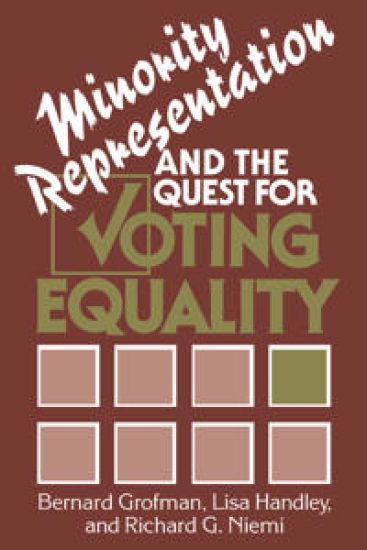
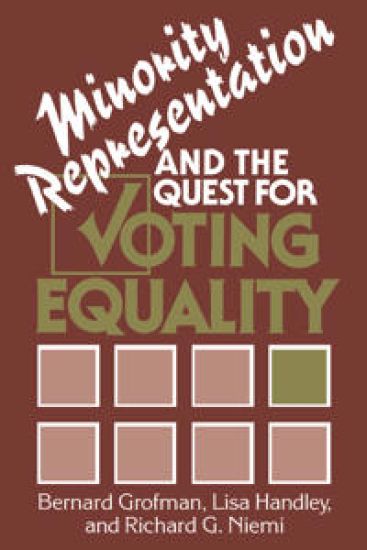
This book provides an up-to-date analysis of American voting rights law and the numerous controversies surrounding minority representation. Written by authors with first-hand experience in the case law, the book details the evolution of the law and precedent from 1965 onwards. The authors explain the logic underlying the major decisions, introduce the reader to the procedures for establishing standards of representation and measuring discrimination, and discuss the major points of recent contention. In conclusion, they address the implications of recent developments in voting rights law for the future of representation in America.
This book provides an up-to-date analysis of American voting rights law and the numerous controversies surrounding minority representation. Written by authors with first-hand experience in the case law, the book details the evolution of the law and precedent from 1965 onwards. The authors explain the logic underlying the major decisions, introduce the reader to the procedures for establishing standards of representation and measuring discrimination, and discuss the major points of recent contention. In conclusion, they address the implications of recent developments in voting rights law for the future of representation in America.