Kirjojen hintavertailu. Mukana 12 203 125 kirjaa ja 12 kauppaa.

Kirjailija

Bernard Stiegler

Kirjat ja teokset yhdessä paikassa: 39 kirjaa, julkaisuja vuosilta 1998-2022, suosituimpien joukossa The Re-Enchantment of the World. Vertaile teosten hintoja ja tarkista saatavuus suomalaisista kirjakaupoista.

39 kirjaa

Kirjojen julkaisuhaarukka 1998-2022.

Philosophies Singulières: Conversation Avec Michaël Crevoisier

Philosophies Singulières: Conversation Avec Michaël Crevoisier

Mehdi Belhaj Kacem; Bernard Stiegler

Diaphanes
2022
nidottu
Rarement les philosophes dont la formation s'est faite l' cart de l'universit se sont entretenus. Le temps d'une conversation Mehdi Belhaj Kacem et Bernard Stiegler se sont pr t s au jeu, changeant propos de ce qui les lie la philosophie. In vitablement, la mort tragique de Bernard Stiegler survenue un an plus tard, donne lire ce texte avec un regard affect . D'autant plus qu'ici, l'enthousiasme des changes nous fait sentir le mouvement vivant de philosophies l'oeuvre, continuant de se constituer en syst me. En effet, bien que les oeuvres de ces deux auteurs soient singuli res, l'une et l'autre proc dent d'une m me exigence qui les place au centre de la tradition philosophique: produire un syst me conceptuel qui donne penser la nouveaut de la situation historique. quoi bon la coh rence d'une philosophie qui ne nous dirait rien de ce qu'est devenu le monde ? Que vaudrait l'abstraction conceptuelle si celle-ci n' tait pas au service de la compr hension de ce qui nous transforme ? Ainsi, les deux auteurs nous appellent ne pas oublier: l'enjeu de la philosophie n'est pas la philosophie. Cette exigence critique, la pr sente conversation la r fl chit bras le corps, non sans d tours et tourments, mais avec franchise et esprit de libert .
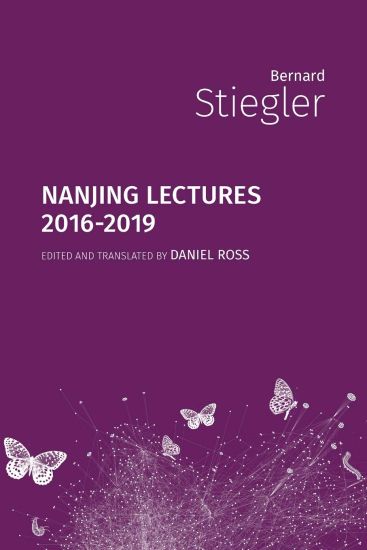
Nanjing Lectures

Nanjing Lectures

Bernard Stiegler

Open Humanities Press
2020
nidottu
French philosopher Bernard Stiegler began his annual lecture series at Nanjing University in 2016, offering eight lectures per year. The first four years of these lectures are included in this volume and amount to a distillation of the movement of his work in this period as well as an engagement with China at a time when its place in the questions about the global future is becoming increasingly central. This movement and this engagement are in fact conjoined, because since 2014 Stiegler's questions have been increasingly concerned with global problems, that is, with thinking the so-called Anthropocene at a profound level and in relation to the philosophical failure to reckon with the manifold and indeed "cosmic" consequences of the entropic and thermodynamic revolution. The first year's lectures introduce these questions via Stiegler's concept of automatic society and technological and speculative questions emerging from the work of Heidegger and Marx. The 2017 lectures begin with the decision of Oxford Dictionaries to make "post-truth" the word of the year, taking this as an opportunity to understand the implications for Heidegger's "history of being", "history of truth" and Gestell, before entering into a lengthy and original consideration of the relationship between Socrates and Plato (and of tragic Greece in general) and its meaning for the history of Western philosophy. The 2018 lectures traverse a path from Foucault's biopower to psychopower to neuropwer, and then to a critique of neuroeconomics, conducted through Stiegler's revision of the Husserlian account of retention to focus on the irreducible connection between human memory and technological memory, culminating in reflections on the significance of neurotechnology in platform capitalism. The 2019 lectures introduce the concept of hyper-matter as necessary for an epistemology that escapes the trap of opposing the material and the ideal, in order to respond to the need for a new critique of the notion of information and technological performativity (of which Moore's law both is and is not an example) in an age when the biosphere has become a technosphere.
The Age of Disruption

The Age of Disruption

Bernard Stiegler

Polity Press
2019
nidottu
Half a century ago Adorno and Horkheimer argued, with great prescience, that our increasingly rationalized world was witnessing the emergence of a new kind of barbarism, thanks in part to the stultifying effects of the culture industries. What they could not foresee was that, with the digital revolution and the pervasive automation associated with it, the developments they had discerned would be greatly accentuated, giving rise to the loss of reason and to the loss of the reason for living. Individuals are now overwhelmed by the sheer quantity of digital information and the speed of digital flows, resulting in a kind of technological Wild West in which they find themselves increasingly powerless, driven by their lack of agency to the point of madness. How can we find a way out of this situation? In this major new book, Bernard Stiegler argues that we must first acknowledge our era as one of fundamental disruption and detachment. We are living in an absence of epokhe in the philosophical sense, by which Stiegler means that we have lost our path of thinking and being. Weaving in powerful accounts from his own life story, including struggles with depression and time spent in prison, Stiegler calls for a new epokhe based on public power. We must forge new circuits of meaning outside of the established algorithmic routes. For only then will forms of thinking and life be able to arise that restore meaning and aspiration to the individual. Concluding with a dialogue between Stiegler and Jean-Luc Nancy, this book will be of great interest to students and scholars in social and cultural theory, media and cultural studies, philosophy and the humanities generally.
The Age of Disruption

The Age of Disruption

Bernard Stiegler

Polity Press
2019
sidottu
Half a century ago Adorno and Horkheimer argued, with great prescience, that our increasingly rationalized world was witnessing the emergence of a new kind of barbarism, thanks in part to the stultifying effects of the culture industries. What they could not foresee was that, with the digital revolution and the pervasive automation associated with it, the developments they had discerned would be greatly accentuated, giving rise to the loss of reason and to the loss of the reason for living. Individuals are now overwhelmed by the sheer quantity of digital information and the speed of digital flows, resulting in a kind of technological Wild West in which they find themselves increasingly powerless, driven by their lack of agency to the point of madness. How can we find a way out of this situation? In this major new book, Bernard Stiegler argues that we must first acknowledge our era as one of fundamental disruption and detachment. We are living in an absence of epokhe in the philosophical sense, by which Stiegler means that we have lost our path of thinking and being. Weaving in powerful accounts from his own life story, including struggles with depression and time spent in prison, Stiegler calls for a new epokhe based on public power. We must forge new circuits of meaning outside of the established algorithmic routes. For only then will forms of thinking and life be able to arise that restore meaning and aspiration to the individual. Concluding with a dialogue between Stiegler and Jean-Luc Nancy, this book will be of great interest to students and scholars in social and cultural theory, media and cultural studies, philosophy and the humanities generally.
Machine

Machine

Thomas Pringle; Gertrud Koch; Bernard Stiegler

University of Minnesota Press
2019
pokkari
On the social consequences of machines Automation, animation, and ecosystems are terms of central media-philosophical concern in today’s society of humans and machines. This volume describes the social consequences of machines as a mediating concept for the animation of life and automation of technology. Bernard Stiegler’s automatic society illustrates how digital media networks establish a new proletariat of knowledge workers. Gertrud Koch offers the animation of the technical to account for the pathological relations that arise between people and their devices. And Thomas Pringle synthesizes how automation and animation explain the history of intellectual exchanges that led to the hybrid concept of the ecosystem, a term that blends computer and natural science. All three contributions analyse how categories of life and technology become mixed in governmental policies, economic exploitation and pathologies of everyday life thereby both curiously and critically advancing the term that underlies those new developments: ‘machine.’
The Neganthropocene

The Neganthropocene

Bernard Stiegler

Open Humanities Press
2018
nidottu
Opening a major new front in discussions of the Anthropocene, The Neganthropocene is a collection of recent lectures by the leading French philosopher, Bernard Stiegler. In this volume, Stiegler engages substantially with Alfred North Whitehead, Jacques Derrida, Gilbert Simondon, Peter Sloterdijk, Karl Marx, Benjamin Bratton, and others in his renewed thought of the concepts of entropy and negentropy. Stiegler's life-long encounter with the work of Martin Heidegger reappears here in pursuit of the question not of what is called "thinking" (penser) but, in a twist on old French, of what is called "caring" (panser) as the possibility of a new therapeutic theory and practice capable of responding to the massive psychological, social and ecological toxicity associated with what, for Stiegler, is the disruptive age of the Entropocene.
Philosophising by Accident

Philosophising by Accident

Bernard Stiegler

Edinburgh University Press
2017
sidottu
This new translation of four revised radio interviews, conducted in December 2002 at France Culture with lie During, is the best introduction to Stiegler's Time and Technics series. This collection includes a new interview conducted specially for this volume and an interview with Artpress from 2001.In Philosophising By Accident, Stiegler introduces some of the key arguments about the technical constitution of the human and its relation to politics, aesthetics and economics. He reads philosophical texts from the perspective of his controversial thesis about the three types of memory and speaks about concepts central to his later works, such as synchrony/diachrony, grammatisation and the industrial temporal object.
Philosophising by Accident

Philosophising by Accident

Bernard Stiegler

Edinburgh University Press
2017
nidottu
In this book of interviews, conducted in 2002 by Elie During, Bernard Stiegler discusses the reasons that motivated him to develop his philosophy of technics. Divided into four parts, Philosophising by Accident introduces some of the key points in Stiegler's argument about the technical constitution of the human, and its relation to politics, aesthetics and economics. Stiegler presents his original analysis of Plato and the beginning of philosophy in relation to the tragic culture, the method of dialectics and metaphysics. He also reads philosophical texts from the perspective of his controversial thesis about the three types of memory, and refers to concepts central to his later works such as synchrony/diachrony, grammatisation and the industrial temporal object. While contemporary times call us to examine and analyse technical tools and new technologies, Stiegler argues that philosophy has, from its very origins, repressed technics, and examining rigorously the evolution of technics and its effects on the human, will provide us with greater insights into what it means to be human.
Automatic Society, Volume 1

Automatic Society, Volume 1

Bernard Stiegler

Polity Press
2016
nidottu
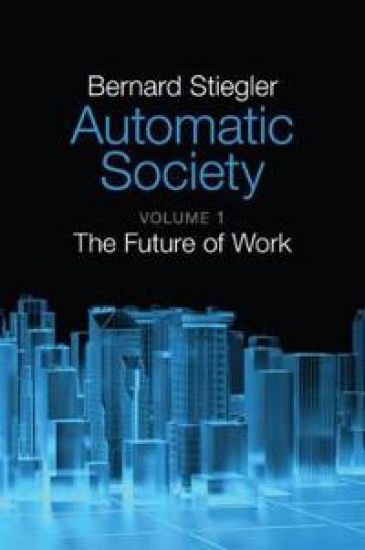
In July 2014 the Belgian newspaper Le Soir claimed that France, Belgium, the United Kingdom, Italy, Poland and the United States may lose between 43 and 50 per cent of their jobs within ten to fifteen years. Across the world, integrated automation, one key result of the so-called ‘data economy’, is leading to a drastic reduction in employment in all areas - from the legal profession to truck driving, from medicine to stevedoring. In this first volume of a new series, the leading cultural theorist Bernard Stiegler advocates a radical solution to the crisis posed by automation and consumer capitalism more generally. He calls for a decoupling of the concept of ‘labour’ (meaningful, intellectual participation) from ‘employment’ (dehumanizing, banal work), with the ultimate aim of eradicating ‘employment’ altogether. By doing so, new and alternative economic models will arise, where individuals are no longer simply mined for labour, but also actively produce what they consume. Building substantially on his existing theories and engaging with a wide range of figures - from Deleuze and Foucault to Bill Gates and Alan Greenspan - Automatic Society will appeal to students and scholars across the social sciences and humanities, as well as anyone concerned with the central question of the future of work.
Automatic Society, Volume 1

Automatic Society, Volume 1

Bernard Stiegler

Polity Press
2016
sidottu
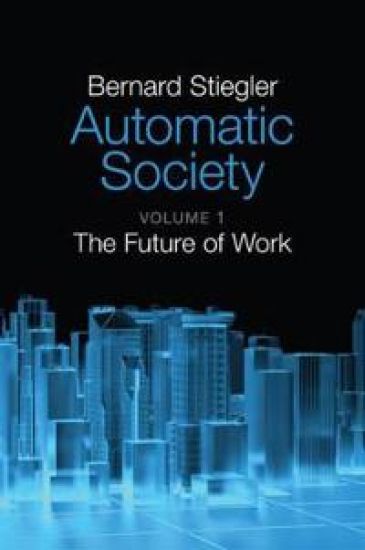
In July 2014 the Belgian newspaper Le Soir claimed that France, Belgium, the United Kingdom, Italy, Poland and the United States may lose between 43 and 50 per cent of their jobs within ten to fifteen years. Across the world, integrated automation, one key result of the so-called ‘data economy’, is leading to a drastic reduction in employment in all areas - from the legal profession to truck driving, from medicine to stevedoring. In this first volume of a new series, the leading cultural theorist Bernard Stiegler advocates a radical solution to the crisis posed by automation and consumer capitalism more generally. He calls for a decoupling of the concept of ‘labour’ (meaningful, intellectual participation) from ‘employment’ (dehumanizing, banal work), with the ultimate aim of eradicating ‘employment’ altogether. By doing so, new and alternative economic models will arise, where individuals are no longer simply mined for labour, but also actively produce what they consume. Building substantially on his existing theories and engaging with a wide range of figures - from Deleuze and Foucault to Bill Gates and Alan Greenspan - Automatic Society will appeal to students and scholars across the social sciences and humanities, as well as anyone concerned with the central question of the future of work.
Symbolic Misery, Volume 2

Symbolic Misery, Volume 2

Bernard Stiegler

Polity Press
2015
nidottu
In this important new book, leading cultural theorist and philosopher Bernard Stiegler re-examines the relationship between politics and art in the contemporary world. Our hyper-industrial epoch represents what Stiegler terms a ?katastroph of the sensible?. This katastroph is not an apocalypse or the end of everything, but the denouement of a drama; it is the final act in the process of psychic and collective individuation known as the ?West?. Hyper-industrialization has brought about the loss of symbolic participation and the destruction of primordial narcissism, the very condition for individuation. It is in this context that artists have a unique role to play. When not subsumed in the capitalist economy, they are able to resist its synchronizing tendency, offering the possibility of reimagining the contemporary model of aesthetic participation. This highly original work - the second in Stiegler?s Symbolic Misery series - will be of particular interest to students in philosophy, media and cultural studies, contemporary art and sociology, and will consolidate Stiegler?s reputation as one of the most original cultural theorists of our time.
Symbolic Misery, Volume 2

Symbolic Misery, Volume 2

Bernard Stiegler

Polity Press
2015
sidottu
In this important new book, leading cultural theorist and philosopher Bernard Stiegler re-examines the relationship between politics and art in the contemporary world. Our hyper-industrial epoch represents what Stiegler terms a ?katastroph of the sensible?. This katastroph is not an apocalypse or the end of everything, but the denouement of a drama; it is the final act in the process of psychic and collective individuation known as the ?West?. Hyper-industrialization has brought about the loss of symbolic participation and the destruction of primordial narcissism, the very condition for individuation. It is in this context that artists have a unique role to play. When not subsumed in the capitalist economy, they are able to resist its synchronizing tendency, offering the possibility of reimagining the contemporary model of aesthetic participation. This highly original work - the second in Stiegler?s Symbolic Misery series - will be of particular interest to students in philosophy, media and cultural studies, contemporary art and sociology, and will consolidate Stiegler?s reputation as one of the most original cultural theorists of our time.
States of Shock

States of Shock

Bernard Stiegler

Polity Press
2014
nidottu
In 1944 Horkheimer and Adorno warned that industrial society turns reason into rationalization, and Polanyi warned of the dangers of the self-regulating market, but today, argues Stiegler, this regression of reason has led to societies dominated by unreason, stupidity and madness. However, philosophy in the second half of the twentieth century abandoned the critique of political economy, and poststructuralism left its heirs helpless and disarmed in face of the reign of stupidity and an economic crisis of global proportions.New theories and concepts are required today to think through these issues. The thinkers of poststructuralism Lyotard, Deleuze, Derrida must be re-read, as must the sources of their thought, Hegel and Marx. But we must also take account of Naomi Klein's critique of Milton Friedman and the Chicago School and her account of the 'shock doctrine'. In fact, argues Stiegler, a permanent 'state of shock' has prevailed since the beginning of the industrial revolution, intensified by the creative destruction brought about by the consumerist model. The result has been a capitalism that destroys desire and reason and in which every institution is undermined, above all those institutions that are the products par excellence of the Enlightenment the education system and universities.Through a powerful critique of thinkers from Marx to Derrida, Stiegler develops new conceptual weapons to fight this destruction. He argues that schools and universities must themselves be transformed: new educational institutions must be developed both to take account of the dangers of digitization and the internet and to enable us to take advantage of the new opportunities they make available.
States of Shock

States of Shock

Bernard Stiegler

Polity Press
2014
sidottu
In 1944 Horkheimer and Adorno warned that industrial society turns reason into rationalization, and Polanyi warned of the dangers of the self-regulating market, but today, argues Stiegler, this regression of reason has led to societies dominated by unreason, stupidity and madness. However, philosophy in the second half of the twentieth century abandoned the critique of political economy, and poststructuralism left its heirs helpless and disarmed in face of the reign of stupidity and an economic crisis of global proportions.New theories and concepts are required today to think through these issues. The thinkers of poststructuralism Lyotard, Deleuze, Derrida must be re-read, as must the sources of their thought, Hegel and Marx. But we must also take account of Naomi Klein's critique of Milton Friedman and the Chicago School and her account of the 'shock doctrine'. In fact, argues Stiegler, a permanent 'state of shock' has prevailed since the beginning of the industrial revolution, intensified by the creative destruction brought about by the consumerist model. The result has been a capitalism that destroys desire and reason and in which every institution is undermined, above all those institutions that are the products par excellence of the Enlightenment the education system and universities.Through a powerful critique of thinkers from Marx to Derrida, Stiegler develops new conceptual weapons to fight this destruction. He argues that schools and universities must themselves be transformed: new educational institutions must be developed both to take account of the dangers of digitization and the internet and to enable us to take advantage of the new opportunities they make available.
The Re-Enchantment of the World

The Re-Enchantment of the World

Bernard Stiegler

Bloomsbury Academic USA
2014
sidottu
Bernard Stiegler's work on the intimate relations between the human and the technical have made him one of the most important voices to have emerged in French philosophy in the last decade. At the same time both an accessible summation of that work and a continuation of it, The Re-Enchantment of the World advances a critique of consumer capitalism that draws on Freud and Marx to construct an utterly contemporary analysis of our time. The book explores the cognitive, affective, social and economic effects of the 'proletarianization' of the consumer in late capitalism and the resulting destruction of the consumer's savoir-vivre. Reflecting the collective work of his activist organisation, Ars Industrialis, Stiegler here sets forth an alternative path to that of 'industrial populism', one that appeals to the force of the human spirit.The Re-Enchantment of the World also includes the manifesto of Ars Industrialis and an account of the organisation's 2005 summit in Tunis.
The Re-Enchantment of the World

The Re-Enchantment of the World

Bernard Stiegler

Bloomsbury Academic USA
2014
nidottu
Bernard Stiegler's work on the intriguing relationship between the human and the technical have made him one of the most important voices to have emerged in French philosophy in the last decade. Both an accessible summation of that work and a continuation of it, The Re-Enchantment of the World advances a critique of consumer capitalism that draws on Freud and Marx to construct an utterly contemporary analysis of our time. The book explores the cognitive, affective, social and economic effects of the 'proletarianization' of the consumer in late capitalism and the resulting destruction of the consumer's savoir-vivre. Reflecting the collective work of his activist organisation, Ars Industrialis, Stiegler here sets forth an alternative path to that of 'industrial populism', one that appeals to the force of the human spirit.The Re-Enchantment of the World also includes the manifesto of Ars Industrialis and an account of the organisation's 2005 summit in Tunis.
Symbolic Misery, Volume 1

Symbolic Misery, Volume 1

Bernard Stiegler

Polity Press
2014
nidottu
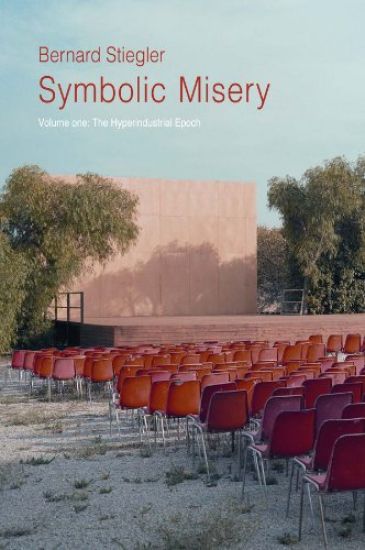
In this important new book, the leading cultural theorist and philosopher Bernard Stiegler re-examines the relationship between politics and aesthetics in our contemporary hyperindustrial age. Stiegler argues that our epoch is characterized by the seizure of the symbolic by industrial technology, where aesthetics has become both theatre and weapon in an economic war. This has resulted in a ‘symbolic misery’ where conditioning substitutes for experience. In today’s control societies, aesthetic weapons play an essential role: audiovisual and digital technologies have become a means of controlling the conscious and unconscious rhythms of bodies and souls, of modulating the rhythms of consciousness and life. The notion of an aesthetic engagement, capable of founding a new communal sensibility and a genuine aesthetic community, has largely collapsed today. This is because the overwhelming majority of the population is now totally subjected to the aesthetic conditioning of marketing and therefore estranged from any experience of aesthetic inquiry. That part of the population that continues to experiment aesthetically has turned its back on those who live in the misery of this conditioning. Stiegler appeals to the art world to develop a political understanding of its role. In this volume he pays particular attention to cinema which occupies a unique position in the temporal war that is the cause of symbolic misery: at once industrial technology and art, cinema is the aesthetic experience that can combat conditioning on its own territory. This highly original work - the first in Stiegler’s Symbolic Misery series - will be of particular interest to students in film studies, media and cultural studies, literature and philosophy and will consolidate Stiegler’s reputation as one of the most original cultural theorists of our time.
Symbolic Misery, Volume 1

Symbolic Misery, Volume 1

Bernard Stiegler

Polity Press
2014
sidottu
In this important new book, the leading cultural theorist and philosopher Bernard Stiegler re-examines the relationship between politics and aesthetics in our contemporary hyperindustrial age. Stiegler argues that our epoch is characterized by the seizure of the symbolic by industrial technology, where aesthetics has become both theatre and weapon in an economic war. This has resulted in a ‘symbolic misery’ where conditioning substitutes for experience. In today’s control societies, aesthetic weapons play an essential role: audiovisual and digital technologies have become a means of controlling the conscious and unconscious rhythms of bodies and souls, of modulating the rhythms of consciousness and life. The notion of an aesthetic engagement, capable of founding a new communal sensibility and a genuine aesthetic community, has largely collapsed today. This is because the overwhelming majority of the population is now totally subjected to the aesthetic conditioning of marketing and therefore estranged from any experience of aesthetic inquiry. That part of the population that continues to experiment aesthetically has turned its back on those who live in the misery of this conditioning. Stiegler appeals to the art world to develop a political understanding of its role. In this volume he pays particular attention to cinema which occupies a unique position in the temporal war that is the cause of symbolic misery: at once industrial technology and art, cinema is the aesthetic experience that can combat conditioning on its own territory. This highly original work - the first in Stiegler’s Symbolic Misery series - will be of particular interest to students in film studies, media and cultural studies, literature and philosophy and will consolidate Stiegler’s reputation as one of the most original cultural theorists of our time.
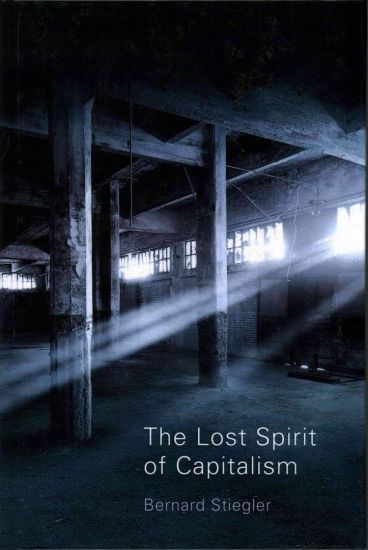
The Lost Spirit of Capitalism

The Lost Spirit of Capitalism

Bernard Stiegler

Polity Press
2014
nidottu
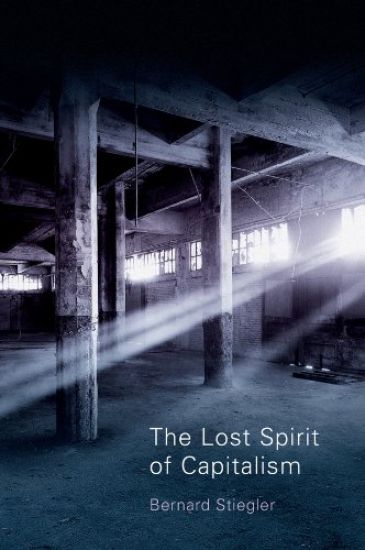
Max Weber famously argued that the rise of capitalism in early modern Europe was premised on the emergence of a distinctive set of attitudes - including the pursuit of profit for its own sake - which he called ‘the spirit of capitalism’. Today, when capitalism has spread across the globe, the spirit of capitalism would appear to reign supreme. In this important book Bernard Stiegler takes a very different view: what we are witnessing today is not the triumph of the spirit of capitalism but rather its demise, as our contemporary ‘hyper-industrial’ societies become increasingly uncontrollable, profoundly irrational and incapable of inspiring hope. Disenchantment and despair have become the everyday lived experiences of countless individuals. Far from being a moment of liberation, May '68 was just the first symptom of our increasing disenchantment and 'spiritual misery'. The libidinal energy that originally underpinned capitalism has become an unbound force, unleashing drives that can no longer be contained. Is there an alternative? Stiegler argues that the development of alternatives must begin with a new industrial policy, designed to recognize that technologies are what Plato called pharmaka, meaning both poison and cure. Industrial society has a future only if we can create technologies that foster relations of care (otium) for people whose spirit has been exhausted by contemporary consumerism. We must develop an ecology not only to protect the planet but also to renew the exploited energies of human desire. This volume - the third in a trilogy that includes The Decadence of Industrial Democracies and Uncontrollable Societies of Disaffected Individuals - will consolidate Stiegler's reputation as one of the most original philosophers and cultural theorists of our time.
The Lost Spirit of Capitalism

The Lost Spirit of Capitalism

Bernard Stiegler

Polity Press
2014
sidottu
Max Weber famously argued that the rise of capitalism in early modern Europe was premised on the emergence of a distinctive set of attitudes - including the pursuit of profit for its own sake - which he called ‘the spirit of capitalism’. Today, when capitalism has spread across the globe, the spirit of capitalism would appear to reign supreme. In this important book Bernard Stiegler takes a very different view: what we are witnessing today is not the triumph of the spirit of capitalism but rather its demise, as our contemporary ‘hyper-industrial’ societies become increasingly uncontrollable, profoundly irrational and incapable of inspiring hope. Disenchantment and despair have become the everyday lived experiences of countless individuals. Far from being a moment of liberation, May '68 was just the first symptom of our increasing disenchantment and 'spiritual misery'. The libidinal energy that originally underpinned capitalism has become an unbound force, unleashing drives that can no longer be contained. Is there an alternative? Stiegler argues that the development of alternatives must begin with a new industrial policy, designed to recognize that technologies are what Plato called pharmaka, meaning both poison and cure. Industrial society has a future only if we can create technologies that foster relations of care (otium) for people whose spirit has been exhausted by contemporary consumerism. We must develop an ecology not only to protect the planet but also to renew the exploited energies of human desire. This volume - the third in a trilogy that includes The Decadence of Industrial Democracies and Uncontrollable Societies of Disaffected Individuals - will consolidate Stiegler's reputation as one of the most original philosophers and cultural theorists of our time.